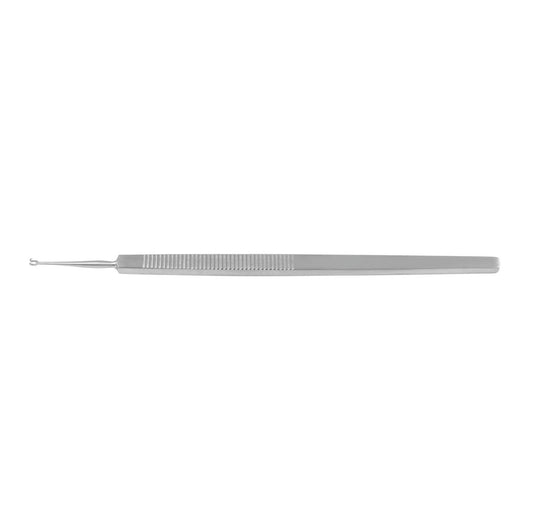
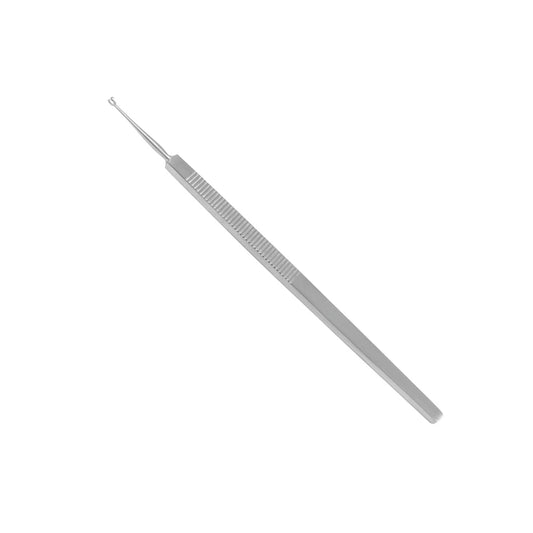
An ophthalmic fixation hook does not hold tissue out of the way. It holds the eye still, and turns it to present the quadrant the surgeon needs. Peak Surgicals stocks Fixation Hooks in 1.5 mm and 2 mm prong widths, from $6.60, in German stainless steel and CE marked and built under ISO 13485. Compare both configurations in the grid below.
Holding the Eye, Not the Tissue Around It
The globe is spherical, mobile and under no useful restraint once the lids are held open, so most of what happens in ocular surgery depends on someone holding it in a known position. A fixation hook engages the conjunctiva or a muscle insertion and provides that anchor, and rotating the hook rotates the eye, which is how a superior or posterior quadrant is brought into the operating field rather than the surgeon working around it.
That makes the working end unusually consequential for such a small instrument. It sits on tissue measured in millimetres, on a structure that will not tolerate being torn, and it has to hold against sustained traction while the surgeon works with both hands elsewhere. A hook that slips loses the position; a hook that holds too aggressively damages the tissue it was placed on. We supply both configurations at MOQ 1.
1.5 mm or 2 mm?
Prong width is the choice between those two failures. The 1.5 mm configuration takes a narrower bite, which suits thinner conjunctiva and cases where the tissue engaged is limited, and it leaves less of a mark. The 2 mm configuration spreads the same traction across more tissue, so the hold is more secure under sustained rotation and less likely to pull through, at the cost of engaging more tissue than some cases need.
Neither is the safer option in every case, which is why both are stocked rather than one. A tray carrying both lets the surgeon match the hook to the tissue in front of them rather than to what is available. Buyers should confirm prong count, prong length, tip profile and overall length against the catalogue before ordering.
Material, Reprocessing and Certification
Both configurations are forged from German stainless steel and passivated for corrosion resistance across repeated cycles. The inspection point is the prong tips under magnification, and it matters more here than on almost any instrument in a tray, because these tips work on conjunctiva and episcleral tissue: check each prong for burring, a rolled edge or any loss of its intended profile, since a prong that has developed a sharp corner will cut the tissue it was placed to hold. Confirm the prongs are matched in length and aligned with each other, as one prong sitting proud takes the whole load. Check the shaft is straight. Clean immediately with a neutral-pH enzymatic solution, working around the prong bases, then rinse with deionised water and dry fully, following the reprocessing instructions supplied.
These are Class I reusable devices, supplied non-sterile, CE marked and built under ISO 13485, with a one-year warranty. We ship at MOQ 1 with free shipping over $99. Browse all Ophthalmology Instruments.