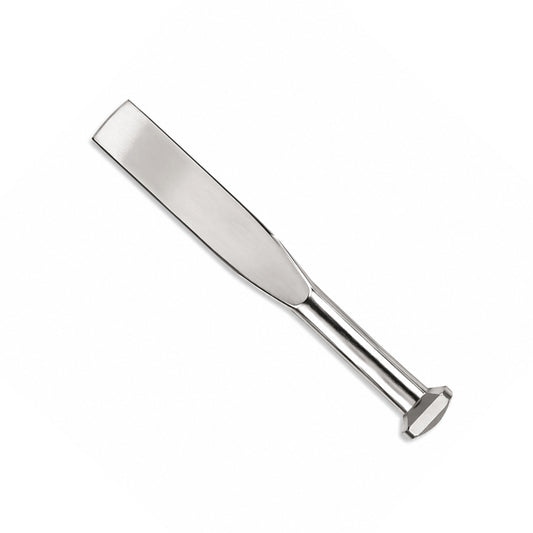
A post-mortem gouge is not a cutting instrument in the way a saw is. The saw makes the cut; the gouge lifts, levers and removes what the saw has freed. Peak Surgicals supplies Gouge for Post Mortem, 19mm blade (PS-P-00014, $27.50), in German stainless steel, CE marked and built under ISO 13485. See the full specification in the grid below.
Where the Gouge Comes In
Opening a cranial vault runs in two stages, and the gouge belongs to the second. A saw scores and divides the outer table, but the calvarium does not simply lift away: the inner table and the dural attachments hold it, and the gouge is worked into the saw line and levered to separate the skull cap cleanly. The same instrument clears cartilage at costochondral junctions and removes bone from the vertebral column when the cord is exposed.
That is why the working end is a curved cutting edge rather than a flat one. A chisel bevelled on one side splits along a plane; a gouge with a scooped edge follows a curved surface and lifts material off it, which is what the vault and the rib ends require. It is driven with a mallet in controlled taps, so force arrives in known increments rather than pushed.
Blade Width, and Why Autopsy Gouges Are Ordered Separately
Blade width sets what the instrument can do. A 19mm edge is a working width for vault and rib work: broad enough to lever a section rather than chip at it, narrow enough to enter a saw kerf and follow it. Wider edges lose that entry; narrower ones remove material a fragment at a time.
Post-mortem instruments are also ordered separately from theatre stock for a reason. An instrument used in the mortuary does not return to clinical circulation, which is why these patterns are catalogued as autopsy instruments rather than sold as general orthopedic gouges. The build follows the same logic: post-mortem bone is not perfused and does not behave like living bone under an edge, so the patterns run heavier through the shank. We supply at MOQ 1.
Material, Reprocessing and Certification
The gouge is forged from German stainless steel and passivated for corrosion resistance across repeated cycles. The inspection point is the cutting edge and the striking end: hold the edge to light and check the full curve for chips or rolled metal, because a gouge is driven by a mallet and a chipped edge will split rather than lift, and check the impact face for mushrooming, since a spread striking surface throws mallet force off axis. Post-mortem instruments carry a heavier soil burden than theatre instruments, so clean immediately with a neutral-pH enzymatic solution, brushing bone debris out of the concave face before it dries, then rinse with deionised water and dry fully before autoclaving at 134°C.
This is a Class I reusable device, CE marked and built under ISO 13485, with a one-year warranty. We ship at MOQ 1 with free shipping over $99. See Post Mortem Dissecting Forceps and Post Mortem Clamps for the wider range, or browse all Post Mortem Instruments. Talk to us about OEM terms.