
Featured Collection
Your cart
Featured Collection

PEAK SURGICALS
SKU:PS-OP-8531
Couldn't load pickup availability


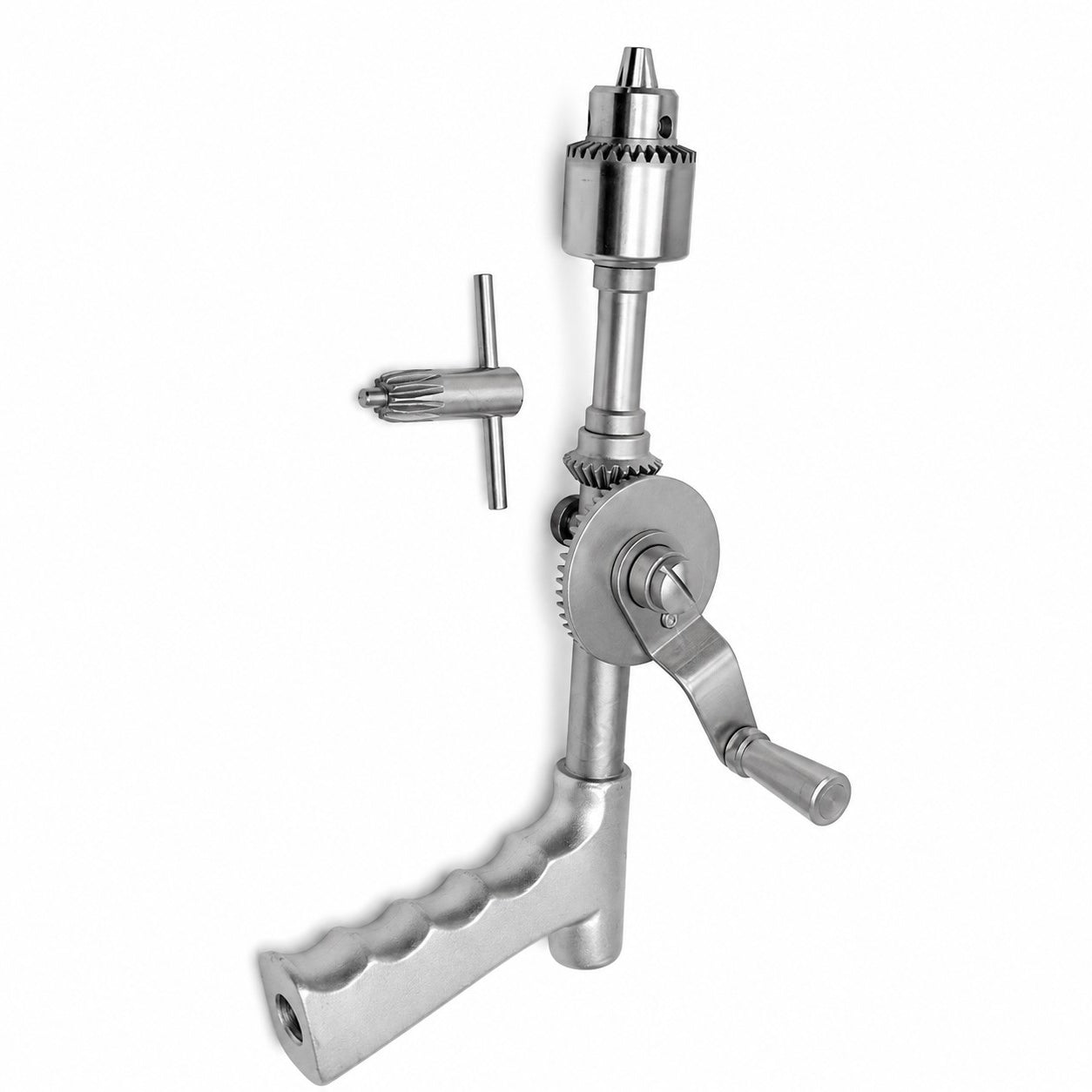
Universal Open Hand Drill, SKU PS-OP-8531 and catalog model PS-320.030, is a manually operated orthopedic bone drill manufactured from German stainless steel with an exposed stainless-steel gear assembly. Its hand-driven mechanism transfers rotational input from the crank to the drill spindle, allowing the surgeon to create controlled pilot channels without an electric or pneumatic power source. The instrument is used during open reduction and internal fixation, fracture stabilization, bone plate positioning, cortical screw placement, cancellous screw preparation, and selected reconstructive procedures. A rotating crank supplies mechanical drive, while the geared transmission maintains continuous spindle rotation as the operator advances the mounted drill bit through cortical or cancellous bone. The supporting handle stabilizes alignment and permits tactile monitoring of resistance as the cutting flutes engage the osseous surface. This configuration is relevant to orthopedic trauma surgeons, hand surgeons, foot and ankle surgeons, veterinary orthopedic specialists, and surgical teams working in hospitals, ambulatory operating rooms, trauma centers, field facilities, or clinics where manual drilling is selected. Drill bits, guides, depth gauges, taps, screws, and fixation implants are separate procedural components unless specifically included with the purchase.
The hand drill converts circular crank movement into rotation at the distal spindle through its exposed stainless-steel gear train. As the surgeon turns the crank, the driving gear engages the corresponding spindle gear, producing controlled rotation of the attached orthopedic drill bit. The open construction provides direct visibility of the transmission during inspection, cleaning, lubrication, and functional assessment. Its mechanical drive does not depend on batteries, electrical cables, compressed air, or a powered console. The upper support handle is held by the non-driving hand to steady the instrument and maintain the selected drilling trajectory. This two-handed arrangement separates rotational input from axial guidance, allowing the operator to regulate advancement according to tactile changes between cortical and cancellous bone. The chuck area retains the selected bit concentrically so that rotational force is transferred along the drilling axis. During use with an appropriately matched drill guide, the guide directs the bit toward the planned screw channel and shields adjacent soft tissue from the rotating shaft. Manual rotation supports deliberate progression when exposure is limited or powered equipment is unavailable. The mechanism must rotate smoothly without gear binding, spindle play, chuck slippage, or visible damage before the instrument enters the sterile field.
The Universal Open Hand Drill is used for manual preparation of bone channels during orthopedic fixation procedures. In open reduction and internal fixation, the fracture is exposed, reduced, and temporarily stabilized before the plate is positioned against the bone. The surgeon places a drill guide through the selected plate hole and seats its working end against the cortex. A compatible drill bit is secured in the hand drill, passed through the guide, and aligned with the planned screw trajectory. Rotation is initiated while controlled axial pressure advances the bit through the near cortex and, when bicortical fixation is intended, toward the far cortex. The drilled channel is then assessed with a depth gauge, tapped when the implant system requires thread preparation, and completed with the selected cortical or cancellous screw. This workflow can be applied during fixation of appropriately selected fractures involving the radius, ulna, metacarpals, phalanges, fibula, malleoli, metatarsals, or other exposed osseous sites. The manual system can also support veterinary fracture repair where implant dimensions and drill-bit compatibility match the operative plan. Bit diameter, guide bore, screw design, drilling depth, and trajectory are determined by the fixation system and surgeon’s preoperative plan rather than by the handpiece alone.
Model PS-320.030 identifies the Universal Open Hand Drill with an open stainless-steel gear arrangement; PS-OP-8531 is the corresponding Shopify inventory SKU displayed on the product page. This listing represents one manual drill configuration and does not present separate size or gauge variants. Clinical selection therefore centers on the compatible drill bit, drill guide, chuck capacity, fixation system, and target bone rather than a handpiece size range. Smaller drill bits are ordinarily paired with mini-fragment or small-fragment fixation components used in phalangeal, metacarpal, wrist, forearm, fibular, or foot procedures. Larger channels require a corresponding guide and bit selected for the plate hole and screw core diameter specified by the implant system. The drill bit must seat concentrically within the chuck to limit eccentric rotation and preserve the planned trajectory. A guide with a correctly matched internal bore supports alignment and prevents excessive lateral movement of the rotating shaft. For bicortical drilling, the operator advances through the near cortex under controlled manual rotation and limits penetration beyond the far cortex. For unicortical preparation, depth is restricted according to the fixation plan. The instrument is supplied as a hand drill; drill bits, guides, taps, depth gauges, screws, plates, chuck keys, and storage cases are included only when expressly stated in the order.
The Universal Open Hand Drill is manufactured from German stainless steel, including the visible open gear components described for catalog model PS-320.030. Surgical stainless steel provides the rigidity required to transmit rotational and axial force while supporting repeated cleaning, inspection, and validated steam sterilization when processed according to the manufacturer’s instructions. The metallic surface permits examination for retained soil, corrosion, discoloration, mechanical wear, and damage around the gears, spindle, chuck, crank, and handle interfaces. Because the transmission is exposed, reprocessing personnel must clean all gear teeth, junctions, recesses, and moving surfaces rather than treating the drill as a simple solid instrument. Hinged or moving areas should remain accessible during cleaning, rinsing, drying, inspection, and sterilization preparation. The device must be supplied to the operating room clean, functional, correctly assembled, and sterilized through the healthcare facility’s validated cycle. Peak Surgicals supports CE and ISO 13485 procurement documentation for institutional purchasing. FDA-related documentation must be interpreted according to the applicable device listing, establishment registration, intended market, and purchasing requirements; it must not be presented as automatic FDA approval of an individual instrument. Hospitals and distributors should retain the applicable invoice, model identification, batch records, declarations, and reprocessing instructions within their quality-management system.
| SKU | PS-OP-8531 |
|---|---|
| Product Name | Universal Open Hand Drill |
| Price | $204.59 USD |
| Size/Gauge Variants | Single configuration; catalog model PS-320.030 |
| Instrument Category | Orthopedic manual bone drill |
| Procedure | Bone-channel preparation during fracture fixation, plate positioning, and screw placement |
| Material | German stainless steel with stainless-steel gears |
| Finish | Metallic surgical instrument finish |
| Sterilization | Reprocess according to the manufacturer’s instructions and the healthcare facility’s validated sterilization protocol |
| Instrument Classification | Reusable manual orthopedic surgical instrument |
| Reusable | Yes |
| Certifications | CE and ISO 13485 procurement documentation; FDA-related documentation supplied according to the applicable market requirement |
| Warranty | 30-day money-back guarantee under the published store policy |
| MOQ | One instrument for standard online orders |
| OEM / Custom Orders | OEM, private-label, and institutional order requirements are handled through a written quotation |
| After-Sale Service | Order, documentation, and product-support assistance through Peak Surgicals customer service |
How does the Universal Open Hand Drill differ from a powered orthopedic drill?
The Universal Open Hand Drill generates rotation through a hand crank and exposed mechanical gears, whereas a powered orthopedic drill uses an electric, battery, or pneumatic motor. Manual operation gives the surgeon direct tactile awareness of resistance as the bit engages cortical and cancellous bone. A powered system generally provides greater rotational speed and is commonly selected for repeated drilling or procedures requiring powered attachments. The manual drill does not require batteries, cables, compressed air, or a drive console. Its suitability depends on the operative plan, target bone, implant system, exposure, and required drilling performance. Both instruments require a correctly matched drill bit and guide for the planned screw channel.
How should the drill bit and guide be selected for this hand drill?
The product has no listed handpiece size variants, so selection is based on the required drill bit, guide bore, and fixation screw. For metacarpal, phalangeal, wrist, forearm, fibular, or foot fixation, the surgeon selects the bit diameter specified by the implant system. The drill guide must correspond to that bit and seat securely against the target cortex or within the plate hole. Mini-fragment and small-fragment constructs use different drilling dimensions, and those dimensions are not interchangeable. The bit must fit concentrically within the Universal Open Hand Drill chuck without slippage or eccentric rotation. Channel depth is established according to unicortical or bicortical fixation requirements and confirmed with a compatible depth gauge.
What do CE, ISO 13485, and FDA references mean for procurement?
CE documentation supports procurement assessment for applicable European medical-device requirements. ISO 13485 relates to the manufacturer’s medical-device quality-management system rather than proving the clinical performance of every individual item. FDA establishment registration, device listing, clearance, and approval are separate regulatory concepts. The Universal Open Hand Drill should not be described as FDA approved unless an applicable approval record specifically supports that statement. United States purchasers should review the documentation relevant to the device classification and supply route. Peak Surgicals can provide available commercial and regulatory documents for hospital, clinic, or distributor review before order authorization.
How is the open gear and crank mechanism used intraoperatively?
The surgeon stabilizes the Universal Open Hand Drill with the support handle while turning the crank with the opposite hand. Crank rotation drives the exposed gear train, which transfers movement to the spindle and mounted bit. The supporting hand maintains trajectory while the driving hand regulates rotational speed. Axial pressure is applied in line with the drill guide rather than through lateral force on the shaft. The operator responds to tactile changes as the bit crosses cortical and cancellous regions. Before use, the gears, crank, spindle, chuck, and handle must be inspected for smooth movement, secure engagement, and absence of mechanical play.
What should an operating-room team check before sterilizing and purchasing this instrument?
The procurement team should confirm the SKU, catalog model, required quantity, supporting documentation, and compatibility with the facility’s drill bits and fixation systems. Reprocessing personnel should have access to the manufacturer’s cleaning and sterilization instructions before the instrument enters service. The open gears and mechanical junctions require direct cleaning, thorough rinsing, complete drying, and visual inspection. The chuck and spindle should be examined for retained debris, corrosion, deformation, and impaired rotation. The Universal Open Hand Drill should undergo a functional check before packaging for the validated sterilization cycle. Hospitals and distributors should retain model, invoice, batch, regulatory, and service records within their purchasing and quality-control documentation.


