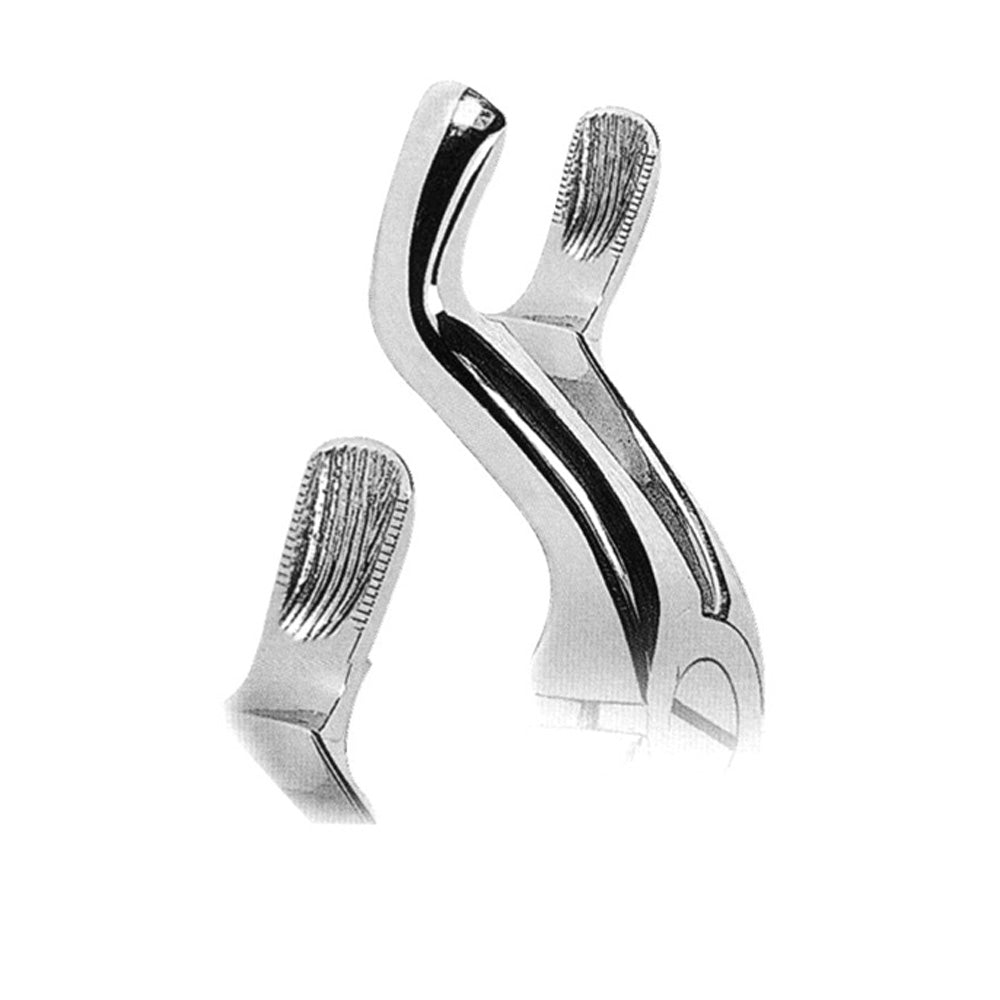
Mastering the Maxillary Reach: Upper Third Molar Forceps Fig. 67A
The extraction of a maxillary third millimeter (wisdom tooth) is among the most difficult procedures during oral surgery. The small vertical space, proximity of the sinus maxillary, as well as the distal position of the tooth, require an instrument that has a precise "offset" geometry. The Extracting Forceps Fig. 67A, which has the Anatomically Shaped Handle with serrated Tips, is the best option to navigate the most remote parts of the arch's upper part without fear and precision.
The 67A Advantage: Angled for Success
The Fig. 67A is distinguished by its striking "double-bend" or bayonet-style neck. This type of engineering is vital for several reasons:
-
Deep Posterior Access. This head offset enables the dentist to reach past the second molars, without handles striking the lower jaw of patients or their lips.
-
Vertical Alignment Regardless of the neck's angle, the beaks are still aligned with the long axis of the tooth, making sure that the forces of extraction are directed vertically to avoid the tooth from breaking.
-
Bayonet Design: This shape offers a clear line of vision, allowing the surgeon to pinpoint exactly where the beaks will be engaged with the tooth when under surgical light.
Precision Grip Using Serrated Tips
Wisdom teeth typically have conical, fusion or unusually shaped root structures that can be difficult to comprehend. 3 The Figure. The solution is serrated tips:
-
Mechanical interlock. Its fine serrations and beak's inner surfaces pierce the cementum and enamel, making a secure, non-slip connect.
-
Controlled Luxation. Since the grip is solid, the surgeon can concentrate on the gentle buccal-palatal movements that are required to expand the socket of the alveolar without the instrument sliding off the crown.
Anatomical Handle: Ergonomics Meets Power
The posterior maxilla, the bone tends to be thinner than the mandible, but the angle at which it is approached can result in hand strain. The Anatomically shaped hand can provide:
-
Hand-Contoured Design. Its handle has been designed to be sculpted to match naturally with the grips of your hands, which decreases the "pinch force" required to hold the device.
-
Stable Lever System: The ergonomic peaks enable the fingers to secure themselves into a position, which provides greater stability in the rotation in the "twisting" motion often used to treat upper molars.
-
Fatigue Reduction for those who are performing several extractions. This technique greatly reduces the risk of repetitive strain injury as well as cramping of muscles.
Material Excellence: Surgical-Grade Stainless Steel
Constructed from premium stainless steel The Fig. 67A is designed for the high-turnover conditions in a modern dental practice.
-
Absolute Sterilizability Compatible with ultrasonic and autoclave cleaners, which ensures absolute hygiene safety for all patients.
-
Resistant to Corrosion: It is resistant to staining and pitting caused by contact with organic solvents as well as aggressive chemical disinfectants. 6
-
Structural Memory Steel is heated to ensure the precise alignment of the neck of a bayonet so that the beaks don't "splay" even under heavy weights.
Technical Overview
Feature Detail
Model Fig. 67A (Bayonet Pattern)
Indication : Maxillary (Upper) Third Molars
Tip Feature Precision Serrated Beaks
Handle Anatomically Shaped (Ergonomic)
Material High-Grade Stainless Steel
Clinical Conclusion
The Fig. 67A Anatomical Forceps are the top of exodontia's specialized design. With the ability of a bayonet neck with serrated tips, as well as the convenience that comes from an ergonomic handle, this device transforms complex lower wisdom teeth extractions into simple and efficient procedures.