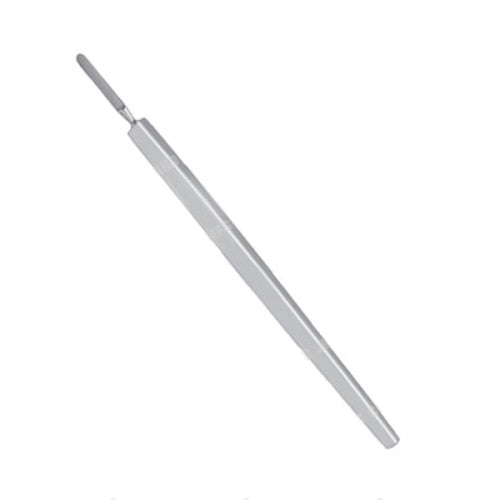
The Tooke Corneal Knife: Precision Dissection for Lamellar Surgery
A Tooke Corneal Knife is a specialized tool that is designed for the precise surgical dissection of the corneal tissue. It is used most often in procedures that require creating a clean surgical plane, for example, lamellar Keratoplasty, Pterygium surgery or even during the creation of the tunnel scleral. The design of the device is distinctive, with a focus on stability and a carefully controlled "shaving" action.
Style Features: Straight Blade with Curved Edge
The Tooke knife is designed to provide surgeons with maximum tactile feedback and an exact cutting path
-
Straight Blade Profile: The blade itself is straight and stiff, and allows for direct transfer of power from the handle towards the tip. This rigidity is vital in dissecting the thick collagen fibers that are organized and arranged in the corneal stroma.
-
Curved Cutting Edge: This is the point of the knife that is a curving, rounded cutting edge. This enables surgeons to make a more lateral "sweeping" or "rocking" motion to divide the tissue planes. The curvature can prevent the surgeon from avoiding "diving" too deeply into the cornea, which is a crucial safety factor when working close to Descemet's membrane.
-
Blunt Sides: Typically, only the curved edge is sharpened, whereas the sides remain sharp. This makes sure that the cutting takes place only at its leading edge. This thereby protects the tissue surrounding it from further injuries.
Primary Surgical Applications
Because of its blunt-depth security and sharp-edge leading edge, this Tooke Knife is a favorite for:
-
Beginning Lamellar Planes: It is a great way to start in the "pocket" or plane in Deep Anterior Lamellar Keratoplasty (DALK) before moving to more specific dissectors.
-
Pterygium Excision The curved edge enables the surgeon to remove the pterygium head from the cornea, preserving the normal anatomy of the limbus without difficulty.
-
Scleral Tunnel Construction: In manual small-incision cataract surgery (MSICS), the Tooke knife is used to create a smooth, uniform flooring for the scleral channel.
Technical Specifications and Handling
-
Material: Constructed from High-Grade Stainless Steel, providing an equilibrium in edge-retention and elasticity needed to ensure that it does not snap under pressure.
-
Ergonomic Handle Most often, it has the handle as a handle that is hexagonal or flattened for a solid, non-slip grip and ensures that the blade isn't twisted when performing high-pressure maneuvers to dissect stroma.
-
Hi-Visibility Straight-line construction guarantees that the surgeon's view of the blade-tissue interface is clear under the operating microscope.
Conclusion
Its Tooke Corneal Knife is a well-known instrument that has remained relevant even in the modern age of lamellar surgical. This instrument's sharp blade, which is straight and has a curving cutting edge give the perfect blend of precision and power that allows for the development of smooth, precise surgical planes.