
Featured Collection
Your cart
Featured Collection

PEAK SURGICAL
SKU:PS-TINIS-00130
Couldn't load pickup availability
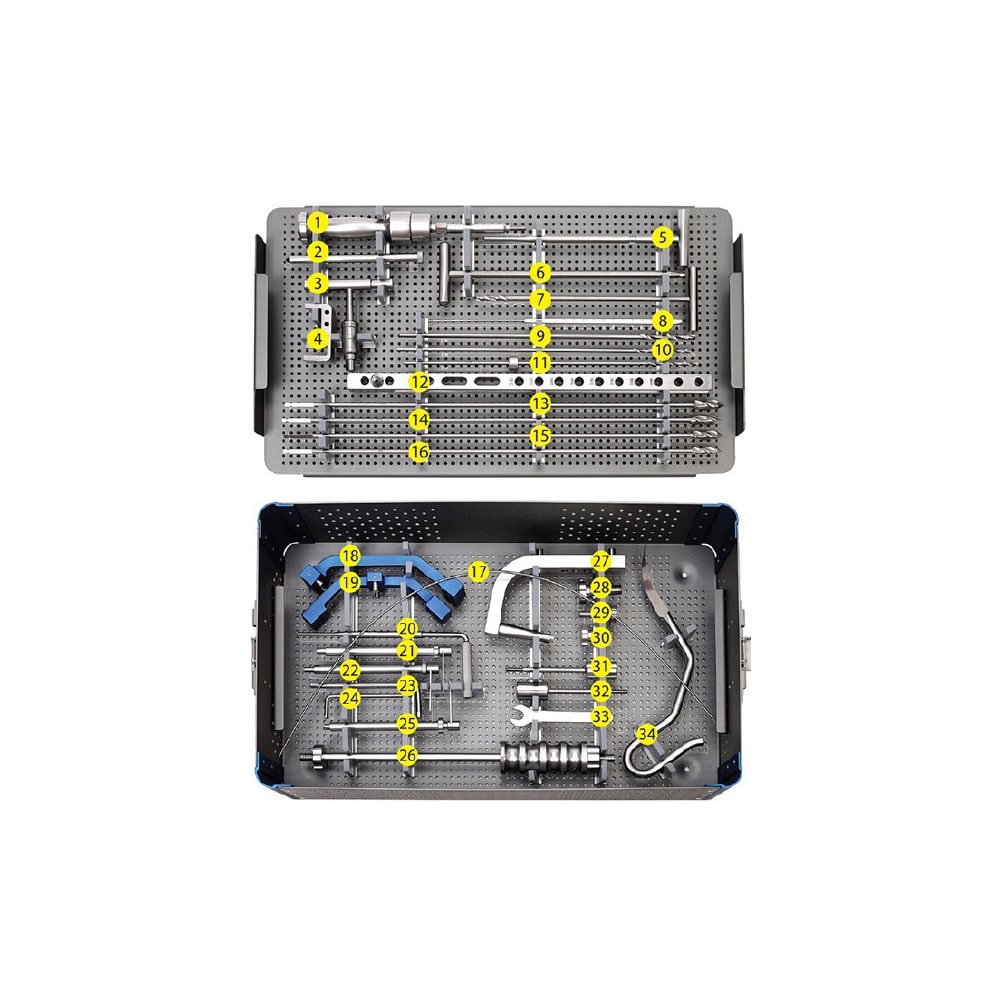
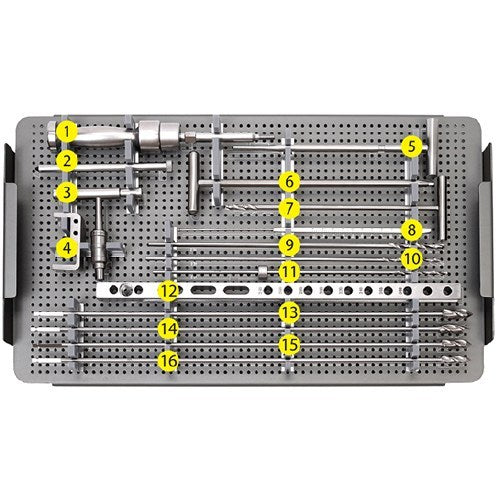
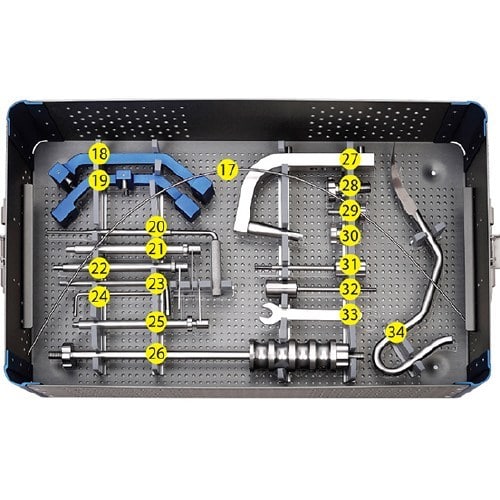
The Tibial Intramedullary Nail Instrument Set from Peak Surgicals is a 34-piece orthopedic instrument set in stainless steel, designed for the complete intraoperative workflow of tibial intramedullary nailing — covering tibial canal entry, guide wire placement, canal reaming, nail introduction, proximal and distal interlocking screw fixation, and nail assembly. The set includes reamers in four diameters (8mm to 11mm), a Proximal Guider and a Distal Guider, both Solid and Cannulated Nail Connectors, a Sighting Device Handle, a depth gauge, and all supporting drill sleeves, wrenches, and connectors, supplied in a dedicated aluminium box. It is used by orthopedic and trauma surgeons in hospital operating theatres performing tibial shaft fracture fixation and related tibia procedures worldwide.
The tibia is the primary weight-bearing bone of the lower leg and the most commonly fractured long bone in adults. Intramedullary nailing of the tibia is the surgical standard of care for displaced tibial shaft fractures, providing load-sharing fixation that allows early weight-bearing and mobilization. Tibial nailing differs from femoral nailing in several clinically significant ways. The tibial entry point — at the tibial plateau level, either through the patellar tendon (transpatellar) or medial to it (parapatellar) — requires a Proximal Guider to direct the AWL and guide wire into the correct entry axis relative to the tibial canal. The tibial medullary canal is smaller in cross-sectional diameter than the femoral canal, requiring smaller reamers (typically 8–11mm) and smaller drill bits. The distal locking screws at the tibial metaphysis, positioned immediately proximal to the ankle, require a Distal Guider for accurate screw trajectory guidance. The combination of Proximal and Distal Guiders in this set reflects these tibia-specific anatomical requirements.
The set includes the AWL for tibial canal cortical entry at the proximal tibial entry point, the Guide Wire for establishing the intramedullary axis from entry point to the distal tibia under fluoroscopic guidance, and the Guide Rod for nail introduction over the established intramedullary trajectory. The Reamers in four diameters — 8mm, 9mm, 10mm, and 11mm — progressively enlarge the tibial medullary canal to the required diameter for the intended nail size. Tibial canal diameters at the isthmus are typically smaller than femoral canal diameters, making the 8mm starting reamer appropriate for many tibial shafts — particularly in female or smaller-framed patients — and the 11mm upper end adequate for the majority of adult tibial nailing cases. The T-handle Drill Bit 5.2mm (item 7) and Drill Bit 5.2×300mm (item 9) provide the axial length required for initial canal preparation and drill access in the tibial canal, which requires a long drill reach from the proximal entry point to the fracture zone. The Drill Bit 4.0×300mm (item 10) and Drill Bit with Limitator 4.0×300mm (item 11) are used for interlocking screw trajectory preparation. The Quick Coupling T-Handle provides the mechanical connection between the reamer and the driving device.
The Proximal Guider (item 19) directs the AWL and initial canal entry instruments into the correct entry axis at the tibial plateau — the entry point must be precisely positioned in the sagittal plane to ensure the nail will track centrally in the tibial canal from the isthmus to the distal metaphysis. Malpositioning at the entry point leads to anterior or posterior cortical impingement during nail introduction, nail malreduction of the fracture, or both. The Distal Guider (item 18) assists in locating the distal interlocking screw holes of the tibial nail at the distal tibia — these holes, situated in the metaphyseal flare of the distal tibia above the ankle, are more difficult to target with standard freehand fluoroscopic technique than femoral distal locking holes, making a distal guider particularly valuable in reducing radiation exposure and operative time during this step. The Sighting Device Handle (item 27) provides the proximal targeting function for the nail's proximal interlocking holes, supported by Bolts (×3) and the Fixed Connector and Location Rod that stabilise the assembly during proximal screw insertion.
This set uniquely provides both a Nail Connector Solid (item 31) and a Nail Connector Cannulated (item 32) — reflecting the two main design categories of tibial intramedullary nails. Cannulated nails are introduced over a guide wire, requiring the nail connector to be cannulated to allow the guide rod to pass through both the connector and the nail during introduction. Solid nails do not have a central canal and require a solid nail connector for engagement. Having both connector types in a single set allows the instrument set to be compatible with either nail design without requiring supplemental connectors, making the set versatile across different tibial nail systems used in a given operating theatre environment. The Universal Joint (item 1) accommodates angular deviation between the driving instrument and the nail axis during introduction in cases where the entry trajectory is not perfectly collinear with the medullary axis.
The Tibial Intramedullary Nail Instrument Set is manufactured under CE Mark, ISO 13485, and FDA compliant quality standards. ISO 13485 certification confirms Peak Surgicals operates a documented quality management system covering design control, material traceability, and production consistency for orthopedic surgical instruments. CE Mark confirms conformity with European medical device regulations, and FDA compliance supports procurement for US-based hospitals, trauma centers, and orthopedic departments requiring verified regulatory documentation for capital instrument set purchases.
| SKU | — (verify in Shopify admin) |
|---|---|
| Product Name | Tibial Intramedullary Nail Instrument Set |
| Price | $2,308.90 USD |
| Total Pieces | 34 instruments + Aluminium Box |
| Instrument Category | Orthopedic — Tibial Intramedullary Nailing |
| Procedure | Tibial shaft fracture fixation by intramedullary nailing |
| Reamer Sizes | 8mm, 9mm, 10mm, 11mm |
| Drill Bits | T-handle 5.2mm; 5.2×300mm; 4.0×300mm; 4.0×300mm with Limitator |
| Depth Gauge Range | 10–100mm |
| Nail Connectors | Solid (item 31) and Cannulated (item 32) — both included |
| Guiders | Proximal Guider (item 19) + Distal Guider (item 18) |
| Key Instruments | AWL, Guide Wire, Guide Rod, Universal Joint, Sighting Device Handle, Location Forcep, Fixed Connector, Location Rod, Drill Sleeves ×4, Bolts ×3, Hex Wrenches ×2, Open Wrench, Quick Coupling T-Handle, Screwdriver, Hammer |
| Container | Aluminium Box (included) |
| Certifications | CE Mark, ISO 13485, FDA |
| Warranty | 1 Year |
| MOQ | 1 Set |
| OEM / Custom Orders | Available |
| After-Sale Service | Return and Replacement |
What fractures is tibial intramedullary nailing used to treat?
Tibial intramedullary nailing is the primary surgical treatment for displaced tibial shaft fractures — the most common long bone fracture in adults — across all fracture patterns including transverse, oblique, spiral, comminuted, and open fractures. It is also used for proximal and distal tibial fractures with shaft extension, selected tibial stress fractures that fail conservative management, and pathological tibial fractures from metastatic disease. The nail provides load-sharing fixation between the cortical entry point and the interlocking screws, allowing early weight-bearing in most tibial shaft fractures and significantly reducing the prolonged non-weight-bearing period required with cast immobilization or external fixation alone. The Tibial Intramedullary Nail Instrument Set from Peak Surgicals provides all instruments required for the complete tibial nailing procedure from entry point preparation through to interlocking screw fixation.
Why are the reamer sizes (8–11mm) smaller than those in the femoral nail sets?
The tibial medullary canal is significantly narrower than the femoral canal. The isthmic (minimum) diameter of the adult tibial canal typically ranges from 7mm to 11mm on anteroposterior and lateral radiographic measurement, compared to 8–14mm for the femoral canal. The narrower canal means tibial nails are correspondingly smaller in diameter — most standard tibial nails are available in 8mm to 12mm diameters — and the canal must be reamed to 1–1.5mm larger than the intended nail to allow passage without cortical impingement. The 8mm starting reamer in this set accommodates tibial canals at the narrow end of the normal range, with 11mm as the upper limit for canals that can be reamed to accept a 10mm nail. For larger tibial canals or larger nail diameters, confirm the maximum reamer size against the nail system being used before ordering.
Why does this set include both a Proximal Guider and a Distal Guider?
Both guiders address specific technical challenges of tibial nailing that are different from femoral nailing. The Proximal Guider is needed because the tibial nail entry point — at the proximal tibia near the tibial plateau — is a constrained target where slight deviations in AWL and guide wire direction translate directly into nail malreduction of the fracture. The guider directs the entry instruments into the correct sagittal and coronal axis relative to the medullary canal before the guide wire is passed. The Distal Guider addresses the difficulty of targeting the distal tibial interlocking holes, which are positioned in the distal tibial metaphysis above the ankle joint. The distal tibial nail holes are angled in multiple planes in some nail designs, making freehand fluoroscopic locking more time-consuming and radiation-intensive than femoral distal locking. The distal guider reduces this difficulty by providing a mechanical targeting reference for the distal drill trajectories.
What is the difference between the Solid and Cannulated Nail Connectors?
Tibial intramedullary nails are available in two main designs: cannulated nails that have a central channel running the full length of the nail, and solid nails without a central channel. Cannulated nails are introduced over a guide wire — the guide rod passes through the central canal of both the nail connector and the nail during introduction, maintaining the nail on the intramedullary trajectory as it is advanced. Solid nails have no central canal and are introduced using a solid nail connector that engages the proximal end of the nail without a central conduit. This set includes both connector types, making it compatible with both nail design categories without requiring separate connector sets for each nail type used in a given operating theatre.
What certifications does this set carry?
The Tibial Intramedullary Nail Instrument Set is manufactured under CE Mark, ISO 13485, and FDA compliant quality standards. ISO 13485 certification confirms Peak Surgicals operates a documented quality management system covering design control, material traceability, and manufacturing consistency for orthopedic surgical instruments. CE Mark confirms conformity with European medical device regulations, and FDA compliance supports procurement for US hospitals, trauma centers, and orthopedic departments requiring verified regulatory documentation for capital instrument set purchases.
How does this set differ from the Femur Intramedullary Nail Instrument Set also available from Peak Surgicals?
The Tibial and Femur IM Nail Instrument Sets are bone-specific — the instruments are configured for the different anatomical requirements of tibial and femoral nailing respectively. Key differences: the Tibial set has reamers 8–11mm (vs femoral 10–13mm) reflecting the smaller tibial canal; the Tibial set includes both a Proximal Guider and a Distal Guider (the femoral set has only a distal sighting device); the Tibial set provides both Solid and Cannulated Nail Connectors (the femoral set uses a single nail connector); and the drill bit range and sizes differ between the two sets. Centres performing both tibial and femoral intramedullary nailing require both sets.
