
Featured Collection
Your cart
Featured Collection

PEAK SURGICALS
SKU:PS-OF-001001
Couldn't load pickup availability
 CE Certified
 FDA Certified
 ISO Certified
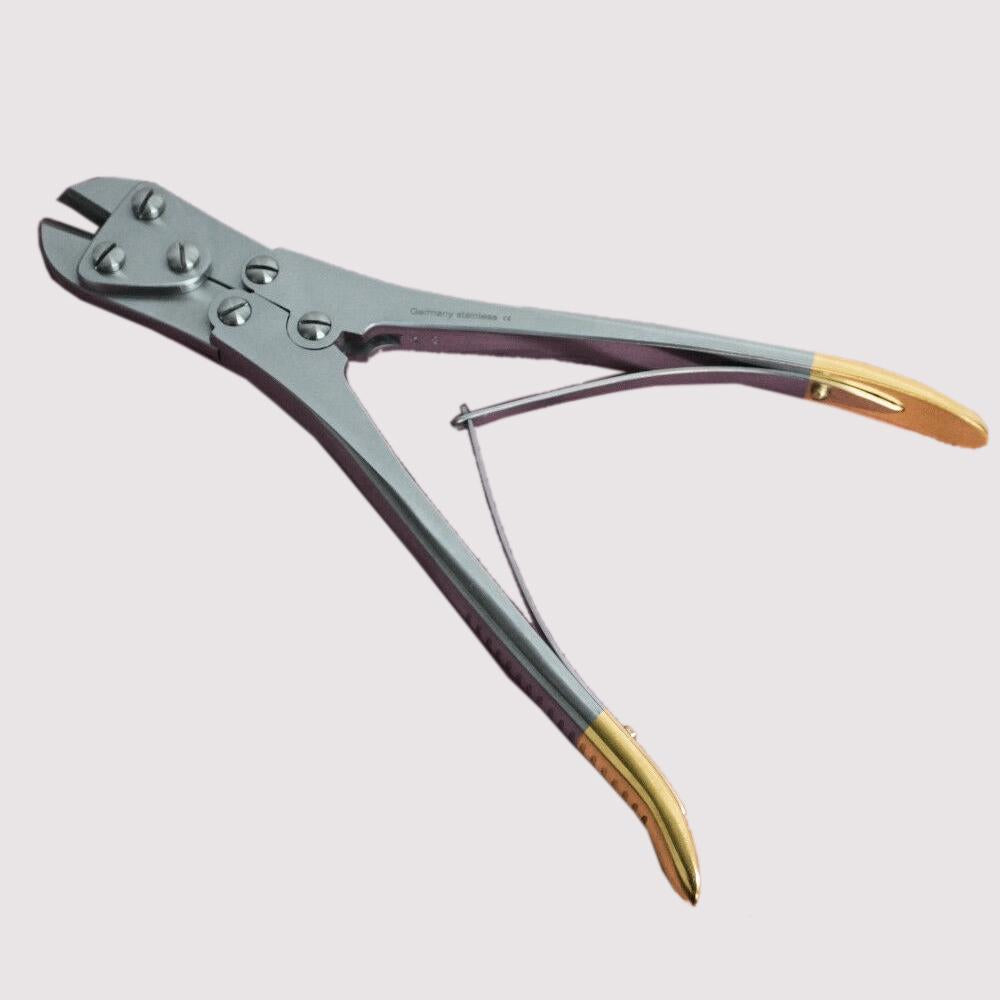
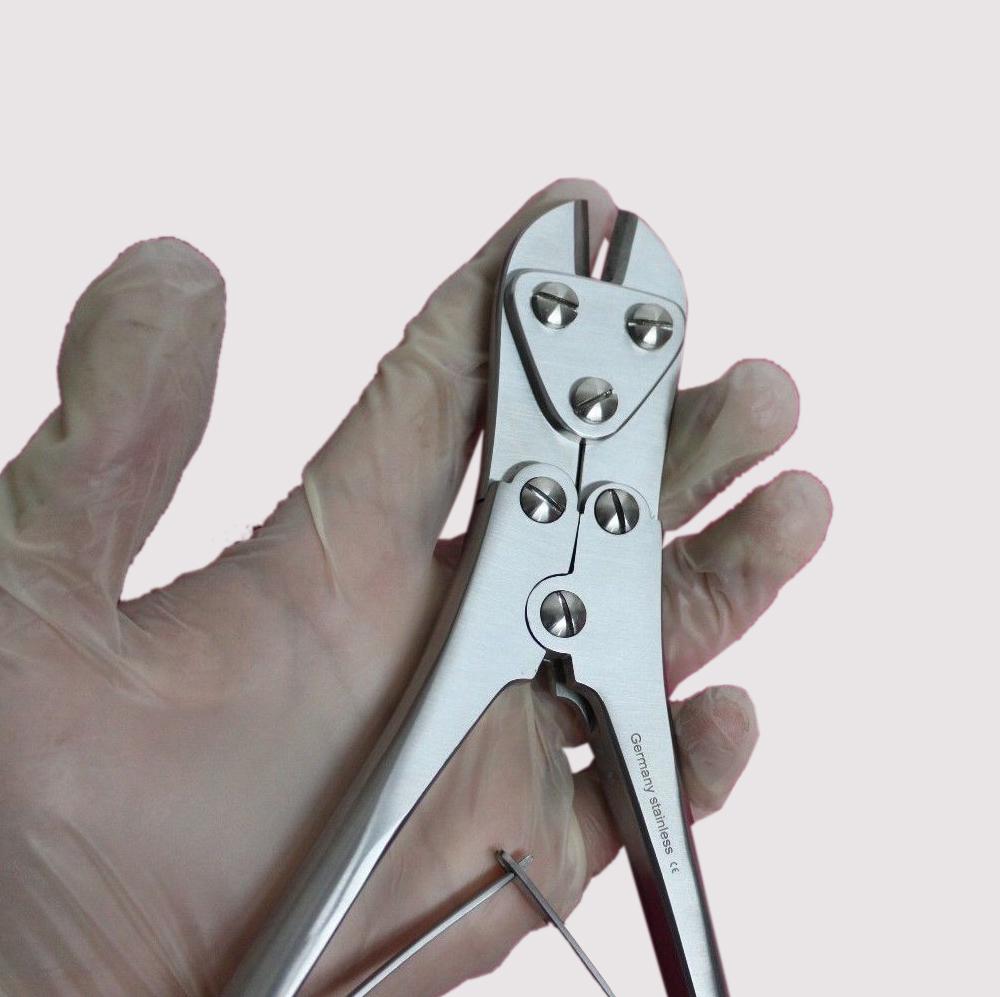
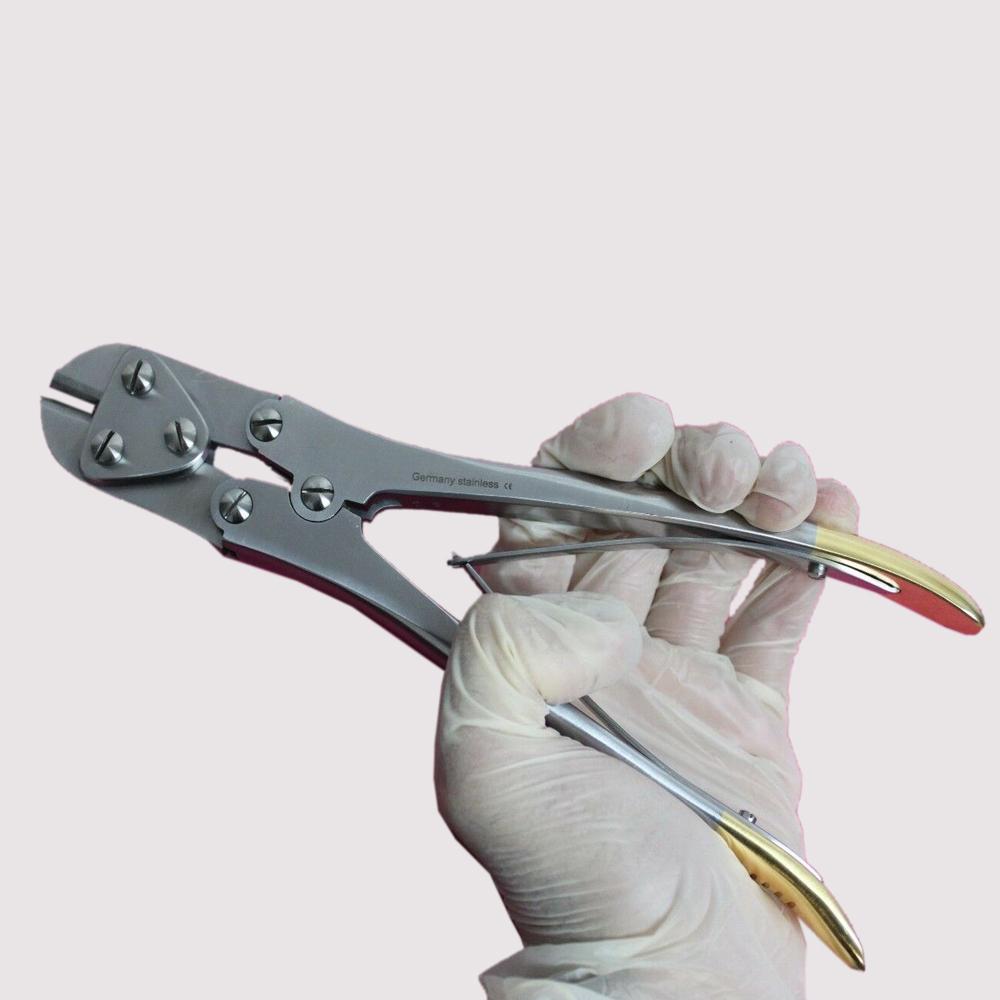
TC Meade Pin Wire & Plate Cutter Pliers, SKU PS-OF-001001, are reusable orthopedic cutting pliers manufactured with a German-forged medical stainless steel body and tungsten carbide cutting inserts for controlled division of fixation wire, pins, and compatible plate material during orthopedic procedures. The Meade pattern combines a compact distal cutting head, multiple pivot points, long curved handles, and an opening spring that returns the handles apart after each cutting cycle. This compound-leverage geometry converts hand compression at the proximal handles into concentrated force at the short cutting jaws, reducing the grip effort required compared with a simple single-pivot wire cutter. The instrument is used during fracture fixation, cerclage wiring, Kirschner-wire management, tension-band constructs, osteotomy fixation, and implant removal when protruding wire or pin ends require controlled trimming. It can also be used for plate modification when the implant material and thickness fall within the intended capability of the cutter. Orthopedic trauma, hand, foot and ankle, reconstructive, and veterinary orthopedic surgeons may use this pattern in operating rooms and procedural settings where reusable heavy-duty cutting instrumentation is required.
The TC Meade pattern uses compound mechanical leverage rather than a single hinge. The distal cutting head is linked to the long handles through multiple pivot points, so a relatively wide movement at the handles produces a smaller, higher-force closing movement at the jaws. This arrangement is useful when dense stainless steel fixation wire or pin material must be divided without requiring excessive hand force. Tungsten carbide cutting inserts form the working surfaces at the head. Their hardness and edge retention support repeated contact with metallic orthopedic materials while helping maintain a defined cutting interface through routine instrument service. The long handles provide leverage and keep the surgeon’s or assistant’s hands away from the immediate fixation site. A spring spans the handles and reopens the instrument after compression, allowing repeated cuts without manually separating the jaws between cycles. The curved handle profile also provides clearance around the operative field and improves control when the cutting head must be positioned close to a plate, bone surface, or wire twist. There is no ratchet or locking jaw. Cutting force is created only while the handles are compressed, which gives the operator immediate control over jaw closure and release.
During fracture fixation, the cutter is introduced after a wire, pin, or plate component has achieved its intended mechanical role and the excess material needs to be shortened. In cerclage fixation, the wire is tensioned and secured first; the cutting head is then placed at the planned trim point so the remaining end can be managed without leaving unnecessary projection into adjacent soft tissue. In tension-band constructs, excess stainless steel wire can be divided after the loop has been tightened and the fixation has been assessed. During Kirschner-wire fixation of small bones, periarticular fractures, hand or foot procedures, the cutter can be positioned over the exposed wire segment after final depth and trajectory have been established. The same workflow applies during removal procedures when retained wire or pin segments must be shortened before extraction with the appropriate grasping instrument. For plate modification, use is limited to implant material and thickness compatible with the cutter’s intended capacity and the fixation system’s instructions. The short head permits focused access close to the implant, while the long handles keep the operator’s grip outside the working corridor. Eye protection and control of the cut fragment are important because divided metal segments can release suddenly when the jaws complete the cut.
PS-OF-001001 is the model reference identified for the Peak Surgicals TC Meade Pin Wire & Plate Cutter Pliers. The clinical configuration is defined by the cutting head, tungsten carbide inserts, compound pivot assembly, spring mechanism, and elongated handles rather than by a gauge-specific working tip. The compact jaws are the primary cutting component and should meet the wire, pin, or compatible plate material squarely before force is applied. The carbide surfaces concentrate the closing load at the intended cut line and should remain aligned so the opposing edges meet without lateral overlap. The compound linkage multiplies handle force and therefore requires inspection for loose screws, pivot play, or asymmetrical movement before the instrument enters the sterile field. The spring between the handles maintains the normally open position and supports rapid repositioning between cuts. Long handles provide the mechanical advantage required for dense fixation material while creating clearance around bone, retractors, and implant hardware. The live product page presents a size selector but identifies PS-OF-001001 as the published model number without a dimensional size table. Procurement teams should therefore use the model identifier as the primary catalog reference and maintain any selected size information from the Shopify order record with the tray or inventory documentation.
German-forged medical stainless steel provides the structural strength and corrosion resistance required for the body, handles, and pivot assembly, while tungsten carbide at the cutting interface supplies greater wear resistance for repeated metallic cutting contact. Peak Surgicals lists satin, dull, and mirror finish options for the instrument. Reprocessing should begin soon after use so blood and debris do not dry around the cutting head, spring, screw joints, or compound pivots. Cleaning must address the recesses around the linkage as well as both cutting surfaces, followed by thorough rinsing and complete drying. Before sterilization, the jaws should be inspected for chips, edge deformation, misalignment, or metal transfer, and the pivot screws should remain secure without restricting smooth movement. The spring should reopen the handles consistently and the cutting head should close evenly through a full cycle. Steam sterilization can be performed within the healthcare facility’s validated reusable-instrument process and the applicable manufacturer instructions. Peak Surgicals lists this device as Class I with CE, ISO 13485, and FDA-related documentation. ISO 13485 addresses the medical-device quality-management system, while CE and FDA information belongs within the hospital or distributor’s regulatory and supplier-qualification review rather than being converted into an unsupported individual FDA approval claim.
| SKU | PS-OF-001001 |
|---|---|
| Product Name | TC Meade Pin Wire & Plate Cutter Pliers |
| Price | $55.00 USD |
| Size/Gauge Variants | PS-OF-001001 model configuration with TC cutting head, compound pivot mechanism, opening spring, and elongated handles |
| Instrument Category | Orthopedic Wire, Pin and Plate Cutting Pliers |
| Procedure | Fracture fixation, cerclage wiring, Kirschner-wire trimming, tension-band fixation, osteotomy fixation, and implant removal |
| Material | German-Foraged Medical Stainless Steel with Tungsten Carbide Cutting Inserts |
| Finish | Satin, Dull, Mirror |
| Sterilization | Reusable; steam sterilization following validated healthcare-facility reprocessing protocols |
| Instrument Classification | Class I Reusable Orthopedic Cutting Instrument |
| Reusable | Yes |
| Certifications | CE, ISO 13485, FDA-compliant procurement context |
| Warranty | 1 Year |
| MOQ | 1 Piece |
| OEM / Custom Orders | Available |
| After-Sale Service | Return and Replacement |
How do TC Meade Pin Wire & Plate Cutter Pliers differ from a Hercules Pin Cutter?
The TC Meade Pin Wire & Plate Cutter Pliers use a compact compound-leverage head and tungsten carbide cutting inserts, whereas a Hercules Pin Cutter is a heavier pin-cutting pattern intended for larger-diameter orthopedic stock. The Meade design places the cutting head close to the fixation site while long spring-loaded handles multiply hand force through several pivots. A Hercules pattern generally uses a more massive end-cutting head and greater overall leverage for heavier pins. The Meade therefore suits controlled trimming of orthopedic wire, Kirschner wire, pins, and compatible plate material when the required cut falls within the instrument’s intended capability. Both instruments are designed to divide metal rather than grasp or twist it. Selection depends on the implant material, cross-sectional size, access around the fixation construct, and the validated cutting capacity of the instrument being used.
How should the appropriate TC Meade cutter configuration be selected?
The live Peak Surgicals listing identifies model PS-OF-001001 and presents a size selector, but the product specification table does not publish separate dimensional values. For clinical selection, the more important issue is whether the cutting head is appropriate for the diameter and hardness of the wire, pin, or plate material being divided. Fine cerclage wire and exposed Kirschner wire require accurate placement of the jaws at the intended trim point rather than use of excessive handle force. Heavier fixation stock should only be cut with an instrument whose documented capacity covers that material. When plate modification is planned, the plate alloy, thickness, hole position, and implant-system instructions determine whether cutting is acceptable. The TC Meade Pin Wire & Plate Cutter Pliers should therefore be matched to the fixation construct and procedure rather than selected solely by overall instrument length.
What do CE, ISO 13485 and FDA references mean for procurement?
Peak Surgicals lists CE, ISO 13485, and FDA-related information for the TC Meade Pin Wire & Plate Cutter Pliers. ISO 13485 concerns the quality-management system used for controlled medical-device manufacturing and related processes. CE documentation supports conformity review for markets operating under the applicable European medical-device framework. For United States procurement, hospitals and distributors should assess FDA establishment, listing, device classification, and other records relevant to the instrument category. These references should not be rewritten as a claim that an individual reusable cutter is FDA approved unless that precise status is supported by the applicable record. Procurement teams should retain the model number, supplier documentation, certificates, and purchase records within their vendor-qualification system.
How do the spring and compound pivot mechanism function intraoperatively?
The spring and compound pivot assembly control how the TC Meade Pin Wire & Plate Cutter Pliers open and transmit force. In the resting position, the spring separates the handles and keeps the cutting jaws open for placement around the selected wire, pin, or compatible plate segment. Squeezing the long handles moves the linked pivots, which multiply the applied hand force and drive the short jaws together. Because the instrument has no ratchet, cutting pressure exists only while the operator compresses the handles. Once the cut is completed and grip pressure is reduced, the spring reopens the handles for withdrawal or repositioning. Before use, the team should check that the spring returns smoothly, the pivot screws are secure, and the cutting surfaces meet in proper alignment.
How should hospitals order, inspect and sterilize these cutting pliers?
Hospitals should order the TC Meade Pin Wire & Plate Cutter Pliers using model PS-OF-001001 and preserve any size selection recorded with the Shopify order. Peak Surgicals lists a current price of $55.00, MOQ of one piece, one-year warranty, OEM availability, and return-and-replacement after-sale service. After surgery, visible soil and metallic debris should be removed promptly from the jaws, spring, screws, and compound linkage. The instrument should then be cleaned, rinsed, dried, and inspected for chipped carbide, jaw misalignment, loose pivots, spring damage, corrosion, or handle distortion. Steam sterilization should follow the healthcare facility’s validated reusable-instrument cycle and the applicable reprocessing instructions. Sterile-processing and orthopedic inventory teams should remove a cutter from service when the cutting edges are damaged or the linkage no longer closes smoothly and symmetrically.
