
Featured Collection
Your cart
Featured Collection

PEAK SURGICAL
SKU:PS-PCCIS-00105
Couldn't load pickup availability
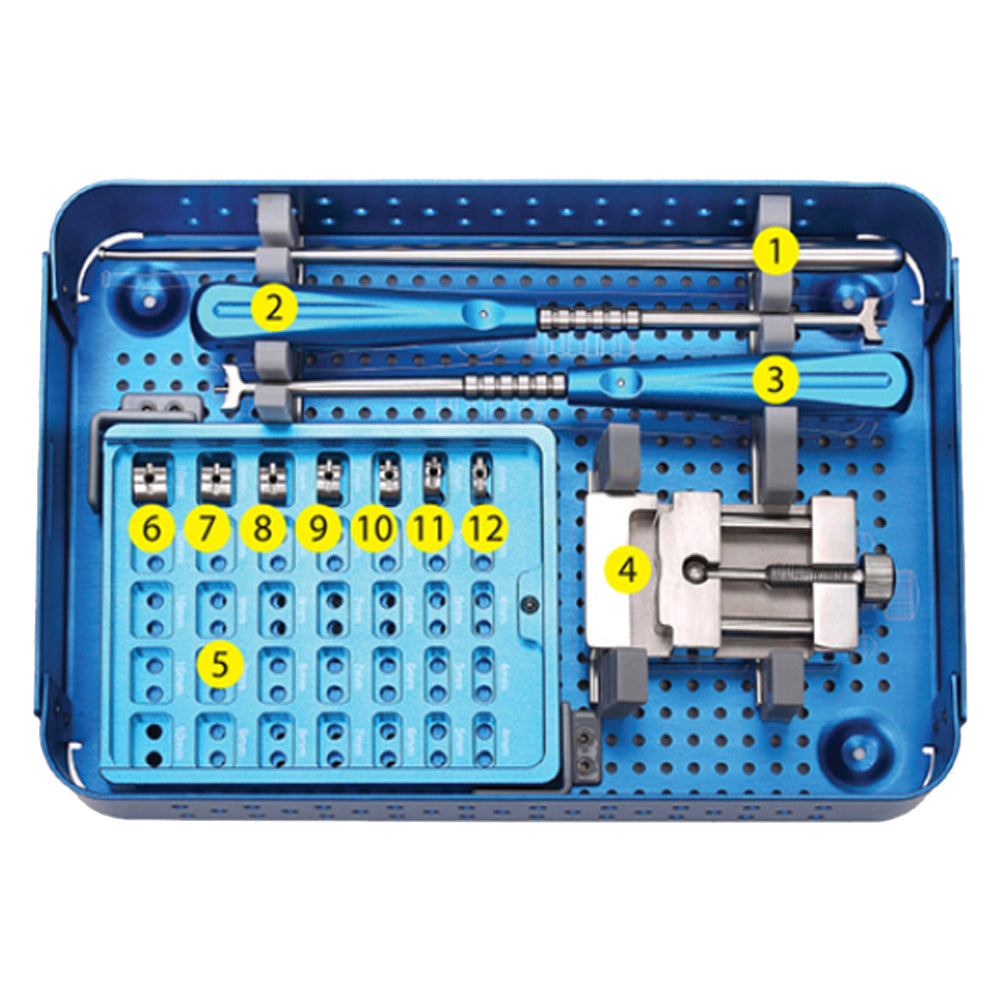

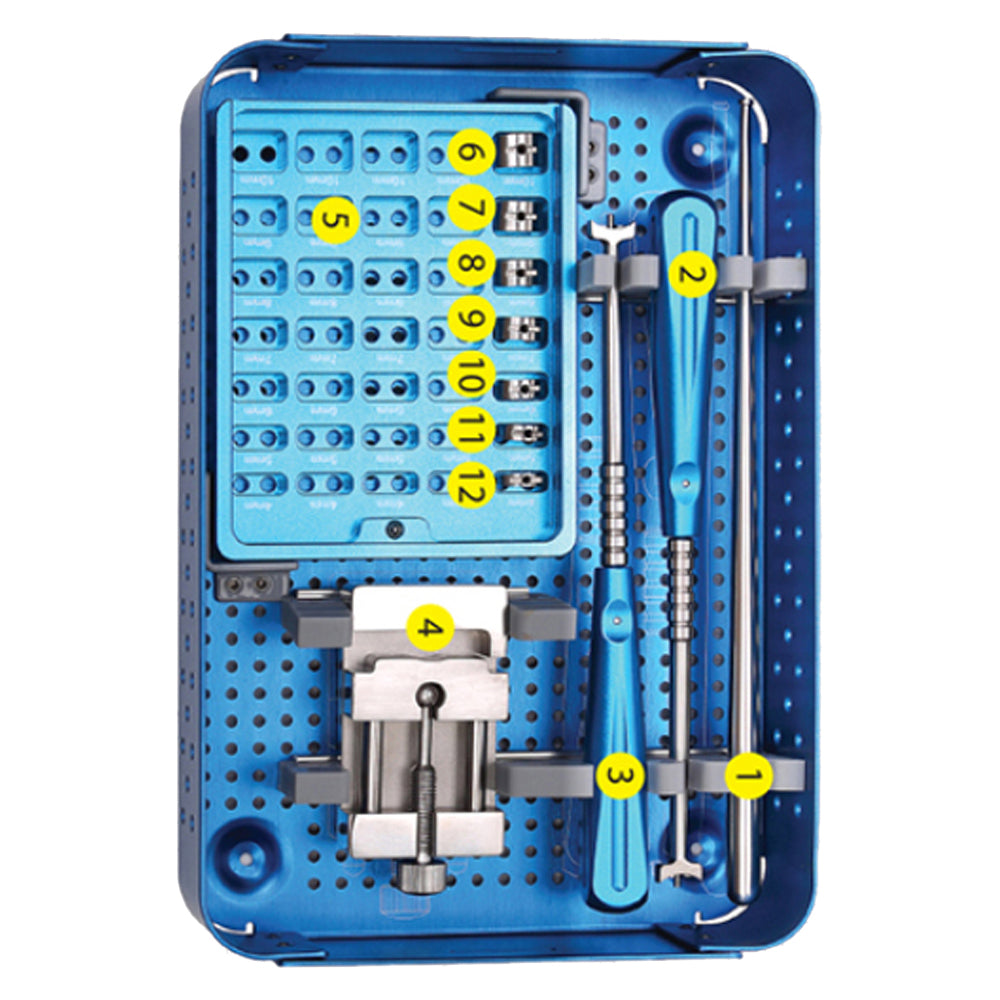
The PEEK Cervical Cage Instrument Set from Peak Surgicals (SKU: PS-PCCIS-00105) is a 13-piece instrumentation set in stainless steel designed for the complete intraoperative workflow of PEEK (polyetheretherketone) interbody cage sizing, placement, and bone graft packing during anterior cervical discectomy and fusion (ACDF) — covering cage size selection with seven Trial spacers from 4mm to 10mm in 1mm increments, trial insertion and positioning with a Trial Holder, definitive PEEK cage introduction and seating with a PEEK Cage Holder, bone graft packing with a Bone Graft Inserter into the Bone Graft Cage, and cage storage and organisation with a Cage Box and Aluminium Box. It is used by spine surgeons and neurosurgeons performing ACDF for cervical disc herniation, cervical spondylotic myelopathy and radiculopathy, and cervical instability requiring interbody fusion with a PEEK cage at one or more cervical levels.
A PEEK interbody cage is a rectangular or oval implant placed in the disc space after anterior cervical discectomy to restore disc height, maintain foraminal height, provide a scaffold for bone fusion between the endplates of the adjacent vertebral bodies, and resist the compressive loads of the cervical spine during the fusion period. PEEK (polyetheretherketone) is the most widely used material for cervical interbody cages because its elastic modulus — the stiffness of the material under compression — closely matches the elastic modulus of cortical bone, reducing the stress shielding at the cage-endplate interface that occurs with stiffer metallic implants such as titanium. Correct cage height selection is the critical determinant of ACDF outcomes: a cage that is too short fails to restore the pre-degeneration disc height and foraminal height, leaving residual foraminal stenosis and failing to adequately tension the anterior and posterior longitudinal ligaments for indirect decompression; a cage that is too tall over-distracts the disc space, risks endplate fracture under the cage corners during insertion, and increases the risk of adjacent segment pathology from altered cervical biomechanics. The seven Trial spacers in this set — 4mm, 5mm, 6mm, 7mm, 8mm, 9mm, 10mm — provide the 1mm increment sizing resolution needed to select the optimal cage height for each individual disc space, accounting for the variation in pre-degenerative disc height across cervical levels (typically 5–8mm at C3/4 to C6/7) and individual patient anatomy.
The seven Trial spacers (PS-T-006 through PS-T-012: 10mm, 9mm, 8mm, 7mm, 6mm, 5mm, 4mm) are precision-machined stainless steel spacers matching the footprint and height profile of the definitive PEEK cage, designed to be inserted into the distracted disc space and assessed fluoroscopically before the definitive cage is selected. The Trial sizing sequence begins with the smallest trial likely to restore the target disc height — typically the pre-degenerative height estimated from the adjacent non-degenerated disc level on preoperative MRI or the distracted intraoperative fluoroscopic image — and progresses upward in 1mm increments until the trial that achieves the correct disc height without excessive resistance at the endplates is confirmed. A correctly sized trial sits snugly in the distracted disc space with no toggling or pistoning under fluoroscopy, restores the correct foraminal height on lateral fluoroscopy, and re-establishes the segmental lordotic angle confirmed on the lateral fluoroscopic view. The Trial Holder (PS-TH-002) grips each trial during insertion and removal through the narrow anterior cervical surgical corridor, maintaining trial orientation during the disc space entry and preventing the trial from toggling off the holder during advancement over the anterior vertebral body edge into the disc space.
Once the correct cage height is confirmed with the Trial spacer, the definitive PEEK cage of the same height is prepared for insertion. The Bone Graft Cage (PS-BGC-004) is the packing receptacle for the bone graft material — cancellous autograft from the iliac crest or local bone from the discectomy decompression, or allograft bone chips — that is packed into the hollow interior of the PEEK cage before it is inserted into the disc space. The Bone Graft Inserter (PS-BCI-001) packs the bone graft material into the Bone Graft Cage through its fenestrations or open face, compressing the graft to maximize the volume of osteoconductive material within the cage before insertion. The PEEK Cage Holder (PS-PCH-003) grips the definitive bone-graft-filled PEEK cage on its posterior face and introduces it through the anterior cervical exposure into the prepared disc space in the same orientation and trajectory as the Trial spacer, advancing the cage to the correct depth — typically flush with the posterior cortical margin of the vertebral bodies confirmed on lateral fluoroscopy, with the anterior face recessed 2–3mm below the anterior vertebral body cortex to allow subsequent anterior plate coverage. The cage is released from the holder once its correct position is confirmed fluoroscopically, and the cage holder is withdrawn before the anterior cervical plate is applied.
The Cage Box (PS-CB-005) provides the dedicated storage compartment for the PEEK cages in their size-labelled positions, allowing rapid cage selection during the procedure once the trial size has been confirmed. The Aluminium Box (PS-AB-013) houses the complete instrument set — the Trial Holder, PEEK Cage Holder, Bone Graft Inserter, Bone Graft Cage, seven Trial spacers, and Cage Box — in a single steam-autoclave-compatible container for sterilization, storage, and transport as a unified set. The single-container layout minimises the risk of instrument loss between procedures and provides immediate visual confirmation that all instruments are present before the set is opened in the sterile field.
The PEEK Cervical Cage Instrument Set covers the disc space sizing, cage insertion, and bone graft packing steps of ACDF — the steps performed after discectomy and endplate preparation and before or alongside anterior cervical plate application. The Anterior Cervical Plate Bone Set (PS-OP-5646, PS1709 series, $1,747.90) from Peak Surgicals provides the complementary anterior cervical plate fixation instruments used after cage insertion — including the Distraction Screws for intervertebral height restoration, the Drill Bit Ø2.5mm and Adjustable Tap Ø4.0mm for vertebral body screw preparation, the Plate Holder and Plate Holding Screws for plate positioning, and the Plate Bender for plate contouring. Spine surgery centres performing ACDF with anterior plate fixation require both sets for the complete procedure workflow.
| SKU | PS-PCCIS-00105 |
|---|---|
| Product Name | PEEK Cervical Cage Instrument Set |
| Sale Price | $1,452.00 USD |
| Regular Price | $2,035.00 USD |
| Discount | 29% off |
| Total Instruments | 13 items |
| Instrument Category | Spine Surgery — PEEK Cervical Interbody Cage Sizing and Insertion |
| Procedure | Anterior cervical discectomy and fusion (ACDF) — PEEK cage sizing, insertion, and bone graft packing |
| Trial Spacers | 4mm (PS-T-012), 5mm (PS-T-011), 6mm (PS-T-010), 7mm (PS-T-009), 8mm (PS-T-008), 9mm (PS-T-007), 10mm (PS-T-006) — 7 sizes |
| Trial Holder | PS-TH-002 |
| PEEK Cage Holder | PS-PCH-003 |
| Bone Graft Inserter | PS-BCI-001 |
| Bone Graft Cage | PS-BGC-004 |
| Cage Box | PS-CB-005 |
| Container | Aluminium Box (PS-AB-013) |
| Certifications | CE Mark, ISO 13485, FDA |
| Warranty | 1 Year |
| MOQ | 1 Set |
| OEM / Custom Orders | Available |
| After-Sale Service | Return and Replacement |
| No. | REF | Description | Qty. |
|---|---|---|---|
| 1 | 2200-0601 | Bone Graft Inserter | 1 |
| 2 | 2200-0602 | Trail Holder | 1 |
| 3 | 2200-0603 | Peek Cage Holder | 1 |
| 4 | 2200-0604 | Bone Graft Cage | 1 |
| 5 | 2200-0605 | Cage Box | 1 |
| 6 | 2200-0606 | Trail 10mm | 1 |
| 7 | 2200-0607 | Trail 9mm | 1 |
| 8 | 2200-0608 | Trail 8mm | 1 |
| 9 | 2200-0609 | Trail 7mm | 1 |
| 10 | 2200-0610 | Trail 6mm | 1 |
| 11 | 2200-0611 | Trail 5mm | 1 |
| 12 | 2200-0612 | Trail 4mm | 1 |
| 13 | 2200-0613 | Aluminium Box | 1 |
What is a PEEK cervical cage and why is PEEK preferred over titanium for ACDF?
A PEEK (polyetheretherketone) cervical cage is a hollow rectangular or oval interbody spacer placed in the cervical disc space after discectomy to maintain disc height, provide a fusion scaffold, and support the anterior column while bone fusion consolidates between the cage and the adjacent vertebral endplates. PEEK is preferred over titanium and other metallic cage materials for ACDF for several reasons. First, PEEK's elastic modulus (approximately 3.6 GPa) is similar to that of cortical bone (14–25 GPa range), compared to titanium's significantly higher modulus (110 GPa), which means PEEK transmits more of the compressive load through the cage-endplate interface and reduces the stress shielding that can impair endplate remodelling and fusion. Second, PEEK is radiolucent on CT and MRI, allowing assessment of the fusion mass growing through the cage's fenestrations on postoperative imaging — titanium cages produce CT and MRI artefact that obscures the fusion zone. Third, PEEK's biocompatibility is well established across a large clinical evidence base. The PEEK Cervical Cage Instrument Set from Peak Surgicals is designed for use with PEEK cages for all these reasons.
How are the Trial spacers used to select the correct cage height?
The Trial sizing sequence in ACDF begins after the disc has been removed, the endplates have been prepared, and the disc space has been distracted to the target height using the distraction screws from the anterior cervical plate instrument set. The smallest Trial likely to match the pre-degenerative disc height is inserted using the Trial Holder. The trial's position in the disc space is assessed on biplane fluoroscopy — on the lateral view, the trial should restore the correct segmental lordosis and foraminal height; on the anteroposterior view, the trial should be centred in the disc space. If the trial toggles or can be easily removed without force, the next larger size is used. If the trial cannot be advanced without significant endplate force, the next smaller size is used. The correct trial is the largest size that can be inserted without endplate cracking and that achieves the target disc height and lordosis on fluoroscopy. The definitive PEEK cage of that size is then filled with bone graft and inserted using the PEEK Cage Holder.
What bone graft is used with PEEK cervical cages and how does the Bone Graft Inserter work?
PEEK cages used in ACDF are hollow with fenestrations or an open face to allow bone graft to contact the decorticated vertebral endplates and promote fusion across the disc space. The bone graft material is placed inside the cage before insertion. The most common options are local bone from the anterior osteophyte removal and endplate preparation (autograft), cancellous bone harvested from the iliac crest (autograft gold standard), or allograft bone chips or putty from a bone bank. The Bone Graft Cage (PS-BGC-004) is the container used to hold and pack the graft material before it is transferred into the PEEK cage, and the Bone Graft Inserter (PS-BCI-001) is the packing instrument used to compress the cancellous graft into the PEEK cage interior through its fenestrations or posterior opening. The goal is to maximise the volume of osteogenic or osteoconductive material within the cage before it is inserted, as the bone graft within the cage provides the initial biological environment for fusion between the endplates.
How does this set relate to the Anterior Cervical Plate Bone Set also available from Peak Surgicals?
The PEEK Cervical Cage Instrument Set covers the cage sizing, cage insertion, and bone graft packing steps of ACDF. The Anterior Cervical Plate Bone Set (PS-OP-5646, PS1709 series) covers the anterior cervical plate fixation steps that follow cage insertion — drilling, tapping, plate positioning, plate bending, and screw insertion. Most ACDF procedures use both a PEEK cage and an anterior cervical plate in combination: the cage restores disc height and provides the fusion scaffold, while the plate prevents cage migration and provides immediate anterior column stability while fusion consolidates. Spine surgery centres performing ACDF with anterior plate fixation should procure both sets for the complete intraoperative instrument coverage.
What certifications does this set carry?
The PEEK Cervical Cage Instrument Set is manufactured under CE Mark, ISO 13485, and FDA compliant quality standards. ISO 13485 certification confirms Peak Surgicals operates a documented quality management system covering design control, material traceability, and manufacturing consistency for spinal surgical instruments. CE Mark confirms conformity with European medical device regulations, and FDA compliance supports procurement for US hospitals, spine surgery centers, and neurosurgical departments requiring verified regulatory documentation for cervical cage instrumentation purchases.

