
Featured Collection
Your cart
Featured Collection

PEAK SURGICAL
SKU:PS-OT-0846
Couldn't load pickup availability


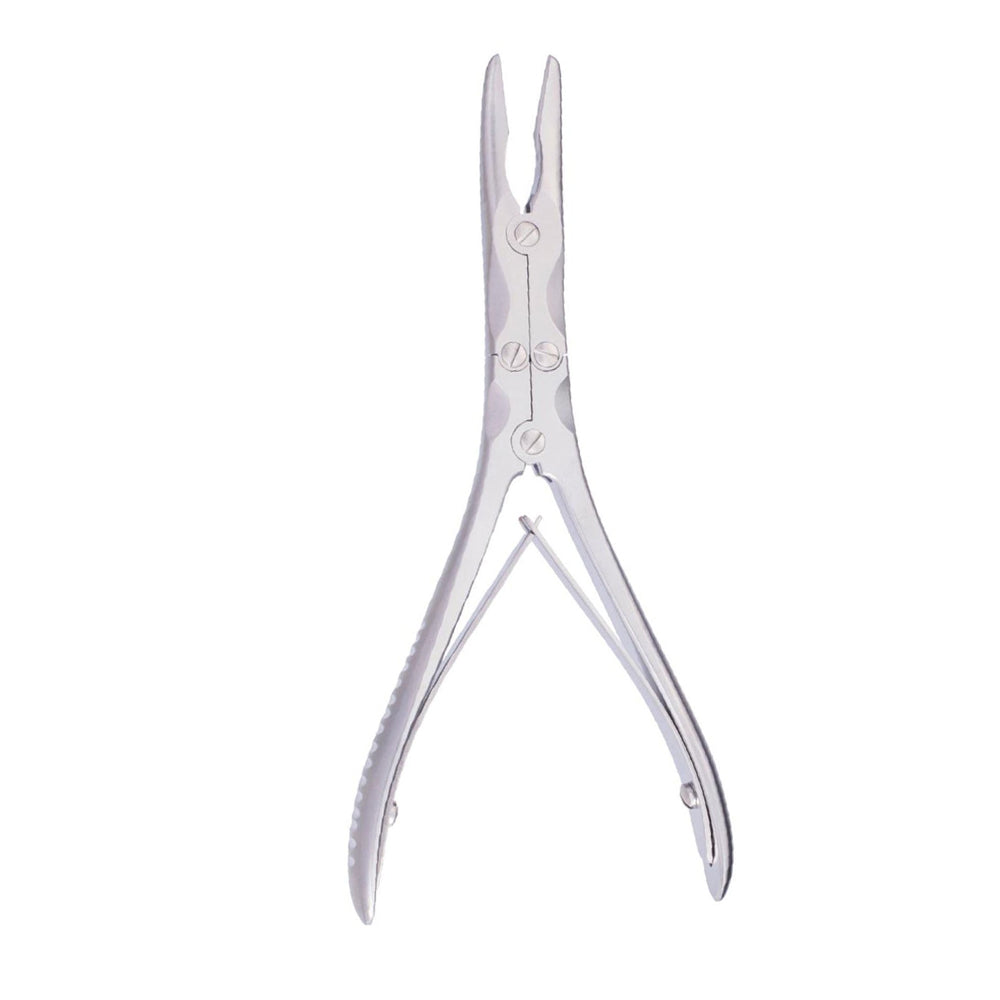
The Kleinert-Kutz Rongeur Forceps (PS-9424/PS-9425) is a reusable German stainless steel orthopedic rongeur instrument available in two jaw widths — PS-9424 with 3mm jaws (small size) and PS-9425 with 4mm jaws (large size) — designed for the precise nibbling and resection of bone in confined anatomical spaces, most classically associated with hand and wrist surgery where the Kleinert-Kutz pattern is a recognized standard instrument. As a rongeur, this instrument differs functionally from a standard cutting forceps or bone cutter: its jaws are designed to bite and remove small fragments of bone progressively, in a controlled nibbling action, rather than executing a single decisive cut through bone in the manner of a bone cutter or osteotome. This nibbling action provides the surgeon with precise, incremental control over the amount and location of bone removed — a critical capability in hand surgery and other small-joint or confined-space orthopedic procedures where the margin for error is small and adjacent neurovascular structures, tendons, and joint surfaces must be protected from inadvertent injury during bone resection. The two jaw width options allow the surgeon to select the instrument scaled to the specific procedure: the 3mm small jaws for fine, precise bone nibbling in the most confined anatomical spaces, and the 4mm large jaws for more efficient bone removal where the procedure allows a larger bite per pass without compromising precision. Manufactured from German stainless steel for the durability required of an instrument that performs repeated high-force biting cycles against bone. Used by hand surgeons, orthopedic surgeons, and plastic surgeons performing bone resection in confined surgical fields. Sold as 1 piece, $35.75.
A rongeur is a surgical instrument category distinct from bone cutters, osteotomes, and saws in its fundamental mechanism of bone removal. Where a bone cutter or osteotome is designed to execute a single decisive cut through bone along a planned line, severing the bone in one motion, a rongeur removes bone through a repeated biting or nibbling action: the jaws close on a small volume of bone, shear or crush through it, and the surgeon repositions the jaws to take the next bite, progressively removing bone in small, controlled increments until the desired resection is achieved. This incremental approach provides several advantages in procedures where precision matters more than speed of bone removal. The surgeon retains continuous tactile feedback throughout the resection, sensing the resistance of each bite and adjusting jaw position and force accordingly, rather than committing to a single cut whose exact margin is determined before the cutting action begins. The incremental nature of rongeur use also allows the surgeon to stop the resection at any point if an unexpected anatomical finding — an adjacent nerve, vessel, or joint surface closer than anticipated — becomes apparent during the procedure, without the risk of an irreversible single cut having already been made. For hand surgery and other confined-space orthopedic work, where the surgical field is small and the proximity of critical structures to the bone being resected is often close, this combination of incremental control and continuous tactile feedback is the primary reason rongeurs are selected over single-cut bone instruments.
The choice between the PS-9424 (3mm, small) and PS-9425 (4mm, large) jaw width variants depends on the specific anatomical space available and the volume of bone requiring resection in the procedure being performed. The 3mm small jaw variant is suited to the most confined anatomical spaces encountered in hand and wrist surgery — interphalangeal and metacarpophalangeal joint procedures, small bone spur or osteophyte resection adjacent to tendons or neurovascular bundles, and any procedure where the working space is narrow enough that a larger jaw profile would risk contact with adjacent structures before the jaws can be positioned on the target bone. The fine 3mm bite also provides finer incremental control for situations requiring very precise, small-volume bone removal, such as smoothing an irregular bone margin or removing a small prominence without disturbing the surrounding bone architecture. The 4mm large jaw variant provides a larger bite per closure, removing bone more efficiently where the procedure allows — larger joint exposures, more substantial bone spurs or exostoses, or any resection where the anatomical space provides adequate clearance for the larger jaw profile and the volume of bone to be removed favors fewer, larger bites over many small ones. Surgeons performing a range of hand and orthopedic procedures with varying bone resection demands typically benefit from having both jaw widths available, selecting the appropriate size for each specific case based on the confined space and bone volume considerations of that procedure.
The Kleinert-Kutz rongeur pattern is most closely associated with hand surgery, where the combination of small bone structures, closely packed tendons and neurovascular bundles, and the functional importance of precise anatomical restoration makes the incremental, tactile-feedback-driven bone resection of a rongeur particularly valuable. Applications in hand surgery include resection of bone spurs or osteophytes associated with osteoarthritis of the interphalangeal or metacarpophalangeal joints, bone shaping during joint arthroplasty or arthrodesis procedures, removal of bone irregularities following fracture malunion or nonunion repair, and resection of bone during tumor or cyst excision in the hand and wrist. Beyond hand surgery specifically, the same instrument design principles apply to other confined-space orthopedic and reconstructive procedures: small joint surgery in the foot, fine bone resection during craniofacial or maxillofacial reconstruction, and any orthopedic or plastic surgery procedure where bone must be precisely shaped or reduced within a confined surgical field adjacent to structures requiring protection. The rongeur's controlled, incremental bone removal capability also makes it useful in revision surgery, where previously placed hardware, scar tissue, or altered anatomy from prior procedures may require the surgeon to proceed with particular caution during bone resection.
The Kleinert-Kutz Rongeur Forceps is manufactured from German stainless steel, providing the hardness, edge retention, and structural strength required of a bone-biting instrument that performs repeated high-force shearing cycles against bone tissue throughout a procedure and across the instrument's service life. The cutting edges of the jaws are the critical functional and maintenance focus of this instrument: sharp, well-maintained jaw edges provide clean, efficient bone shearing with each bite, while dulled or damaged edges require greater closing force to achieve the same bone removal, increasing the risk of bone fragmentation, jaw slippage, or excessive force transmission to surrounding tissue. The jaw edges and pivot mechanism should be inspected at each reprocessing cycle for sharpness, alignment, and smooth hinge action; any rongeur showing dulled cutting edges, jaw misalignment, or hinge looseness should be removed from clinical service for sharpening or maintenance assessment. Compatible with steam autoclave sterilization at 134°C pre-vacuum parameters, with ultrasonic cleaning recommended before terminal sterilization for thorough removal of bone debris from the jaw and hinge areas. Available in satin, dull, or mirror surface finish.
The Kleinert-Kutz Rongeur Forceps (PS-9424, PS-9425) is manufactured under a quality management system certified to ISO 13485, governing German stainless steel material sourcing, precision forging and machining of the rongeur jaws at both the 3mm and 4mm width specifications, cutting edge sharpness and dimensional inspection, hinge mechanism precision, surface finishing, and packaging. CE Mark certification confirms conformity with European Medical Device Regulation requirements for Class I reusable surgical instruments distributed within EU and associated regulatory territories. FDA compliance documentation is maintained for United States distribution, satisfying regulatory requirements for reusable orthopedic surgical instruments procured by US hospitals, orthopedic and hand surgery practices, and surgical instrument distributors. These certifications satisfy procurement and tender documentation requirements of institutional buyers in the USA, India, Pakistan, Vietnam, and across international surgical instrument supply frameworks. Certificates of conformity and quality management system documentation are available on request. OEM manufacturing is available within the same certified manufacturing framework.
| SKU (Storefront) | PS-OT-0846 |
|---|---|
| Model Numbers | PS-9424 (small) / PS-9425 (large) |
| Product Name | Kleinert-Kutz Rongeur Forceps |
| Price | $35.75 USD |
| PS-9425 | Jaws 4mm wide, large size — efficient bone removal in less confined surgical fields |
| PS-9424 | Jaws 3mm wide, small size — fine, precise bone nibbling in confined anatomical spaces |
| Instrument Function | Rongeur — controlled, incremental bone biting/nibbling, not single-cut resection |
| Category | Orthopedic Surgical Instruments — Bone Holding Forceps / Rongeurs |
| Instrument Classification | Class I Reusable Surgical Instrument |
| Primary Indications | Hand and wrist surgery bone resection; confined-space orthopedic and reconstructive bone shaping |
| Clinical Setting | Operating room, hand surgery unit, orthopedic surgery unit |
| Users | Hand surgeons, orthopedic surgeons, plastic and reconstructive surgeons |
| Material | German Stainless Steel |
| Surface Finish | Satin / Dull / Mirror |
| Certifications | CE, ISO 13485, FDA |
| Reusability | Reusable |
| Quantity | 1 Piece per size selected |
| Rust Resistance | Yes |
| Warranty | 1 Year |
| MOQ | 1 Piece |
| OEM / Custom Orders | Available |
| Packing | Carton Box |
| Place of Origin | Pakistan |
| Brand | Peak Surgicals |
| Primary Use | Controlled bone nibbling/resection in hand surgery and confined-space orthopedic procedures — select 3mm (PS-9424) for fine precision work or 4mm (PS-9425) for more efficient bone removal |
| After-Sale Service | Return and Replacement |
What is a rongeur, and how does the Kleinert-Kutz pattern differ from a standard bone cutter?
A rongeur is a surgical instrument designed to remove bone through a repeated biting or nibbling action — the jaws close on a small volume of bone, shear through it, and the surgeon repositions for the next bite, progressively removing bone in controlled increments. This differs from a bone cutter or osteotome, which is designed to execute a single decisive cut through bone along a planned line. The Kleinert-Kutz pattern is a recognized rongeur design originating in hand surgery, with jaw widths scaled for the small, confined anatomical spaces typical of hand and wrist procedures. The incremental nibbling action of a rongeur provides continuous tactile feedback to the surgeon throughout bone removal and allows the procedure to be paused or adjusted at any point if an unexpected anatomical finding is encountered — an important safety consideration in confined surgical fields where critical structures may be close to the bone being resected. This makes the Kleinert-Kutz rongeur particularly suited to precision bone work in hand surgery and similar confined-space procedures, where a single-cut instrument would offer less control.
How do I choose between the 3mm small jaw (PS-9424) and the 4mm large jaw (PS-9425)?
The choice depends on the anatomical space available in the surgical field and the volume of bone requiring resection. The 3mm small jaw variant (PS-9424) is suited to the most confined spaces — interphalangeal and metacarpophalangeal joint procedures, bone work adjacent to tendons or neurovascular bundles, and any situation where a larger jaw profile risks contact with surrounding structures before the jaws can engage the target bone. It also provides finer incremental control for precise, small-volume bone shaping. The 4mm large jaw variant (PS-9425) removes more bone per bite, making it more efficient where the anatomical space provides adequate clearance and the procedure involves resecting a larger volume of bone — bigger joint exposures, larger bone spurs, or exostoses. Surgeons performing a range of hand and orthopedic procedures with varying bone resection demands typically stock both jaw widths, selecting the appropriate size for the specific case.
What surgical procedures most commonly use the Kleinert-Kutz rongeur?
The Kleinert-Kutz rongeur pattern is most closely associated with hand surgery, where applications include resection of osteoarthritic bone spurs at the interphalangeal or metacarpophalangeal joints, bone shaping during joint arthroplasty or arthrodesis, removal of bone irregularities following fracture malunion repair, and bone resection during tumor or cyst excision in the hand and wrist. The same precision, confined-space bone resection capability is also applicable to other procedures requiring fine bone control: small joint surgery in the foot, craniofacial and maxillofacial bone shaping, and revision orthopedic surgery where altered anatomy or scar tissue from prior procedures requires particularly cautious bone resection. The common thread across these applications is the need for controlled, incremental bone removal in a confined surgical field, often adjacent to structures requiring protection from inadvertent injury.
What sterilization protocol is recommended, and what should be inspected at each reprocessing cycle?
The Kleinert-Kutz Rongeur Forceps is manufactured from German stainless steel and is fully compatible with steam autoclave sterilization at 134°C pre-vacuum parameters. Ultrasonic cleaning before terminal sterilization is recommended for thorough removal of bone debris and tissue from the jaw and hinge areas. At each reprocessing cycle, the jaw cutting edges should be inspected for sharpness and any chipping or dulling — a rongeur with dulled cutting edges requires greater closing force to shear bone, which increases the risk of bone fragmentation and reduces the precision that is the instrument's primary clinical advantage. The hinge mechanism should be checked for smooth, secure pivot action and correct jaw alignment. Any rongeur showing dulled edges, jaw misalignment, or hinge looseness should be removed from clinical service for sharpening or maintenance.
What certifications does this instrument carry, and are bulk or OEM orders available?
The Kleinert-Kutz Rongeur Forceps (PS-9424, PS-9425) is manufactured under an ISO 13485-certified quality management system covering German stainless steel material procurement, precision forging and machining of both jaw width variants, cutting edge and hinge inspection, and packaging. CE Mark certification confirms conformity with European Medical Device Regulation requirements for Class I reusable surgical instruments. FDA compliance documentation supports United States distribution. Certificates of conformity are available on request for hospital and surgical practice procurement and tender documentation. Bulk orders are accepted with a minimum of 1 piece per jaw width, with volume pricing available for hospitals, hand and orthopedic surgery practices, and surgical instrument distributors. OEM manufacturing for custom jaw widths or private-label branding is available within the same ISO 13485-certified framework. Free shipping applies on orders of $99 or more.


