
Featured Collection
Your cart
Featured Collection

PEAK SURGICALS
SKU:PS-OP-5570
Couldn't load pickup availability


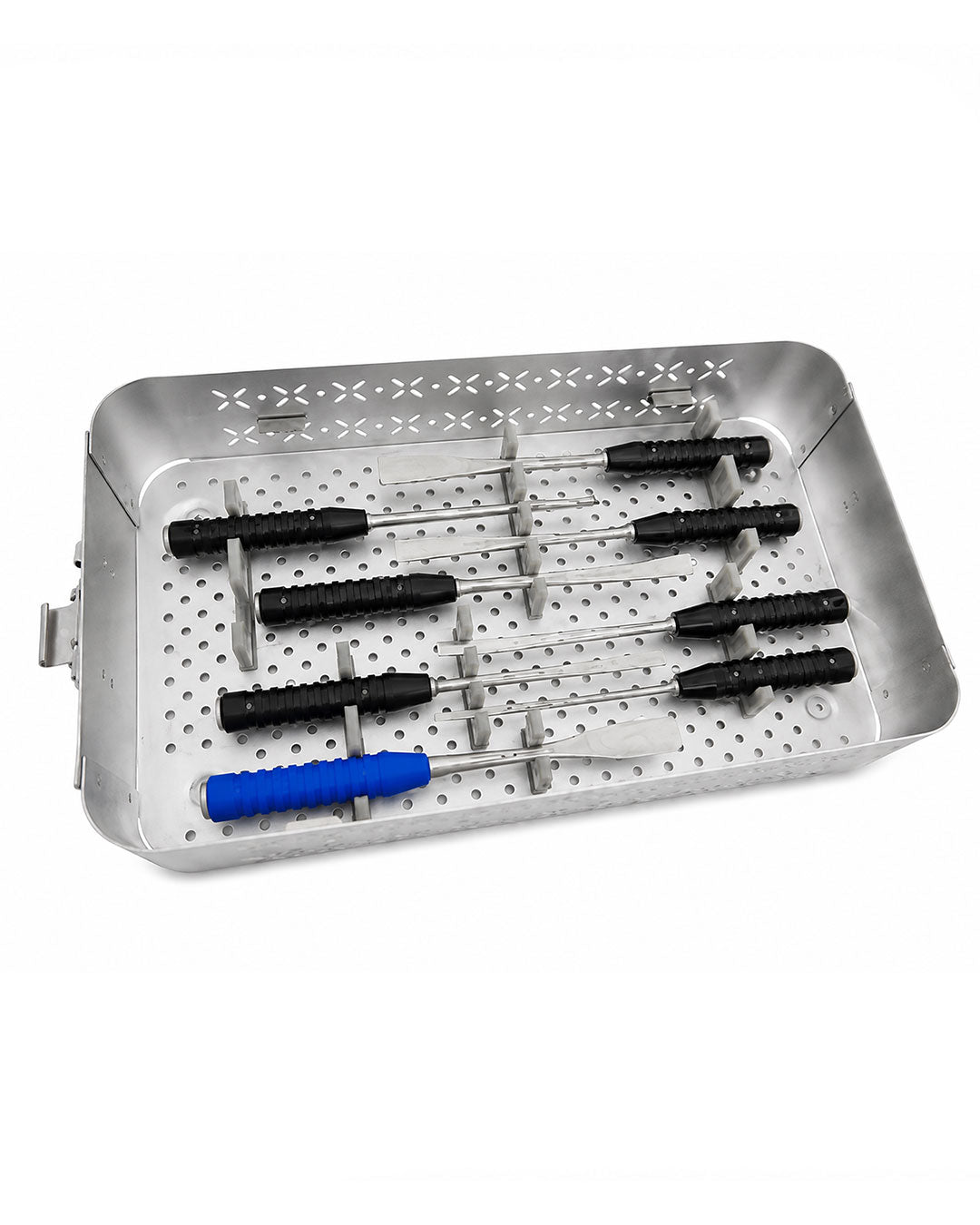
Hip Joint Instruments Set, SKU PS-OP-5570, is an 18-instrument reusable German stainless steel Q-Series system for hip exposure, acetabular access, controlled bone preparation, and proximal femoral manipulation. The configuration contains two PS-300.01 minimally invasive acetabular retractors, three PS-300.02 retractors, two PS-300.03 acetabular screws measuring 4.0 mm in diameter and 140 mm long, one PS-300.04 bone shovel, one PS-300.05 tuberosity distractor, straight chisels PS-300.06-6 at 6 mm, PS-300.06-10 at 10 mm, PS-300.06-15 at 15 mm, and PS-300.06-20 at 20 mm, curved chisels PS-300.07-10 at 10 mm and PS-300.07-15 at 15 mm, one PS-300.08 gouge, left and right bone hooks PS-300.09-L and PS-300-09-R, and container PS-300.000. Orthopedic hip surgeons use these components during primary or revision total hip arthroplasty, hemiarthroplasty, acetabular reconstruction, surgical dislocation, implant removal, and proximal femoral exposure. The set supports hospital operating rooms, trauma units, arthroplasty centers, and specialist orthopedic facilities requiring organized exposure and bone-working instrumentation.
The two minimally invasive acetabular retractors are configured for localized access around the acetabular rim through restricted operative corridors. Three additional retractors provide alternative tissue displacement according to approach, depth, and required visualization. The 4.0 mm acetabular screws provide threaded bony purchase for system-compatible retraction or positioning when the operative technique calls for anchored control. Straight chisels transmit impact force directly along their longitudinal axis and are used where the surgeon requires a linear osteotomy or controlled interface release. Curved chisels redirect the working edge around contoured bone or an implant surface that cannot be approached coaxially. The gouge has a concave cutting profile for removing or contouring cancellous and cortical bone along a defined channel. Left and right bone hooks apply directional traction to the proximal femur according to the operative side and selected approach. The bone shovel receives and transfers excised bone fragments or graft material without using a cutting edge. The tuberosity distractor separates or mobilizes the targeted bony region through controlled mechanical leverage. Each component supplies a distinct line of force, working angle, and anatomical access route.
During total hip arthroplasty, the retractors are placed sequentially around the anterior, posterior, superior, or inferior acetabular margin according to the surgical approach and structures requiring protection. The minimally invasive pair maintains targeted exposure where incision length and soft-tissue corridors restrict access. Acetabular screws can establish anchored purchase for the compatible retraction workflow before reaming, cup assessment, or implant removal. Bone hooks mobilize and present the proximal femur during femoral preparation, with left and right patterns selected according to anatomy and traction direction. Straight chisels release accessible cement, osteophytes, bone interfaces, or implant margins using a direct impact path. Curved versions reach behind an obstructing contour or follow the acetabular and proximal femoral geometry. The gouge contours a recessed bony surface, while the bone shovel retrieves fragments or places prepared graft. The tuberosity distractor provides controlled separation during exposure or reconstruction involving the proximal femoral attachment region. In revision surgery, the combined instruments support exposure, interface access, osteophyte removal, cement disruption, component extraction, and bone-bed preparation. Implant-specific reamers, trials, inserters, and extraction devices remain separate from this Q-Series configuration.
The 6 mm straight chisel PS-300.06-6 provides the narrowest linear edge for confined interfaces and localized bone removal. The 10 mm PS-300.06-10 increases working width while retaining access to restricted acetabular or femoral regions. The 15 mm PS-300.06-15 addresses a broader interface where force must be distributed across a larger surface. The 20 mm PS-300.06-20 offers the widest listed straight edge for accessible bone margins or extensive interface release. Curved chisel PS-300.07-10 combines a 10 mm working width with an offset trajectory for confined curved anatomy. The 15 mm curved model PS-300.07-15 covers a broader surface while reaching around an implant or osseous contour. Width selection depends on interface dimensions, access angle, remaining bone stock, implant position, and the amount of material requiring removal. The narrower edge provides localized control but concentrates impact force, whereas a wider blade distributes force across more bone. Left and right hooks are chosen by operative side and intended traction vector. Retraction components are selected according to surgical approach, acetabular depth, soft-tissue tension, and required visualization rather than being placed simultaneously.
German stainless steel provides corrosion resistance, rigidity, and dimensional stability across the retractors, screws, chisels, gouge, shovel, distractor, and bone hooks. Cutting instruments require inspection for edge rounding, chipping, bending, impact deformation, or corrosion after every procedure. Threaded acetabular screws must be checked for damaged threads and straightness, while hooks and retractors require examination for tip deformation or surface defects. Cleaning should begin before blood, bone, cement, or tissue dries on the instruments. Hinges, recesses, threads, curved working surfaces, and container contact points require direct access during decontamination. Components should be cleaned, rinsed, inspected, dried, packaged, and steam sterilized according to validated institutional protocols and manufacturer instructions. CE documentation concerns conformity with applicable European medical-device requirements. ISO 13485 addresses the quality management system governing manufacture, documentation, and traceability. FDA procurement depends on the establishment, listing, labeling, importer, and market-access documentation applicable to the destination. Container PS-300.000 organizes the set but does not independently determine cleaning efficacy, packaging configuration, sterilization parameters, drying, or sterile shelf life.
| Hip Joint Instruments Set Q-Series | Units |
|---|---|
| PS-300.01 – Acetabulum Minimally Invasive Retractor | 2 |
| PS-300.02 – Retractor | 3 |
| PS-300.03 – Acetabular Screw, Ø4.0 mm, 140 mm Length | 2 |
| PS-300.04 – Bone Shovel | 1 |
| PS-300.05 – Tuberosity Distractor | 1 |
| PS-300.06-6 – Straight Chisel, 6 mm | 1 |
| PS-300.06-10 – Straight Chisel, 10 mm | 1 |
| PS-300.06-15 – Straight Chisel, 15 mm | 1 |
| PS-300.06-20 – Straight Chisel, 20 mm | 1 |
| PS-300.07-10 – Curved Chisel, 10 mm | 1 |
| PS-300.07-15 – Curved Chisel, 15 mm | 1 |
| PS-300.08 – Gouge | 1 |
| PS-300.09-L – Bone Hook, Left | 1 |
| PS-300-09-R – Bone Hook, Right | 1 |
| PS-300.000 – Empty Container | Included |
| SKU | PS-OP-5570 |
|---|---|
| Product Name | Hip Joint Instruments Set |
| Price | $1,098.90 USD |
| Size/Gauge Variants | Straight chisels: 6, 10, 15 and 20 mm; curved chisels: 10 and 15 mm; acetabular screws: Ø4.0 × 140 mm |
| Instrument Category | Orthopedic hip surgery instrument set |
| Procedure | Total hip arthroplasty, hemiarthroplasty, acetabular reconstruction, and revision hip surgery |
| Material | German stainless steel |
| Finish | Satin orthopedic finish with polished functional surfaces |
| Sterilization | Reusable instruments for validated hospital cleaning and steam sterilization |
| Instrument Classification | Reusable orthopedic surgical instrument system |
| Reusable | Yes |
| Certifications | CE and ISO 13485 documentation; FDA procurement documentation according to destination-market requirements |
| Warranty | 1 year |
| MOQ | 1 set |
| OEM / Custom Orders | Available for documented component, labeling, tray, packaging, and quantity requirements |
| After-Sale Service | Replacement instrument, order, documentation, return, and maintenance support |
How does this Q-Series set differ from a complete total hip replacement instrument system?
Hip Joint Instruments Set focuses on exposure, retraction, bone manipulation, and chisel-based preparation. A complete total hip replacement system additionally contains implant-specific acetabular reamers, cup trials, femoral rasps, stem trials, head trials, inserters, impactors, and extraction components. The Q-Series configuration can support primary or revision exposure but does not replace those prosthesis-matched instruments. Its straight and curved chisels address bone or implant interfaces rather than calibrated canal broaching. The retractors and hooks position anatomy but do not determine implant size. Hospitals should combine this set only with instrumentation authorized for their selected hip implant system.
How should the straight and curved chisel sizes be selected?
Hip Joint Instruments Set provides 6, 10, 15, and 20 mm straight chisels plus 10 and 15 mm curved options. The 6 mm blade addresses confined interfaces requiring localized cutting. The 10 and 15 mm widths provide progressively broader contact while maintaining access to restricted regions. The 20 mm straight edge distributes impact across the widest listed surface. Curved blades are selected when acetabular or femoral contours prevent a direct axial approach. Selection depends on access, interface width, implant position, bone stock, and the amount of material requiring removal.
What do CE, ISO 13485, and FDA references mean for procurement?
CE documentation concerns conformity with applicable European medical-device requirements. ISO 13485 addresses the quality management system used for medical-device manufacture and traceability. Neither designation independently means that Hip Joint Instruments Set has received FDA approval. United States procurement requires the relevant establishment, listing, labeling, importer, and market-access documentation. Hospitals should retain those records with the ordered SKU, component table, and supplier information. The documentation supports vendor qualification, instrument traceability, maintenance, and complaint handling.
How are the retractors and acetabular screws controlled intraoperatively?
The retractors use their shaped working ends and lever arms to maintain tissue displacement around the acetabular rim or proximal femur. Hip Joint Instruments Set includes multiple retractors so the surgeon can select the working angle required by the chosen approach. The 4.0 × 140 mm acetabular screws provide threaded bony purchase for the compatible anchored retraction or positioning technique. Their placement, depth, and removal remain under direct surgical control. Excessive leverage or insecure purchase can alter exposure and damage bone. Each screw and retractor must be inspected for deformation, thread damage, or unstable engagement before use.
How should the complete set be cleaned and sterilized?
The instruments should be counted and transferred for decontamination immediately after surgery. Bone, blood, cement, and tissue must be removed from cutting edges, threads, curved surfaces, hooks, and retractor tips. Hip Joint Instruments Set should be cleaned, rinsed, inspected, dried, packaged, and steam sterilized under validated institutional and manufacturer instructions. Chisel and gouge edges require magnified inspection, while acetabular screw threads must remain unobstructed. Container PS-300.000 supports organization but does not replace validated sterilization packaging or cycle controls. The tray should be released only after component reconciliation, functional inspection, cycle completion, drying, and sterilization-record approval.


