
Featured Collection
Your cart
Featured Collection

PEAK SURGICAL
SKU:PS-DTES-00220
Couldn't load pickup availability
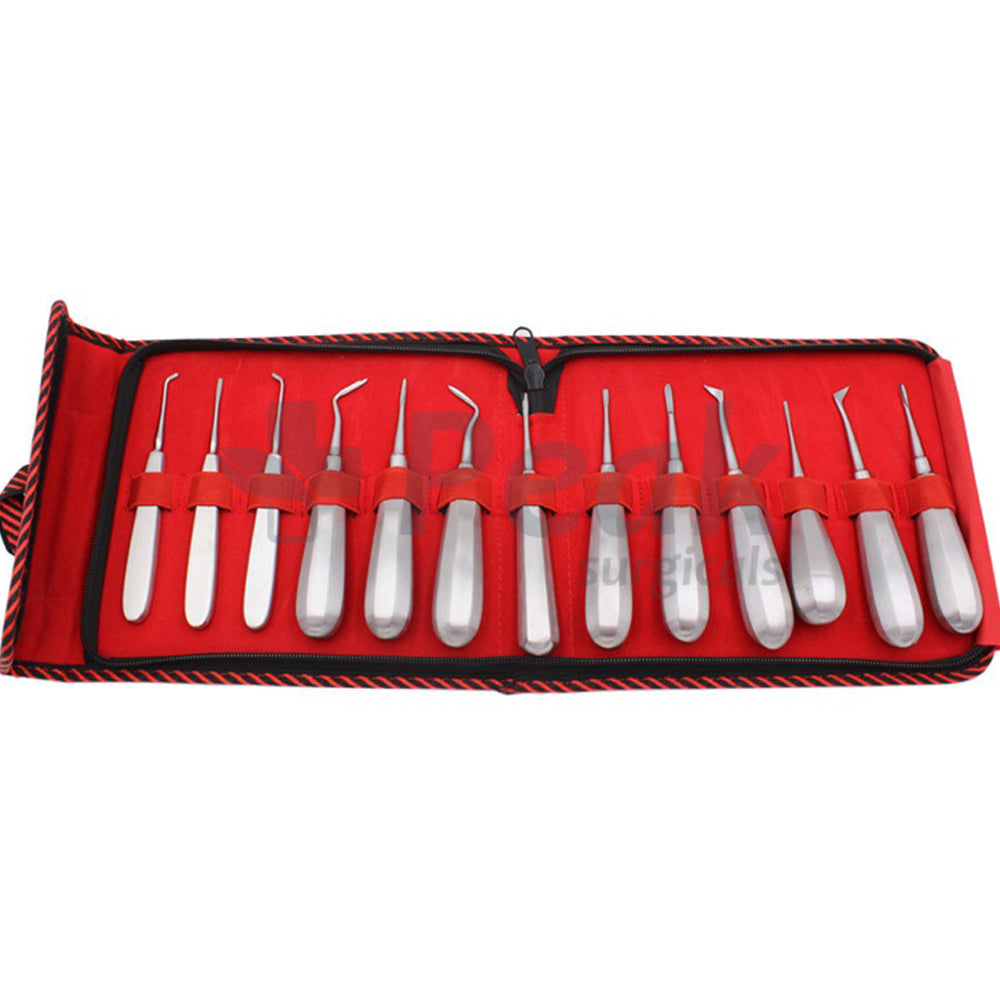
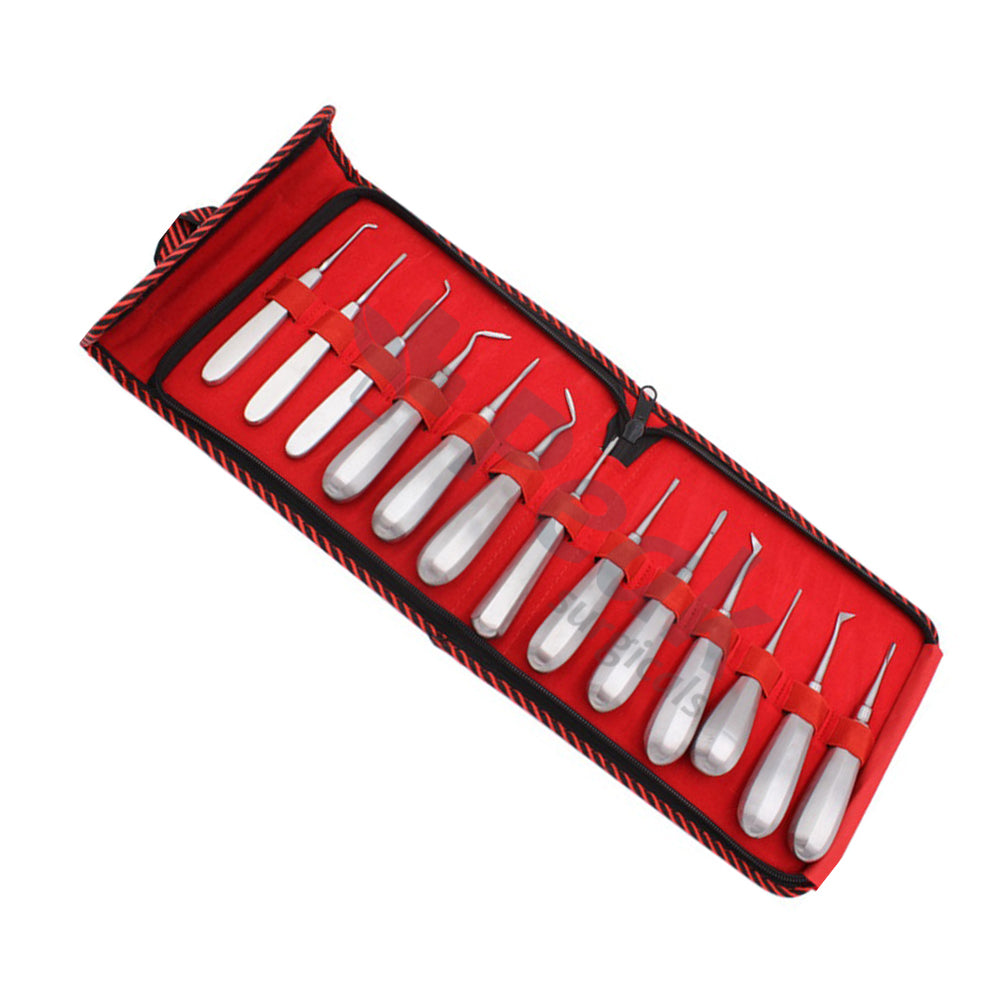
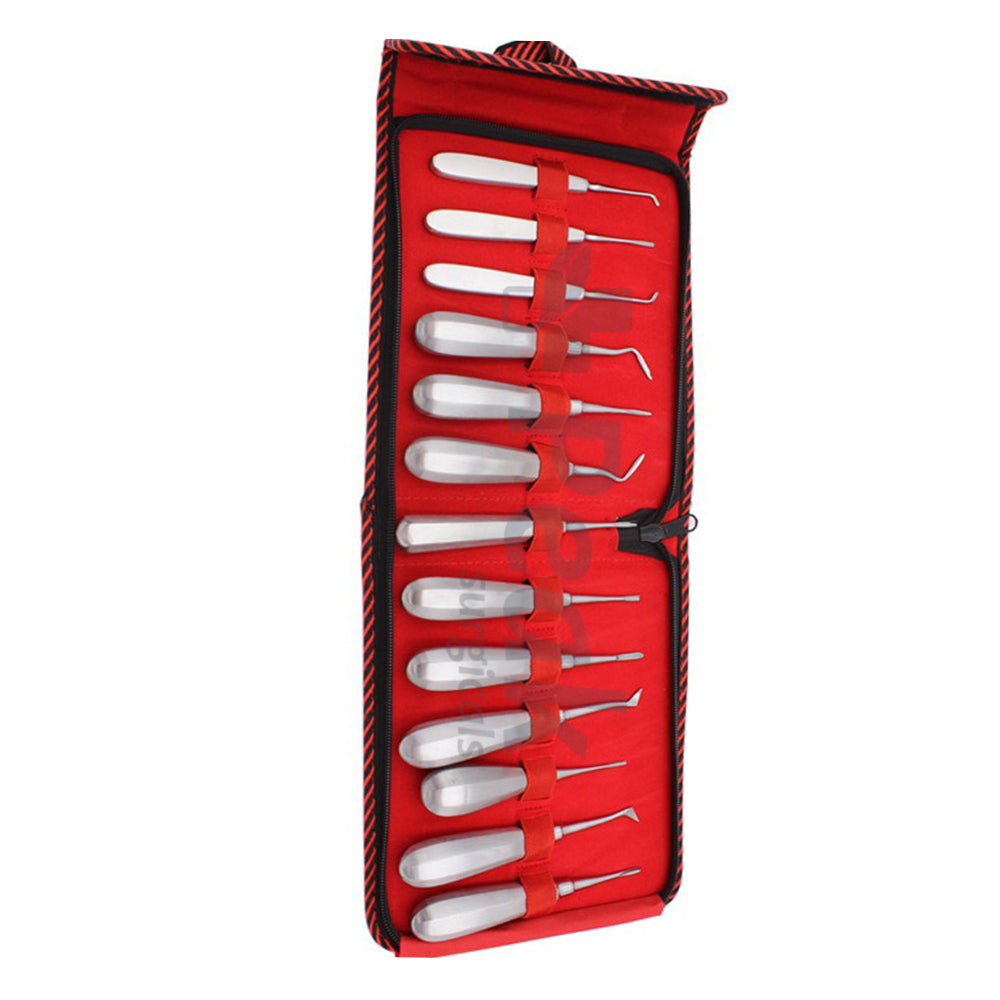
Dental Tooth Elevator Set (SKU: PS-DTES-00220) is a German stainless steel dental elevator kit for periodontal ligament separation, staged tooth loosening, retained root retrieval, apical fragment elevation, and controlled root mobilization during surgical exodontia. The visible configuration includes white-handled dental elevators arranged in a red zippered instrument case, with straight apical tips, curved shafts, angled terminal profiles, offset working ends, broad ribbed handles, slim stainless steel shanks, and fine root-access tips for anterior, premolar, molar, mesial, distal, buccal, lingual, and apical socket surfaces. It is used for closed extraction, open extraction, fractured crown management, retained apex removal, premolar extraction, molar root elevation, periodontal ligament release, posterior socket exploration, interradicular access, socket inspection, curettage preparation, irrigation, hemostasis, and mucosal closure. General dentists, oral surgeons, maxillofacial surgeons, hospital dental teams, dental residents, teaching laboratories, and procurement officers use this kit in dental clinics, oral surgery departments, operating rooms, extraction trays, and institutional dental units.
The Dental Tooth Elevator Set uses broad ribbed handles to transfer controlled hand pressure through slim shanks to fine apical working ends. The white handle profile gives the operator a stable palm-supported grip, while the longitudinal grooves improve tactile orientation when gloves contact saliva, blood, irrigation fluid, or dental debris. Straight tips enter accessible periodontal ligament spaces around incisors, canines, and premolars when the root surface aligns with the operator’s hand path. Curved shafts follow posterior socket anatomy and keep the handle clear of cheek tissue, adjacent crowns, and opposing dentition. Angled working ends reach distal root surfaces, lingual walls, buccal access points, and apical fragments where a straight elevator cannot keep its blade face seated against cementum. Each terminal tip is placed between cementum and alveolar bone, advanced with measured apical pressure, and rotated through short controlled movements to separate ligament fibers. This mechanical sequence creates root mobility before extraction forceps or root forceps complete final delivery.
Clinical use begins after radiographic assessment, anesthesia, sulcular release, crown evaluation, and extraction planning. During closed extraction, the straight elevator profile is introduced into the periodontal ligament space after gingival attachment release, then advanced along the root surface to begin mobility before forceps engagement. Curved profiles are selected around posterior premolars and molars because the shank follows the dental arch while maintaining handle clearance from cheek tissue and neighboring occlusal surfaces. During open exodontia, the surgeon reflects a mucoperiosteal flap, relieves buccal bone when required, sections multirooted teeth, and places an angled elevator tip against exposed cementum or a retained apical segment. Fractured crown cases require narrow tip access because forceps beaks cannot grasp a root remnant below the gingival margin. The set supports root-tip delivery, socket wall inspection, interradicular fragment access, localized ligament release, periapical exposure, lavage preparation, and final inspection before curettage and closure.
The instrument layout gives the clinician a controlled sequence across different tooth positions, root diameters, and socket corridors. Straight fine elevators are selected for incisors, accessible premolars, exposed roots, and socket sites aligned with the long axis of the root. Slightly curved working ends are selected for posterior premolars and molars where the shank needs to follow arch curvature while preserving visibility at the alveolar crest. More angulated tips are used around distal walls, lingual surfaces, apical fragments, and interradicular spaces after tooth sectioning. Narrow terminal ends create the first purchase point around retained apices and fractured root tips, while broader working faces develop mobility after the ligament interface opens. This sequence allows the surgeon to start with fine periodontal ligament entry, progress to controlled socket expansion, and complete delivery with forceps. In extraction tray workflow, these elevators bridge fine luxators and heavier wedge elevators by providing multiple access angles inside one organized case.
German stainless steel construction gives the elevator kit the rigidity required for root-surface tracking, apical purchase, socket-wall contact, and repeated clinical reprocessing. The material resists corrosion through cleaning, ultrasonic processing, steam sterilization, drying, and storage in dental surgery trays. Satin, dull, and mirror-finished surfaces support operative visibility and maintenance by reducing distracting reflection while allowing blood, saliva, and debris to be removed from exposed metal areas before packaging. The reusable Class I profile fits manually operated dental hand instruments used for nonpowered tooth loosening and root elevation. Autoclave compatibility supports return to extraction trays after decontamination, inspection, wrapping, sterilization, and dry storage. The red zippered case organizes the instruments for chairside selection, storage, and inventory control. CE marking, ISO 13485 certification, and FDA compliance support procurement documentation for dental clinics, hospitals, distributors, and institutional buyers. The one-year warranty, OEM availability, one-piece MOQ, carton-box packing, rust-free specification, and return and replacement service support standardized oral surgery tray purchasing.
| SKU | PS-DTES-00220 |
|---|---|
| Product Name | Dental Tooth Elevator Set |
| Price | $110.00 |
| Size/Gauge Variants | Multi-instrument elevator kit with straight, curved, angled, offset, fine apical, and broader root elevator working profiles |
| Instrument Category | Dental elevator kit |
| Procedure | Closed extraction, open extraction, surgical exodontia, retained root retrieval, fractured crown management, premolar extraction, molar root elevation, posterior socket access, periodontal ligament release |
| Material | German stainless steel |
| Finish | Satin, dull, and mirror finish |
| Sterilization | Reusable and autoclavable after standard instrument cleaning |
| Instrument Classification | Class I reusable dental hand instrument set |
| Reusable | Yes |
| Certifications | CE marked, ISO 13485 certified, FDA compliant |
| Warranty | 1 year |
| MOQ | 1 piece |
| OEM / Custom Orders | Available |
| After-Sale Service | Return and replacement support |
How does the Dental Tooth Elevator Set compare with a Coupland Elevator?
The Dental Tooth Elevator Set provides straight, curved, angled, and offset access profiles for staged root luxation. A Coupland Elevator has a broader wedge blade and is selected when the socket wall can accept stronger direct elevation. Coupland patterns deliver heavier wedge leverage after access has been created. This kit is stronger for retained roots, fractured apices, posterior socket access, and extraction sequences where the working angle changes across the procedure. Its fine apical tips enter the periodontal ligament space before broader force is applied. The Dental Tooth Elevator Set supports the fine-access phase of surgical exodontia before forceps delivery.
Which elevator profile is selected for anterior teeth, premolars, molars, and retained apices?
The Dental Tooth Elevator Set uses straight profiles for incisors, accessible premolars, and exposed root remnants aligned with the operator’s hand path. Curved profiles are selected for posterior premolars and molars because the shank follows the dental arch while clearing cheek tissue and adjacent crowns. Angled working ends are selected for distal walls, lingual root surfaces, buccal access points, and apical fragments. Fine terminal tips create the first purchase point around retained apices and fractured root ends. Broader working faces are used after early ligament release has created movement at the root-bone interface. Profile selection follows tooth position, socket depth, root diameter, access corridor, and the stage of luxation.
How do CE, ISO 13485, and FDA compliance support dental procurement?
The Dental Tooth Elevator Set supports procurement programs that require documented sourcing for reusable dental instruments. CE marking supports international conformity records for regulated purchasing environments. ISO 13485 certification supports manufacturing control, traceability, inspection consistency, and quality-system documentation. FDA compliance language supports USA-facing procurement files where device sourcing and supplier records are reviewed. These credentials help clinics, hospitals, distributors, and institutional buyers standardize extraction trays across multiple operators. The one-year warranty, OEM availability, MOQ of one piece, and return and replacement service support repeat purchasing and distributor planning.
How are the ribbed handles used during intraoperative tooth loosening?
The ribbed handles are held in a palm-supported grip with fingertip guidance near the neck of the selected elevator. The surgeon seats the working tip into the periodontal ligament space or against exposed cementum. Measured apical pressure advances the blade along the root surface, while short wrist rotation separates ligament fibers and begins socket expansion. The handle grooves improve grip and orientation when saliva, blood, or irrigation fluid reaches the glove surface. During posterior extraction, the curved or angled tip remains engaged while the handle clears the cheek and opposing arch. On the Dental Tooth Elevator Set, this control sequence prepares the tooth or root fragment for forceps delivery, curettage, irrigation, and socket inspection.
What role does this kit serve in an oral surgery extraction tray?
The Dental Tooth Elevator Set serves as a multi-profile root mobilization kit for dental extraction and surgical exodontia trays. It is placed with luxators, Coupland elevators, winged elevators, periosteal elevators, extracting forceps, root forceps, curettes, suction tips, mirrors, and needle holders. Before forceps application, the narrow working ends separate periodontal ligament fibers and create controlled mobility. During fractured crown management, the set develops purchase around root remnants that cannot be grasped directly. During open extraction, curved and angled profiles assist after flap reflection, bone removal, and tooth sectioning. Reusable German stainless steel construction and case organization support repeated tray cycling in dental clinics, hospital departments, and teaching laboratories.
