
Featured Collection
Your cart
Featured Collection

PEAK SURGICALS
SKU:
Couldn't load pickup availability
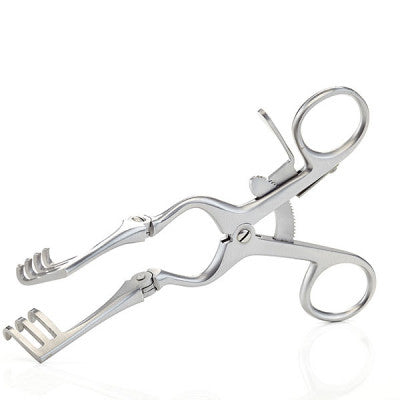
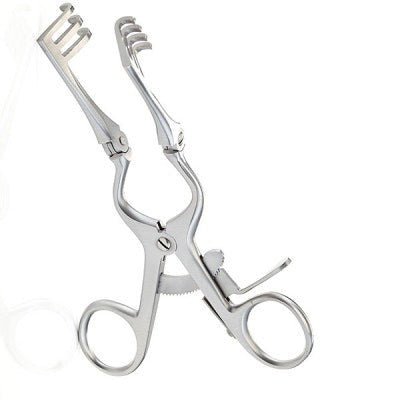
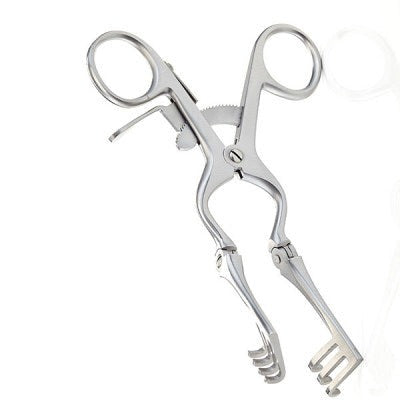
Beckman Weitlaner Retractor is a reusable veterinary self-retaining retractor designed for controlled skin, fascia, muscle, and wound-edge separation during small animal surgical procedures. The instrument combines Beckman-style working depth with Weitlaner-style self-retaining exposure, giving the surgeon a stable operative window without continuous manual retraction. It has finger-ring handles, curved arms, hinged rake-style pronged blades, a central pivot, ratchet locking arc, and release lever for hands-free tissue exposure. The pronged working ends help engage wound margins while the ratchet maintains selected spread during dissection, hemostasis, exploration, implant access, closure, or soft-tissue repair. It is used during veterinary orthopedic exposure, spinal access, trauma surgery, wound revision, mass excision, abscess exploration, tendon exposure, layered closure, and general soft-tissue procedures. Veterinary surgeons, small animal practitioners, teaching laboratories, hospitals, referral centers, and procurement teams use this pattern in surgical trays where stable self-retaining retraction is required.
The Beckman Weitlaner pattern works through opposing pronged blades that separate tissue as the finger-ring handles are closed. The central pivot transfers handle movement into blade spread, while the ratchet locking arc holds the selected opening without continuous assistant traction. Hinged blade necks allow the rake heads to adapt to the wound angle, supporting better contact with curved or uneven tissue margins. The pronged blades distribute traction across several contact points instead of concentrating all force at one edge. This helps maintain exposure during layered dissection, cautery, irrigation, implant placement, suture passage, and closure. The release lever disengages the ratchet when the surgeon needs to reduce tension, reposition the prongs, or remove the retractor. Curved arms keep the handles away from the immediate working field while maintaining mechanical leverage. This self-retaining mechanism is useful in veterinary procedures where both hands must remain free for the primary operative step and the wound window must remain stable.
Clinical use begins after incision placement, hemostasis, initial tissue separation, and assessment of the required exposure depth. During veterinary soft-tissue surgery, the retractor separates skin, subcutaneous tissue, fascia, and wound edges while the surgeon performs dissection, mass removal, abscess exploration, or layered closure. During orthopedic procedures, the pronged blades help maintain access around fascia, muscle, tendon sheath, periosteal exposure, fracture sites, and small joint approaches. In spinal and paraspinal work, the self-retaining lock supports stable retraction while deeper structures are approached with elevators, rongeurs, suction, hemostats, and needle holders. During trauma surgery and wound revision, the instrument keeps irregular wound margins open for debridement, inspection, lavage, and closure planning. The Beckman Weitlaner design is stronger than a small superficial retractor and more stable than manual skin hooks when continuous exposure is needed. It is selected when the surgical field requires firm, repeatable, hands-free tissue separation.
The Beckman Weitlaner Retractor is selected when the surgeon needs a self-retaining retractor with more working strength than compact Weitlaner patterns and more controlled exposure than handheld hooks. The hinged pronged blades are useful where tissue thickness, wound depth, or tissue recoil would make manual retraction inefficient. In veterinary trays, it supports procedures involving skin, fascia, muscle, tendon, orthopedic access, spinal exposure, and deep wound inspection. The instrument is commonly placed with scalpel handles, Metzenbaum scissors, Mayo scissors, hemostatic forceps, Adson forceps, tissue forceps, needle holders, suction tips, periosteal elevators, rongeurs, and suture material. Its ratchet mechanism allows the team to maintain one consistent field while the surgeon changes instruments. During placement, the prongs are seated into the wound margins, the handles are closed to the required spread, and the ratchet is allowed to hold the field. Repositioning follows tissue tension, exposure quality, depth, and the next procedural step.
Medical-grade German stainless steel construction gives the Beckman Weitlaner Retractor the rigidity required for repeated retraction, ratchet locking, hinged blade movement, and operating room reprocessing. The smooth stainless steel surface supports cleaning and inspection after contact with blood, fat, saline, tissue residue, and surgical debris. The reusable Class I profile fits manually operated veterinary surgical retractors used for nonpowered tissue separation. Autoclave compatibility supports return to orthopedic, soft-tissue, emergency, teaching, and general surgery trays after decontamination, brushing, joint inspection, drying, packaging, sterilization, and storage. During reprocessing, the prong spaces, hinged blade necks, pivot screw, ratchet teeth, and release lever should be checked for retained debris and mechanical alignment. CE marking, ISO 13485 certification, and FDA compliance support procurement documentation for veterinary clinics, hospitals, distributors, and institutional buyers. The reusable stainless steel construction, from $33.00 price point, and veterinary surgical application support tray standardization for repeated clinical use.
| SKU | Not listed on product page |
|---|---|
| Product Name | Beckman Weitlaner Retractor |
| Price | From $33.00 |
| Size/Gauge Variants | Product size selector listed; exact size labels not shown in available indexed page data |
| Instrument Category | Veterinary self-retaining surgical retractor |
| Procedure | Soft-tissue exposure, orthopedic access, spinal exposure, trauma surgery, wound revision, mass excision, tendon exposure, layered closure |
| Material | Medical-grade German stainless steel |
| Working End | Hinged rake-style pronged blades |
| Handle | Finger-ring self-retaining handle with ratchet lock and release lever |
| Sterilization | Reusable and autoclavable after standard instrument cleaning |
| Instrument Classification | Class I reusable veterinary surgical hand instrument |
| Reusable | Yes |
| Certifications | CE marked, ISO 13485 certified, FDA compliant |
| Warranty | 1 year |
| MOQ | 1 piece |
What is the Beckman Weitlaner Retractor used for? Beckman Weitlaner Retractor is used to retract skin, fascia, muscle, and wound edges during veterinary surgery. Its self-retaining ratchet holds the operative field open while the surgeon performs dissection, hemostasis, exploration, orthopedic access, spinal exposure, wound revision, or closure. The hinged pronged blades provide stable engagement in tissue planes where handheld retraction would require continuous assistance.
How does the ratchet locking mechanism support surgical exposure? The ratchet locking mechanism holds the selected blade spread after the finger-ring handles are closed. Once engaged, the retractor maintains tissue separation without continuous manual traction. This keeps the surgeon’s hands free for the main operative step and maintains a consistent wound window during dissection, lavage, cautery, implant access, or suturing. The release lever disengages the lock when the instrument must be repositioned or removed.
How does this retractor compare with a standard Weitlaner Retractor? Beckman Weitlaner Retractor provides stronger and deeper self-retaining exposure than smaller standard Weitlaner patterns. The Beckman-style arm geometry and hinged pronged blades support larger wound margins, deeper tissue planes, and firmer retraction needs. Standard Weitlaner retractors remain useful for superficial procedures and compact incisions, while Beckman Weitlaner patterns are selected when a wider, more stable, hands-free field is required.
What instruments are commonly used with a Beckman Weitlaner Retractor? Beckman Weitlaner Retractor is commonly used with scalpel handles, Metzenbaum scissors, Mayo scissors, hemostatic forceps, Adson forceps, tissue forceps, needle holders, suction tips, periosteal elevators, rongeurs, orthopedic instruments, and suture material. The retractor maintains exposure while those instruments complete dissection, tissue handling, hemostasis, bone or soft-tissue access, and layered closure.
How should the retractor be cleaned and inspected? After use, the retractor should be cleaned before debris dries around the prongs, hinge joints, pivot screw, ratchet teeth, and release lever. The prong spaces should be brushed carefully, and the hinged blade heads should move freely after cleaning. The ratchet should lock and release smoothly before packaging. German stainless steel construction supports autoclaving after full cleaning, drying, and inspection according to the facility reprocessing workflow.
