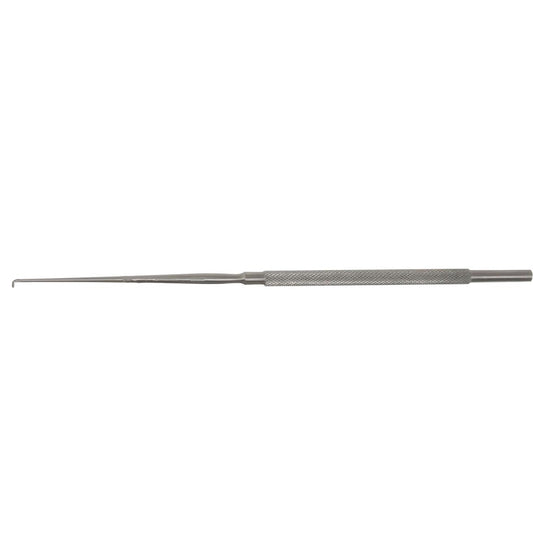
Cardiovascular hooks do the work a forceps tip cannot: they slip under a vessel, nerve, or tissue plane and lift it clear without a grasping jaw touching either side. Peak Surgicals stocks three patterns here: Crile Single Hook (PS-8156, $8.58), Crile Hook and Dissector (PS-8154, $5.83), and Adson Blunt Dissecting Hook (PS-8155, $6.60), all in German stainless steel and CE-marked and built under ISO 13485. Compare all three patterns in the grid below.
Why Use a Hook Instead of Forceps?
A hook works by contact area rather than pressure: the blunt tip presents a curved surface that slides along a tissue plane, so the structure is lifted on the curve instead of pinched between two jaws. That is why hooks are used where a forceps would risk crushing, around nerves, small vessels, and dura.
Crile Single Hook (PS-8156, $8.58) carries one hook at the working end for straightforward retraction and mobilisation. Crile Hook and Dissector (PS-8154, $5.83) is double-ended, pairing a hook with a dissector tip so a single instrument handles both lifting and blunt separation without the surgeon swapping. Both trace to George Washington Crile, the Cleveland Clinic founder whose work on surgical shock and transfusion shaped early cardiovascular practice. We supply every pattern at MOQ 1.
Crile and Adson Patterns: Reach and Tip Profile
Crile and Adson patterns differ in tip profile and reach rather than in principle. Crile hooks are the longer-reach instruments, built for open chest and deep vessel work where the hand stays outside the field. Adson Blunt Dissecting Hook (PS-8155, $6.60) is the shorter, finer pattern, developed by Mayo Clinic neurosurgeon Alfred Washington Adson for dura and delicate tissue elevation, and it carries into cardiovascular sets wherever a small blunt tip is needed close to the surface.
The blunt tip is the point of both patterns. A sharp hook holds better but perforates what it holds, which is unacceptable against vessel wall or nerve sheath. Blunt tips trade some grip for the certainty that the structure lifts intact, and in cardiovascular work that trade is not optional.
Material, Reprocessing and Certification
All three patterns are forged from German stainless steel and passivated for corrosion resistance across repeated cycles. The inspection point on a hook is the tip and the shaft junction: check the tip for burrs or flattening that would turn a blunt profile sharp, and flex the shaft lightly to confirm no play at the joint. Clean immediately after use with a neutral-pH enzymatic solution, working into the hook curve where tissue collects, then rinse with deionised water and dry fully before autoclaving at 134°C.
These are Class I reusable devices, CE marked and built under ISO 13485, with a one-year manufacturing warranty. We ship at MOQ 1 with free shipping over $99, and OEM and private-label production is available for distributors. For atraumatic thumb forceps, see Cardiovascular Dissecting Forceps; for ratcheted patterns, see Cardiovascular Forceps, or browse the full Cardiovascular Instruments range. Talk to us about OEM and volume terms.