
Featured Collection
Your cart
Featured Collection

PEAK SURGICAL
SKU:PS-OT-0501
Couldn't load pickup availability
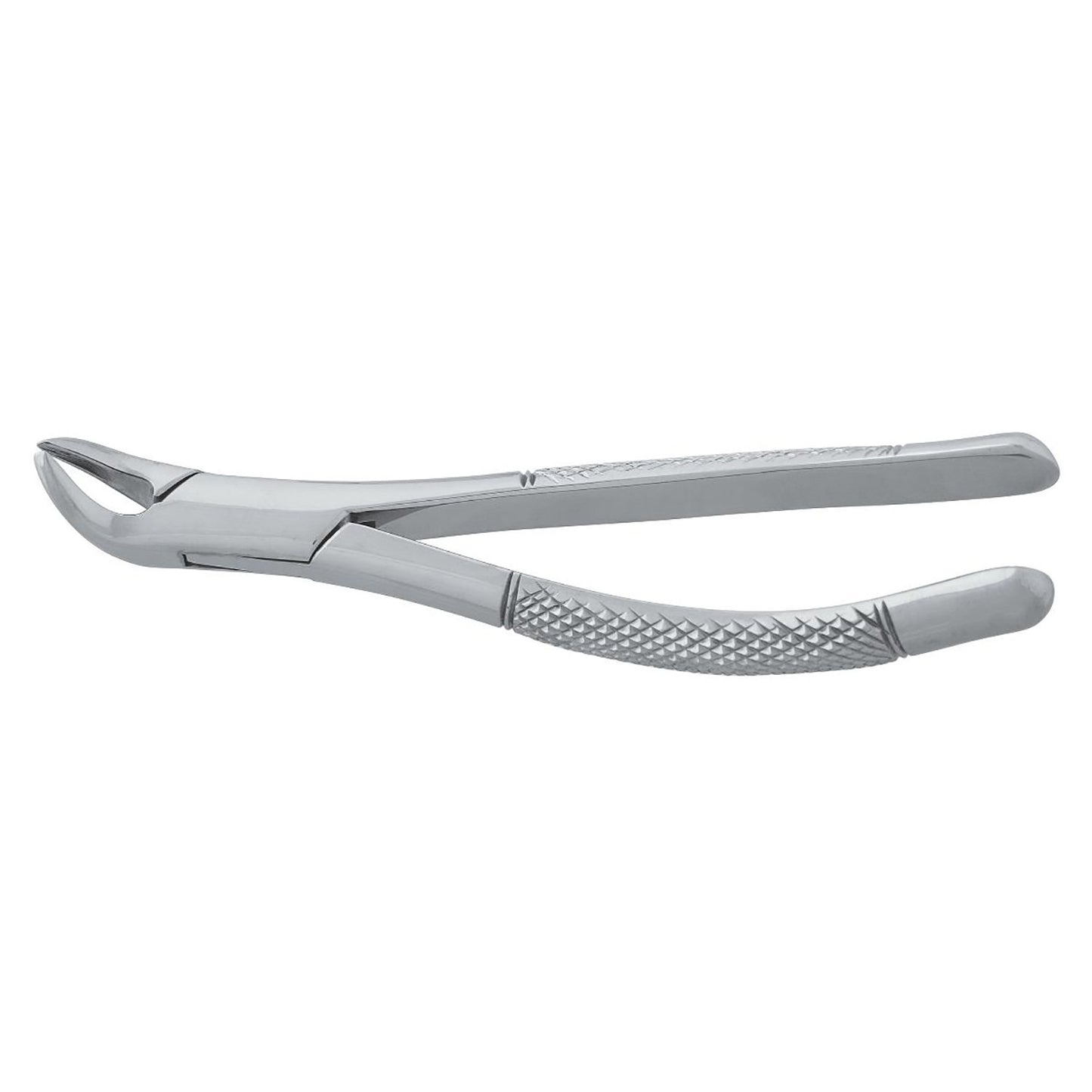


The Lower Forceps (PS-6908 series) is a range of three German stainless steel mandibular dental extraction forceps identified by internationally standardized pattern numbers — No. 74N (PS-6908), No. 74XN (PS-6909), and No. 151S (PS-6910) — each designed for extraction of teeth in the lower (mandibular) dental arch, with beak geometry specific to each pattern's designated tooth indications. All three patterns share the fundamental lower forceps design characteristic: the beaks are angled relative to the handle to allow the operator to apply force along the long axis of lower teeth from an ergonomic working position above the mandible, without requiring the handle to pass into the patient's bite plane. The No. 74N features a narrow beak profile for lower premolars and narrower-rooted anterior teeth; the No. 74XN provides an extended geometry for the same tooth group with additional reach for deeper or more posterior mandibular access; and the No. 151S features serrated, broader beaks suited to lower anterior teeth and premolars where the increased beak surface area and serration improve grip on a wider range of root profiles. Manufactured from German stainless steel for the structural strength required to transmit extraction forces through the beak-hinge-handle assembly without deformation, and for the corrosion resistance required of instruments that undergo repeated steam autoclave sterilization. Used by dentists, oral surgeons, and maxillofacial surgeons in dental clinics, oral surgery units, and hospital dental departments. Sold as 1 piece per pattern selected, at $6.60.
The No. 74N is a lower universal forceps with narrow beaks — the "N" designation in the pattern name indicates the narrow beak profile that distinguishes it from broader-beaked lower forceps patterns. This narrow beak geometry is specifically suited to the root dimensions of mandibular premolars, which are typically single-rooted with a root diameter and root trunk profile that a narrower beak engages more effectively than a broader beak would: a beak that is proportionally narrower than the root can seat further apically along the root surface, below the cervical margin and down toward the root's mid-third, providing a deeper and more mechanically secure grip than a beak so wide that it contacts the cervical enamel rather than the root surface below. Mandibular premolars — the first and second premolars in the lower arch — are among the most commonly extracted teeth in dental practice, and the No. 74N is a standard instrument in a comprehensive mandibular extraction forceps set for precisely this reason. The No. 74N can also be applied to lower canines and incisors where the root profile is compatible with the narrow beak dimensions, providing a versatile lower anterior and premolar extraction instrument in a single pattern. The handle design, with beaks angled relative to the handle in the plane that allows the operator to seat the beaks along the long axis of the lower arch teeth from a superior approach, is characteristic of all lower forceps patterns and distinguishes them from upper forceps designs.
The No. 74XN is a modified version of the No. 74N design, with the "X" indicating an extended geometry — a modified handle length, additional shank extension, or altered angulation that provides greater reach for accessing teeth in the more posterior regions of the mandibular arch, or for patients whose anatomy or degree of mouth opening makes the standard No. 74N handle geometry more difficult to position correctly. The beak profile of the No. 74XN retains the "N" (narrow) specification, making it suited to the same tooth indications as the No. 74N — lower premolars, canines, and narrow-rooted anterior teeth — but with the extended geometry providing additional instrument reach or an altered approach angle that is advantageous in specific clinical circumstances. Situations where an extended lower forceps variant provides a genuine clinical advantage include patients with a deep, steep mandibular arch where the posterior premolars sit at a significant depth below the operator's access point; patients with a limited mouth opening that restricts the approach angle available for a standard-length handle; and operators who find the extended handle of the No. 74XN provides better force control and leverage for their specific hand size and grip style during mandibular premolar extractions. The No. 74XN is therefore not a replacement for the No. 74N but a complement to it, available for cases where the extended geometry of the "X" variant provides a specific advantage over the standard configuration.
The No. 151S is among the most widely used mandibular extraction forceps patterns in dental and oral surgical practice internationally, and its inclusion in the Lower Forceps range reflects its status as a near-essential instrument in a comprehensive extraction forceps set. The "151" pattern number identifies a lower universal forceps design with a distinctive beak geometry — broader than the 74N series — suited to a wider range of mandibular tooth profiles, from lower incisors through premolars and in some configurations to accessible lower molar root trunks where the socket morphology permits a universal approach. The "S" suffix in No. 151S designates serrated beak surfaces — the inner gripping surfaces of the beaks have a fine serration pattern machined into them, which increases the coefficient of friction between the beak surface and the tooth's root surface during extraction. This serration provides a more secure grip on the tooth during the sustained rocking and delivery forces of extraction, reducing the risk of the beak slipping off the root at a critical moment during the procedure — a risk that is particularly relevant for lower anterior and premolar extractions where the root surface may be smooth and tapered, offering less natural mechanical purchase than a furcated molar root. The broader beak profile of the No. 151S compared to the No. 74N series means it engages a larger surface area of the root when seated, distributing extraction forces across a broader contact zone and potentially reducing the risk of root fracture from concentrated beak-on-root contact at a single point.
Lower (mandibular) extraction forceps have a fundamentally different design geometry from upper (maxillary) forceps, reflecting the different approach angles required to engage lower teeth from the operator's working position above and behind the patient. For upper teeth, the operator directs force downward and can hold the handle with the wrist in a relatively neutral position. For lower teeth, the operator needs to direct force upward into the root of the lower teeth, and a forceps designed with its beaks in line with the handle — as an upper forceps would be — would require the operator to invert their wrist into an anatomically extreme position to seat the beaks correctly along the lower root axis. Lower forceps address this by angling the beaks relative to the shank and handle, so that when the handle is held in an ergonomically accessible position with the operator's hand positioned at or above the patient's occlusal plane, the beaks point in the correct direction to engage the lower tooth along its long axis. All three patterns in this Lower Forceps range — No. 74N, No. 74XN, and No. 151S — incorporate this fundamental lower forceps beak-to-handle angulation, and none should be used for upper teeth, where the beak geometry would present in the wrong orientation relative to the maxillary root axis.
All three Lower Forceps patterns are manufactured from German stainless steel, providing the structural strength and corrosion resistance required of reusable dental extraction instruments. The hinge mechanism, which transmits the greatest mechanical load during extraction, should be inspected at each reprocessing cycle for wear, looseness, or deformation — a hinge that has become loose or asymmetric in its pivot affects the symmetry of beak closure and the accuracy of force transmission to both beaks equally during extraction. For the No. 151S specifically, the serrated beak surfaces should be inspected at each reprocessing cycle for any wear or dulling of the serration pattern, as a worn serration provides progressively less grip enhancement compared to a newly manufactured instrument; re-serration is not typically performed in the field, so significant serration wear is grounds for instrument replacement. All three patterns are fully compatible with steam autoclave sterilization at 134°C pre-vacuum parameters, with ultrasonic cleaning recommended before terminal sterilization for thorough debris removal from the hinge area and beak surfaces. Available in satin, dull, or mirror surface finish.
The Lower Forceps (PS-6908, PS-6909, PS-6910) are manufactured under a quality management system certified to ISO 13485, governing German stainless steel material sourcing, precision forging and machining of the forceps shanks, beaks, and hinge mechanisms across all three pattern numbers, dimensional and functional inspection of beak geometry and angulation for each pattern's mandibular tooth indication, surface finishing, and packaging. CE Mark certification confirms conformity with European Medical Device Regulation requirements for Class I reusable dental surgical instruments distributed within EU and associated regulatory territories. FDA compliance documentation is maintained for United States distribution, satisfying regulatory requirements for reusable dental extraction instruments procured by US dental clinics, oral surgery units, and dental instrument distributors. These certifications satisfy procurement and tender documentation requirements of institutional buyers in the USA, India, Pakistan, Vietnam, and across international dental instrument supply frameworks. Certificates of conformity and quality management system documentation are available on request. OEM manufacturing is available within the same certified manufacturing framework.
| SKU (Storefront) | PS-OT-0501 |
|---|---|
| Model Number (Base) | PS-6908 |
| Product Name | Lower Forceps |
| Price | $6.60 USD per piece |
| Arch | Mandibular (lower) — all three patterns |
| No. 74N (PS-6908) | Narrow beak lower forceps — mandibular premolars and narrow-rooted anterior teeth |
| No. 74XN (PS-6909) | Extended narrow lower forceps — same indications as No. 74N with extended geometry for deeper posterior mandibular access |
| No. 151S (PS-6910) | Serrated beak lower universal forceps — mandibular anterior and premolar teeth; broader beak with serrated gripping surfaces for improved root purchase |
| Beak Design | No. 74N: Narrow, smooth; No. 74XN: Extended narrow, smooth; No. 151S: Broader, serrated |
| Handle Geometry | Mandibular (lower) forceps angulation — beaks angled to align with lower tooth long axis from superior approach |
| Instrument Classification | Class I Reusable Dental Surgical Instrument |
| Primary Indications | Mandibular premolar and anterior tooth extraction across all three patterns; No. 151S additionally suited to a broader range of lower tooth root profiles |
| Clinical Setting | Dental clinic, oral surgery unit, hospital dental department |
| Users | Dentists, oral surgeons, maxillofacial surgeons |
| Material | German Stainless Steel |
| Surface Finish | Satin / Dull / Mirror |
| Certifications | CE Mark, ISO 13485, FDA |
| Reusability | Reusable |
| Quantity | 1 Piece per pattern selected |
| Rust Resistance | Yes |
| Warranty | 1 Year |
| MOQ | 1 Piece |
| OEM / Custom Orders | Available |
| Packing | Carton Box |
| Place of Origin | Pakistan |
| Brand | Peak Surgicals |
| Primary Use | Mandibular dental extraction — select No. 74N (narrow beak), No. 74XN (extended narrow), or No. 151S (serrated universal) based on tooth type and access requirement |
| After-Sale Service | Return and Replacement |
What is the difference between No. 74N, No. 74XN, and No. 151S, and how do I select the correct pattern?
All three are mandibular (lower arch) extraction forceps, but they serve different tooth indications and access scenarios. The No. 74N (PS-6908) has a narrow beak profile — the "N" denotes narrow — suited to mandibular premolars and narrow-rooted lower anterior teeth, where a narrower beak can seat further apically below the cervical margin for a deeper, more secure root grip. The No. 74XN (PS-6909) retains the narrow beak of the No. 74N but adds an extended geometry, providing additional reach for accessing premolars in deeper or more posterior mandibular positions, or for operators whose hand size or grip style benefits from the extended handle proportions. These two are closely related in indication — the choice between them depends on anatomy and operator preference rather than tooth type. The No. 151S (PS-6910) is a different design: broader beaks with serrated inner surfaces, suited to a wider range of lower tooth profiles including lower anterior teeth and premolars where the broader beak surface area and serration improve grip, particularly on smooth, tapered single roots. A dental practice equipping for routine mandibular extractions would typically stock all three to cover the range of lower tooth sizes and root profiles encountered across a mixed caseload.
Why do lower forceps look different from upper forceps, and why can't they be used interchangeably?
Lower (mandibular) and upper (maxillary) extraction forceps have fundamentally different handle-to-beak geometries because the approach direction from the operator's working position is different for each arch. For lower teeth, the operator approaches from above, and the forceps beaks must point upward and slightly inward to engage the lower root along its long axis from this approach position. A lower forceps achieves this by angling the beaks at approximately 90 degrees to the handle, so that when the handle is held horizontally or at a slight downward angle in front of the operator's body, the beaks point upward toward the lower tooth roots. An upper forceps has its beaks more closely aligned with the handle, because the approach to upper teeth from above places the handle and beaks in a more linear relationship. Using a lower forceps on an upper tooth, or vice versa, would present the beaks at the wrong angle relative to the root long axis of the tooth being treated, preventing proper beak seating and directing extraction forces at an incorrect angle that increases the risk of root fracture, beak slippage, and injury to adjacent structures. Lower forceps are designed specifically for mandibular use and should only be used for lower arch extractions.
What is the significance of the "S" (serrated) designation in No. 151S?
The "S" in No. 151S designates serrated beak surfaces — the inner gripping surfaces of the beaks have a fine machined serration that increases friction between the beak and the tooth's root surface during extraction. Smooth beak surfaces, as on the No. 74N and No. 74XN, rely on the compression of the beak against the root to maintain grip, which is generally sufficient for most extractions where the beak is well-seated apically. Serrated beaks provide additional mechanical grip, which is particularly beneficial for lower anterior and premolar teeth with smooth, tapered single roots that offer less natural mechanical interlocking with a smooth beak surface. The serration reduces the risk of the beak slipping along the root surface during the sustained rocking and delivery forces of extraction — a slip that, at a critical moment, can result in loss of purchase on the tooth and inadvertent contact with adjacent teeth or soft tissue. The trade-off is that serrated beaks can leave micro-impressions on the root surface if applied with excessive pressure, though for extraction purposes this is clinically insignificant since the tooth is being removed. For the same reason, serrated beaks are not recommended for surgical procedures where the extracted tooth is being reimplanted or stored for replantation.
What sterilization protocol is recommended, and what should be inspected for each pattern?
All three Lower Forceps patterns are fully compatible with steam autoclave sterilization at 134°C pre-vacuum parameters. Ultrasonic cleaning before terminal sterilization is recommended for thorough removal of blood, tissue debris, and bone fragments from the hinge area and beak surfaces. At each reprocessing cycle, the hinge should be inspected for smooth, secure pivot action — a loose or binding hinge affects the symmetry of beak closure and force transmission during extraction. For the No. 74N and No. 74XN, the narrow beak edges should be inspected for any deformation or roughness; for the No. 151S specifically, the serration pattern on the beak inner surfaces should be checked for wear or dulling — a significantly worn serration provides reduced grip enhancement and may indicate the instrument has reached the end of its serviceable life for serration-dependent applications. Any instrument showing hinge looseness, beak damage, or shank deformation should be removed from clinical service.
What certifications do these instruments carry, and are bulk or OEM orders available?
The Lower Forceps (PS-6908, PS-6909, PS-6910) are manufactured under an ISO 13485-certified quality management system covering German stainless steel material procurement, precision forging and machining of the forceps shanks, beaks, and hinge across all three pattern numbers, and packaging. CE Mark certification confirms conformity with European Medical Device Regulation requirements for Class I reusable dental surgical instruments. FDA compliance documentation supports United States distribution. Certificates of conformity are available on request for dental practice procurement and tender documentation. Bulk orders are accepted with a minimum of 1 piece per pattern, with volume pricing available for dental clinics, oral surgery units, hospital dental departments, and dental instrument distributors. Dental practices routinely order all three patterns together to cover the full range of mandibular premolar and anterior extraction scenarios in a single procurement. OEM manufacturing for custom pattern configurations or private-label branding is available within the same ISO 13485-certified framework. Free shipping applies on orders of $99 or more.


