
Featured Collection
Your cart
Featured Collection

PEAK SURGICALS
SKU:PS-OP-02675
Couldn't load pickup availability


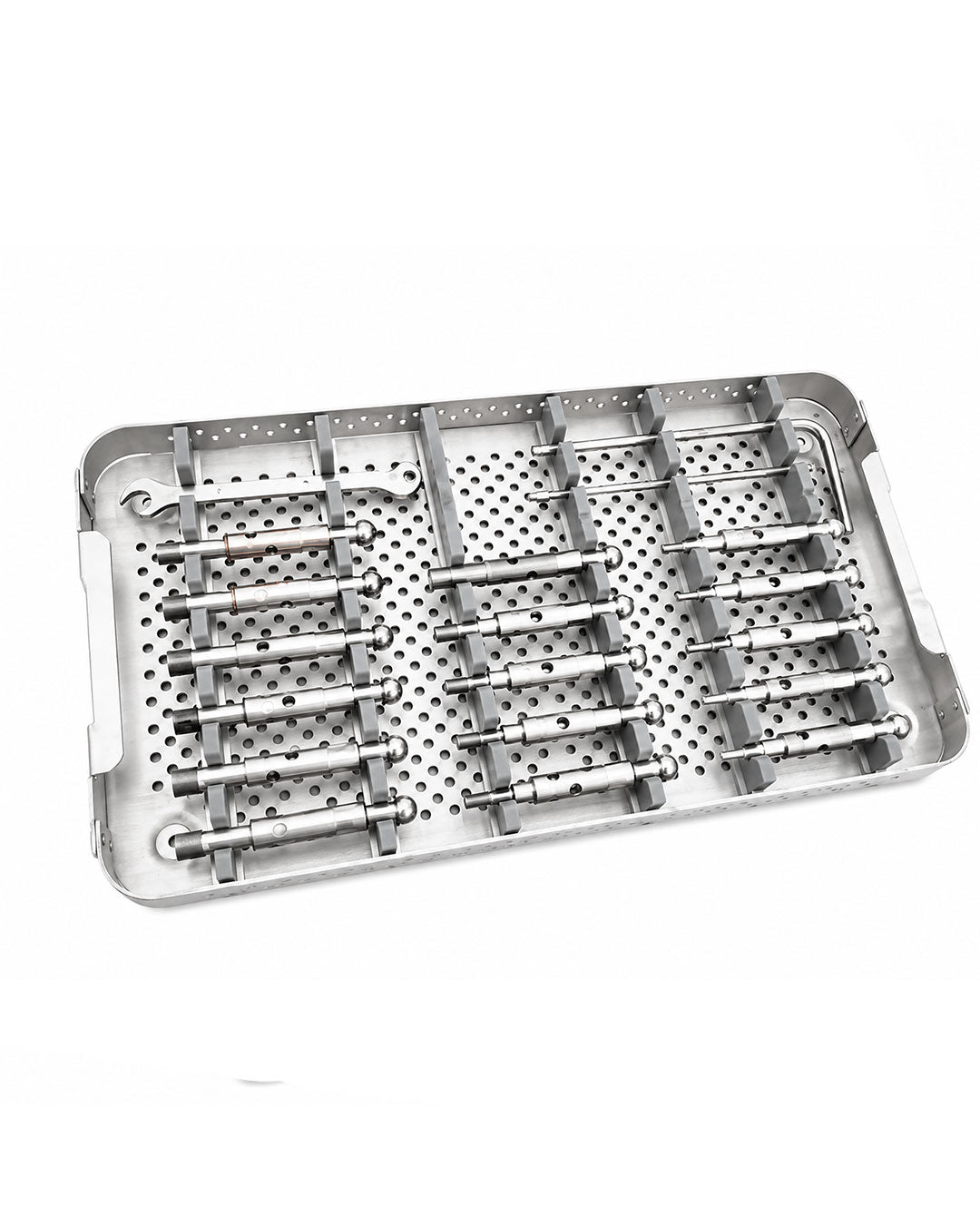
Broken Nail Removal Instruments Set Q-Series – 34-Piece Fractured Nail Fragment Extraction System, PS-675 Series, SKU PS-OP-02675, is a reusable orthopedic revision system manufactured from German stainless steel for removing fractured intramedullary nail components. The 34 instruments comprise M1 × 3.5, taper 1 × 3.5, M2 × 5, taper 2 × 5, M3 × 6, M4 × 7, M5 × 8, M6 × 9, left-handed M7 × 10, M8 × 11, M9 × 12, M10 × 10, M11 × 12, M12 × 11, M13 × 7, and taper 3 × 9 connecting rods; L-type, L-type hexagon, and open-end wrenches; left- and right-hand PFNA blade screwdrivers; SW2.5, SW3.0, SW3.5, SW4.0, SW4.5, SW5.0, SW7.0, and SW8.0 × 150 mm hex shafts; a blade extractor; extractor; connecting-rod handle; T-type quick-coupling handle; and cylindrical sliding hammer. One empty container completes the 35 catalogued units. Orthopedic trauma and revision surgeons use this configuration for broken femoral, tibial, and humeral nail retrieval, locking-screw disengagement, PFNA blade removal, and revision associated with implant fatigue, delayed union, or nonunion in hospital trauma centers and specialist reconstruction theatres.
The extraction sequence converts rotational purchase inside a fractured nail into controlled axial force. A selected connecting rod is introduced through the original entry corridor and engaged with the accessible internal bore or compatible threaded interface of the retained fragment. Parallel metric and tapered profiles provide alternative contact geometries: straight threaded rods mate with a corresponding internal connection, while tapered patterns develop progressive contact where the fractured opening is irregular. The M7 × 10 mm left-handed option supplies opposite-direction engagement for a matching interface or a situation in which the conventional direction releases purchase. The connecting-rod handle transmits rotation during seating, and the T-type quick-coupling handle permits attachment, detachment, and torque application without changing the established axis. Q.675.61 joins the engaged rod to the extraction train. Once locking elements and any PFNA blade are removed, the cylindrical sliding hammer travels along its shaft and impacts the stop, delivering repeated longitudinal impulses to mobilize the retained segment. The blade extractor grips the helical blade assembly, whereas the left- and right-hand PFNA drivers address the two thread directions encountered during blade disengagement. L-type, hexagonal, and open-end wrenches counterhold or release nuts, end caps, and coupling interfaces before traction begins.
In revision of a fractured femoral or tibial intramedullary nail, fluoroscopy defines the break level, retained locking screws, fragment length, and relationship to the original entry portal. The appropriate SW2.5–SW8.0 shaft disengages locking screws before axial extraction so the implant is not tethered to cortical bone. An L-type, hexagonal, or open-end wrench releases the accessible end cap or coupling hardware. For proximal femoral nail antirotation constructs, the matching left- or right-thread PFNA driver unlocks the blade, and the dedicated blade extractor removes it from the femoral neck before nail traction. The proximal nail segment is addressed through its accessible extraction interface. For the distal remnant, the surgeon selects a connecting rod against the implant’s documented bore geometry, advances it along the medullary canal, establishes threaded or tapered purchase, then joins Q.675.61, Q.675.63, and Q.675.65. The sliding hammer applies coaxial reverse impact while imaging monitors fragment migration and osseous response. In humeral nail revision, the same principle is used through the shoulder or elbow entry route defined by the original implant. The set supports implant-removal stages; fracture stabilization, canal debridement, grafting, and definitive reconstruction require separate procedure-specific systems.
The connecting sequence contains Q.675.01 M1 × 3.5 mm, Q.675.03 taper 1 × 3.5 mm, Q.675.05 M2 × 5 mm, Q.675.07 taper 2 × 5 mm, Q.675.09 M3 × 6 mm, Q.675.11 M4 × 7 mm, Q.675.13 M5 × 8 mm, Q.675.15 M6 × 9 mm, Q.675.17 left-handed M7 × 10 mm, Q.675.19 M8 × 11 mm, Q.675.21 M9 × 12 mm, Q.675.23 M10 × 10 mm, Q.675.25 M11 × 12 mm, Q.675.27 M12 × 11 mm, Q.675.29 M13 × 7 mm, and Q.675.31 taper 3 × 9 mm. Selection follows the nail’s internal connection and available purchase, with tapered profiles reserved for compatible irregular openings. Q.675.43 through Q.675.57 provide SW2.5, SW3.0, SW3.5, SW4.0, SW4.5, SW5.0, SW7.0, and SW8.0 drivers, each 150 mm long, for matched screw recesses. Q.675.33, .35, and .37 supply L-type, hexagonal, and open-end wrench interfaces. Q.675.39 and .41 address opposing PFNA blade threads; .59 withdraws the blade; .61 transfers traction; .63 seats the rod; .65 provides T-handle control; .67 supplies sliding impact; and .000 stores the complete configuration.
German stainless steel gives the threaded rods, driver shafts, wrenches, couplings, extractor, and impact assembly the torsional strength, hardness, corrosion resistance, and dimensional stability required for repeated orthopedic revision use. A satin instrument finish limits glare under operating lights and supports visual examination of thread crests, hex corners, coupling shoulders, and the sliding-hammer impact surfaces. The set is reusable and supplied non-sterile. After use, staff should separate detachable parts, remove gross soil before it dries, brush threaded profiles, flush joints and recesses, process the instruments through the validated manual or automated cleaning workflow, rinse, dry, inspect, package, and steam sterilize according to the applicable instructions for use and healthcare-facility protocol. Any connecting rod with flattened threads, shaft deformation, corrosion, or impaired coupling should be removed from circulation. CE documentation addresses applicable European conformity requirements, while ISO 13485 identifies the medical-device quality-management system governing manufacture and traceability. For United States purchasing, FDA procurement review concerns the applicable establishment registration, device listing, labeling, importer, and market-access records; CE and ISO 13485 do not constitute FDA approval. Hospitals and distributors should retain current declarations, reprocessing instructions, warranty terms, and component records in the vendor file.
| Q.675 Broken Nail Removal Instruments Set Q-Series | Set Consisting of | Units |
|---|---|---|
| Q.675.01 | Connecting Rod, M1 × 3.5 mm | 1 |
| Q.675.03 | Connecting Rod, Taper 1 × 3.5 mm | 1 |
| Q.675.05 | Connecting Rod, M2 × 5 mm | 1 |
| Q.675.07 | Connecting Rod, Taper 2 × 5 mm | 1 |
| Q.675.09 | Connecting Rod, M3 × 6 mm | 1 |
| Q.675.11 | Connecting Rod, M4 × 7 mm | 1 |
| Q.675.13 | Connecting Rod, M5 × 8 mm | 1 |
| Q.675.15 | Connecting Rod, M6 × 9 mm | 1 |
| Q.675.17 | Connecting Rod, M7 × 10 mm, Left-Handed | 1 |
| Q.675.19 | Connecting Rod, M8 × 11 mm | 1 |
| Q.675.21 | Connecting Rod, M9 × 12 mm | 1 |
| Q.675.23 | Connecting Rod, M10 × 10 mm | 1 |
| Q.675.25 | Connecting Rod, M11 × 12 mm | 1 |
| Q.675.27 | Connecting Rod, M12 × 11 mm | 1 |
| Q.675.29 | Connecting Rod, M13 × 7 mm | 1 |
| Q.675.31 | Connecting Rod, Taper 3 × 9 mm | 1 |
| Q.675.33 | L-Type Wrench | 1 |
| Q.675.35 | L-Type Hexagon Wrench | 1 |
| Q.675.37 | Open-End Wrench | 1 |
| Q.675.39 | PFNA Blade Screwdriver, Left-Hand Thread | 1 |
| Q.675.41 | PFNA Blade Screwdriver, Right-Hand Thread | 1 |
| Q.675.43 | Hex Screwdriver Shaft, SW2.5 × 150 mm | 1 |
| Q.675.45 | Hex Screwdriver Shaft, SW3.0 × 150 mm | 1 |
| Q.675.47 | Hex Screwdriver Shaft, SW3.5 × 150 mm | 1 |
| Q.675.49 | Hex Screwdriver Shaft, SW4.0 × 150 mm | 1 |
| Q.675.51 | Hex Screwdriver Shaft, SW4.5 × 150 mm | 1 |
| Q.675.53 | Hex Screwdriver Shaft, SW5.0 × 150 mm | 1 |
| Q.675.55 | Hex Screwdriver Shaft, SW7.0 × 150 mm | 1 |
| Q.675.57 | Hex Screwdriver Shaft, SW8.0 × 150 mm | 1 |
| Q.675.59 | Blade Extractor | 1 |
| Q.675.61 | Extractor, Connected to Connecting Rod Handle Q.675.63 | 1 |
| Q.675.63 | Connecting Rod Handle | 1 |
| Q.675.65 | Quick-Coupling Handle, T-Type | 1 |
| Q.675.67 | Sliding Hammer, Cylindrical | 1 |
| Q.675.000 | Empty Container | 1 |
| SKU | PS-OP-02675 |
|---|---|
| Product Name | Broken Nail Removal Instruments Set Q-Series |
| Price | $2,035.00 USD |
| Size/Gauge Variants | Sixteen connecting rods from M1 × 3.5 mm through M13 × 7 mm, including three taper profiles and left-handed M7 × 10 mm; eight SW2.5–SW8.0 × 150 mm hex shafts |
| Instrument Category | Orthopedic implant-removal and revision instrument set; 34 instruments plus one container |
| Procedure | Fractured femoral, tibial, and humeral intramedullary nail extraction; PFNA blade and locking-screw removal |
| Material | German stainless steel instruments with aluminium storage container |
| Finish | Satin, non-reflective instrument finish |
| Sterilization | Supplied non-sterile; clean and steam sterilize under the validated facility protocol and applicable instructions for use |
| Instrument Classification | Reusable orthopedic surgical instrument set |
| Reusable | Yes |
| Certifications | CE; ISO 13485 quality-management system; FDA procurement documentation according to applicable market requirements |
| Warranty | 1 year against manufacturing defects |
| MOQ | 1 set |
| OEM / Custom Orders | Available for private labeling, revised component ranges, code mapping, and custom container layouts |
| After-Sale Service | Return and replacement support with coded component replenishment |
How does this system differ from an intact intramedullary nail removal set?
An intact nail removal set couples to the accessible proximal extraction thread after the locking screws and end cap have been removed. A broken implant can leave a distal fragment without that proximal connection. The Broken Nail Removal Instruments Set uses sixteen straight, tapered, and opposite-thread rods to establish purchase inside the retained bore. Its extractor, connecting-rod handle, quick-coupling T-handle, and cylindrical sliding hammer then form a coaxial traction assembly. PFNA blade drivers and a dedicated blade extractor also support proximal femoral nail antirotation revision. Instrument choice must correspond to the documented implant interface and operative findings.
How is the correct connecting rod or hex shaft selected?
The Broken Nail Removal Instruments Set provides M1 through M13 rods, but selection follows the retained nail’s internal bore and thread form rather than bone size alone. During femoral, tibial, or humeral nail revision, the surgeon identifies the implant system and evaluates the exposed fragment under imaging. A matching straight rod engages a corresponding internal connection, while a taper pattern provides progressive contact in a compatible irregular opening. The left-handed M7 × 10 mm option is used where opposite-direction engagement matches the extraction interface. SW2.5–SW8.0 shafts are chosen by the recess in the locking screw being removed. The selected component should seat fully before rotational or sliding-hammer force is applied.
What do CE, ISO 13485, and FDA status mean for procurement?
The Broken Nail Removal Instruments Set is offered within Peak Surgicals’ stated CE and ISO 13485 procurement framework. CE documentation addresses the applicable European conformity route for the supplied device. ISO 13485 concerns the quality-management system used for controlled medical-device manufacture and traceability. Neither designation means FDA approval. United States buyers evaluate establishment registration, device listing, labeling, importer information, classification, and any applicable market-access record. Hospitals and distributors should retain current certificates, declarations, technical files, and supplier-qualification documents with the purchase record.
How do the quick coupling and sliding hammer work during extraction?
The connecting-rod handle seats the selected threaded or tapered rod in the retained implant fragment. Q.675.61 couples that rod to the extraction assembly, while the T-type quick-coupling handle provides rotational control during attachment and release. Once locking screws, end caps, and blade components have been cleared, the cylindrical weight slides along its shaft. Contact with the terminal stop converts hand motion into an axial reverse-impact impulse. Repeated coaxial strokes mobilize the fragment without requiring the operator to redirect the extraction line between impacts. Coupling security, thread purchase, and fluoroscopic alignment are checked before impact force is delivered.
What should a hospital or distributor inspect when receiving and reprocessing the set?
The Broken Nail Removal Instruments Set should be received as 34 instruments plus the coded empty container. Staff should reconcile all sixteen rods, three wrenches, two PFNA drivers, eight hex shafts, blade extractor, traction components, T-handle, and sliding hammer against the table. The instruments are reusable and supplied non-sterile. Reprocessing personnel should detach couplings, brush every thread, clean recesses and joints, rinse, dry, inspect, package, and steam sterilize under the validated facility process and applicable instructions for use. Flattened threads, rounded hex tips, distorted shafts, loose couplings, or damaged impact surfaces require removal from circulation. Individual Q.675 references allow targeted replenishment, while OEM buyers can request documented labeling and container configurations.


