
Featured Collection
Your cart
Featured Collection

PEAK SURGICAL
SKU:PS-TMCI-00102
Couldn't load pickup availability
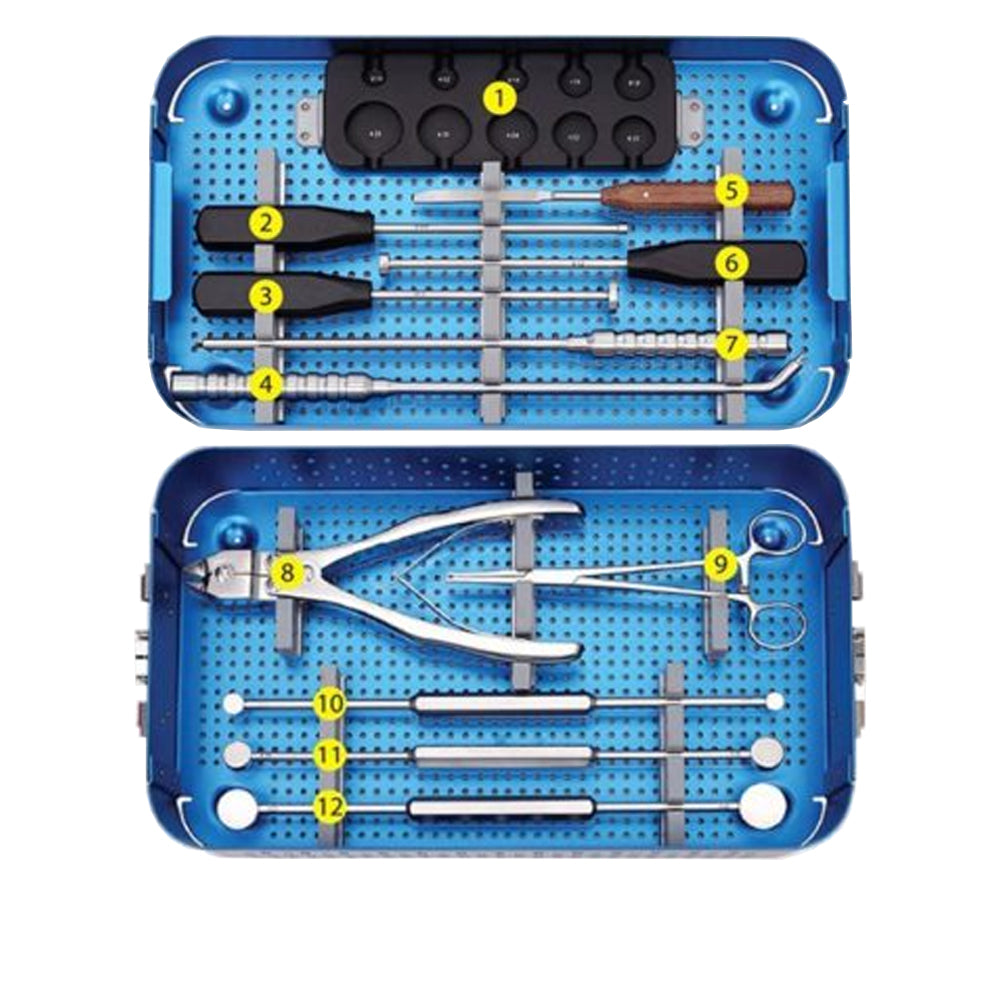
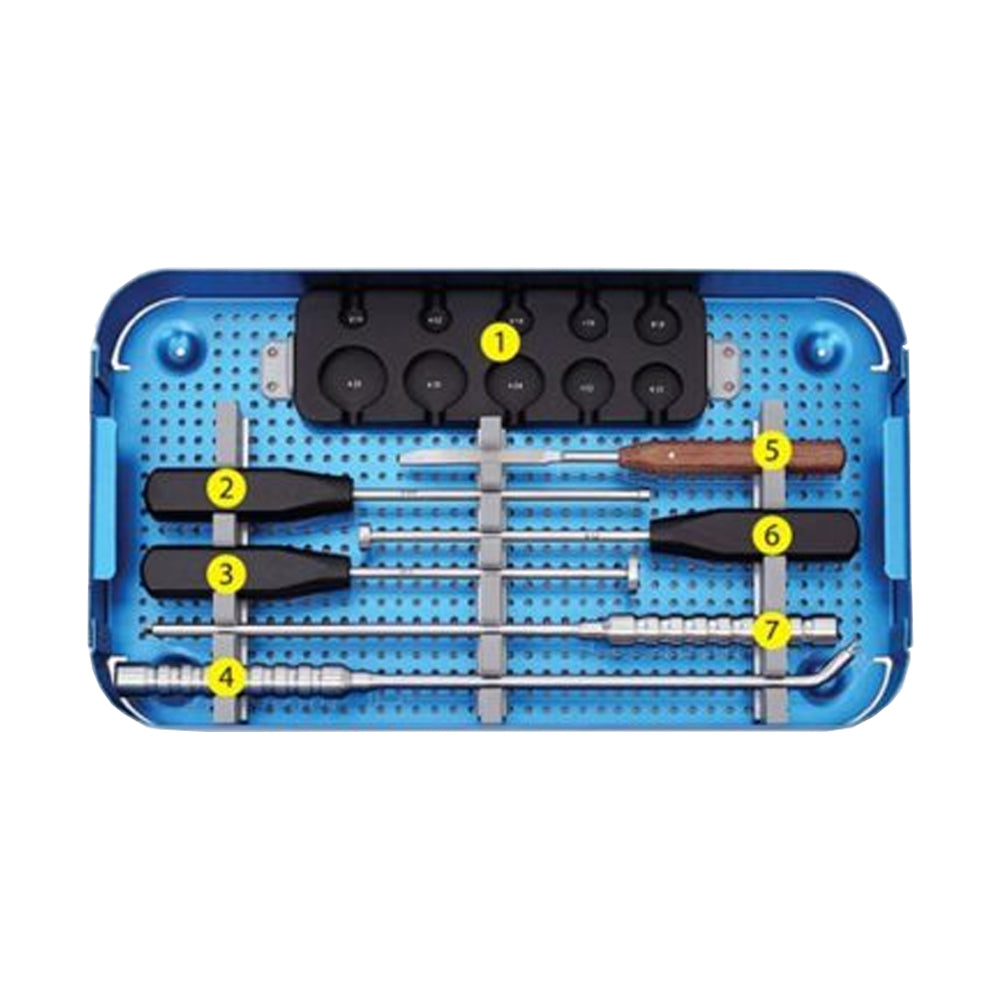
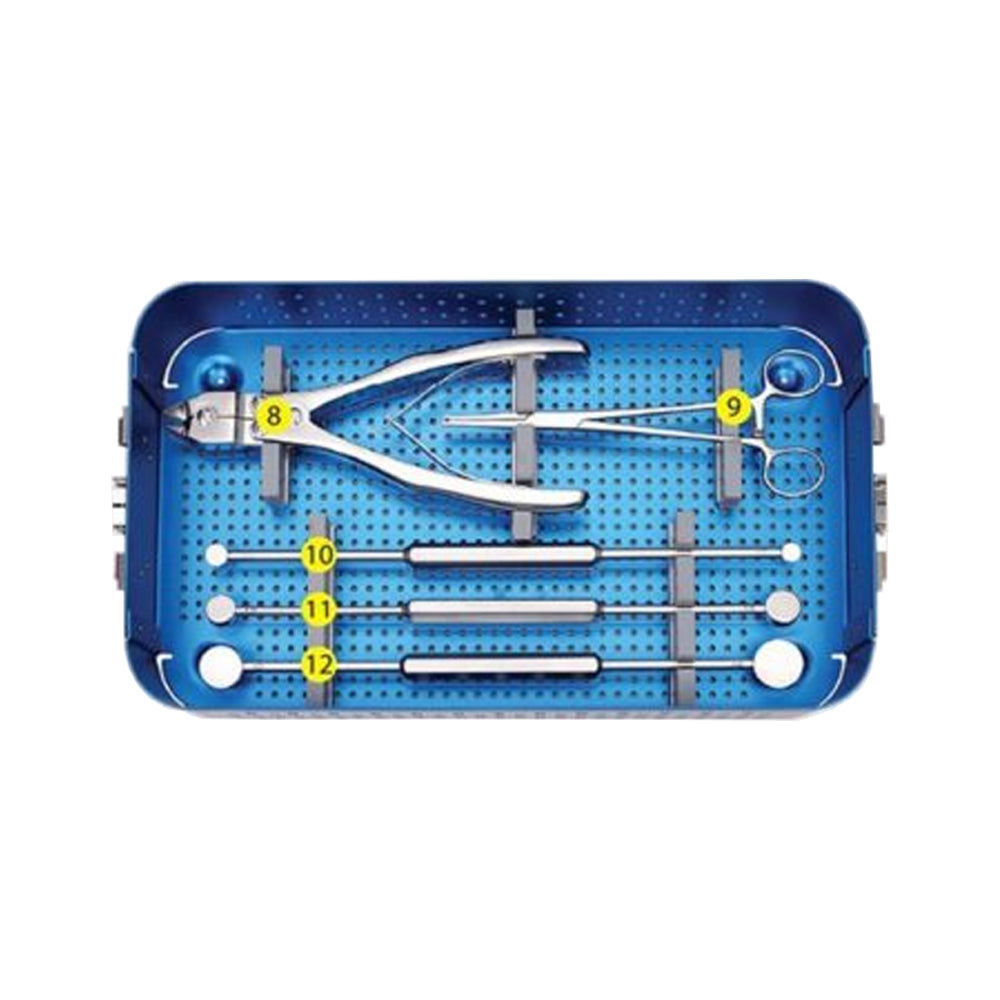
The Mesh Cage Instrument Set from Peak Surgicals (SKU: PS-TMCI-00102) is a 12-piece titanium mesh cage instrumentation set in stainless steel, designed for the complete intraoperative workflow of titanium mesh cage placement for vertebral body reconstruction after anterior or posterior cervical, thoracic, or lumbar corpectomy — covering cage diameter and length selection with three Implant Measures (10–12mm, 16–18mm, and 22–25mm), mesh cage trimming to the correct height with a Cage Cutter, cage introduction and positioning with a Cage Holding Forcep, Pusher Straight, and Pusher Curved, bone graft compaction into the mesh cage with three Pressure instruments (6mm, 12mm, and 18mm) and an Osteotribe, and cage support and orientation with a Cage Stand, all in an Aluminium Box. It is used by spine surgeons and neurosurgeons performing titanium mesh cage vertebral body reconstruction after cervical, thoracic, and lumbar corpectomy for spinal cord or nerve root decompression in patients with vertebral body tumour, metastasis, infection (osteomyelitis/discitis), burst fracture with anterior column failure, and multilevel cervical spondylotic myelopathy requiring corpectomy.
A titanium mesh cage (TMC) is a cylindrical or rectangular implant made of titanium mesh — a perforated titanium sheet formed into a tube — that is packed with autograft bone, allograft, or bone substitute and placed in the defect created by a corpectomy to reconstruct the anterior or middle spinal column. The mesh design allows bone graft to be contained within the cage while permitting direct contact between the graft and the decorticated endplates of the vertebrae above and below, providing the osteoconductive environment needed for cage-to-endplate fusion. Titanium mesh cages are intraoperatively adjustable — they are supplied in standard cylinder heights that the surgeon cuts to the precise height needed to fill the specific corpectomy defect using the Cage Cutter, accommodating the individual patient's vertebral body height as confirmed by intraoperative fluoroscopy. This intraoperative adjustability contrasts with PEEK interbody cages, which are manufactured in fixed discrete heights and selected by trial sizing. Indications for titanium mesh cage vertebral body reconstruction include cervical and thoracic metastatic tumour causing spinal cord compression with vertebral body destruction, primary spinal tumours requiring anterior column resection, vertebral osteomyelitis and spondylodiscitis with vertebral body collapse, burst fractures with severe anterior column comminution that cannot support anterior plate fixation alone, and multilevel cervical corpectomy for cervical spondylotic myelopathy where two or more vertebral bodies are removed and the resulting defect requires a single-cage reconstruction spanning the full corpectomy height.
The three Implant Measures — 10–12mm (PS-IM-012), 16–18mm (PS-IM0-011), and 22–25mm (PS-IM-010) — are the primary sizing instruments for selecting the titanium mesh cage diameter appropriate for the patient's vertebral body diameter and the corpectomy defect geometry. The diameter of the titanium mesh cage must be matched to the anterior-posterior and medial-lateral dimensions of the corpectomy defect and the endplate surface of the adjacent vertebrae to ensure the cage contacts the load-bearing cortical ring of both endplates rather than the softer cancellous centre — a cage that is too small contacts only the central cancellous endplate region and risks cage subsidence through the endplate under axial loading. The implant measure gauges confirm the available space in the corpectomy defect at each diameter range and guide the surgeon's cage diameter selection before the mesh cage is cut to height. Once the diameter is confirmed, the Cage Cutter (PS-CC-009) trims the titanium mesh cylinder to the correct height — the height of the corpectomy defect measured intraoperatively with fluoroscopy or direct calibration, allowing the cage to be seated flush between the exposed cancellous endplates of the adjacent vertebrae with slight distraction fit that provides inherent stability before additional anterior plate fixation is applied.
The Cage Stand (PS-CS-001) provides a stable holder for the titanium mesh cage on the sterile back table during bone graft packing — the cage is placed vertically in the stand while the graft material is impacted into the cage interior from above, ensuring the graft is evenly packed throughout the cage lumen before cage insertion. The three Pressure instruments — 6mm (PS-P-002), 12mm (PS-P-006), and 18mm (PS-P-003) — are bone graft tamping instruments of different diameters matched to the openings in the titanium mesh or to the different zones of the cage interior; they compact the bone graft or bone substitute into the cage at progressively greater force, maximising the graft volume within the cage and eliminating voids that would reduce the osteoconductive surface area available for endplate contact. The Osteotribe (PS-O-005) is a bone preparation and compaction instrument used for decortication and endplate preparation at the cut ends of the adjacent vertebral bodies in the corpectomy defect — it provides a textured surface contact that decorticate the cortical endplate and stimulate a bleeding cancellous surface for improved graft incorporation at the cage-bone interface. The Cage Holding Forcep (PS-CHF-008) grips the packed titanium mesh cage for introduction into the corpectomy defect through the anterior surgical approach, maintaining the cage orientation during seating against the cut endplates. The Pusher Straight (PS-PS-007) and Pusher Curved (PS-PC-004) advance the cage to its final position — the straight pusher is used in straightforward anterior approaches with direct axial access, while the curved pusher provides a deflected trajectory for cage advancement in approaches where the surgical corridor is not directly aligned with the cage insertion axis.
The Mesh Cage Instrument Set is manufactured under CE Mark, ISO 13485, and FDA compliant quality standards. ISO 13485 certification confirms Peak Surgicals operates a documented quality management system covering design control, material traceability, and production consistency for spinal surgical instruments. CE Mark confirms conformity with European medical device regulations, and FDA compliance supports procurement for US-based hospitals, spine surgery centres, and neurosurgical departments requiring verified regulatory documentation for vertebral body reconstruction cage instrumentation purchases.
| SKU | PS-TMCI-00102 |
|---|---|
| Product Name | Mesh Cage Instrument Set |
| Sale Price | $1,384.90 USD |
| Regular Price | $1,870.00 USD |
| Discount | 26% off |
| Total Instruments | 12 + Aluminium Box |
| Instrument Category | Spine Surgery — Titanium Mesh Cage Vertebral Body Reconstruction |
| Procedure | Titanium mesh cage placement after cervical, thoracic, or lumbar corpectomy; vertebral body reconstruction for tumour, infection, fracture, and myelopathy |
| Cage Stand | PS-CS-001 |
| Pressure Instruments | 6mm (PS-P-002), 12mm (PS-P-006), 18mm (PS-P-003) |
| Pusher Curved | PS-PC-004 |
| Osteotribe | PS-O-005 |
| Pusher Straight | PS-PS-007 |
| Cage Holding Forcep | PS-CHF-008 |
| Cage Cutter | PS-CC-009 |
| Implant Measures | 22–25mm (PS-IM-010), 16–18mm (PS-IM0-011), 10–12mm (PS-IM-012) |
| Container | Aluminium Box (PS-AB-013) |
| Certifications | CE Mark, ISO 13485, FDA |
| Warranty | 1 Year |
| MOQ | 1 Set |
| OEM / Custom Orders | Available |
| After-Sale Service | Return and Replacement |
What surgical procedures is the Mesh Cage Instrument Set used for?
The Mesh Cage Instrument Set is used for titanium mesh cage placement after vertebral body corpectomy — the surgical removal of one or more vertebral bodies to decompress the spinal cord or nerve roots, followed by anterior column reconstruction using the mesh cage to restore vertebral height and spinal stability. Primary indications include cervical corpectomy for multilevel cervical spondylotic myelopathy where two or more vertebral bodies are removed to decompress the anterior spinal cord; anterior resection of vertebral body metastases causing epidural spinal cord compression; anterior debridement of pyogenic vertebral osteomyelitis and spondylodiscitis with vertebral body collapse requiring anterior column reconstruction; thoracolumbar burst fracture with severe anterior column comminution requiring anterior corpectomy and mesh cage reconstruction; and primary spinal tumour requiring anterior vertebral body resection. Following mesh cage placement, an anterior plate (cervical, thoracic, or lumbar) is typically applied to provide additional stability while the graft-endplate fusion consolidates.
Why is a Cage Cutter needed and how does titanium mesh cage sizing differ from PEEK cage sizing?
PEEK interbody cages used in ACDF are manufactured in fixed heights (4mm, 5mm, 6mm through 10mm or 12mm) selected by trial sizing — the surgeon selects the pre-manufactured height that best matches the disc space height and there is no intraoperative cutting. Titanium mesh cages for corpectomy are supplied as cylindrical mesh tubes in standard heights (commonly 50mm, 75mm, or 100mm) that must be cut intraoperatively to match the specific corpectomy defect height of the individual patient, which varies with the number of vertebral bodies removed and the patient's anatomy. The Cage Cutter (PS-CC-009) trims the mesh cylinder to the measured height using a cutting mechanism that cleanly shears the titanium mesh without deforming the cut edge of the cage or leaving sharp projections. The Implant Measures provide the diameter selection step — confirming that the cage diameter fits the endplate dimensions of the adjacent vertebrae — while the Cage Cutter addresses the height dimension intraoperatively after fluoroscopic measurement of the defect height.
What bone graft is packed into a titanium mesh cage?
Titanium mesh cages for vertebral body reconstruction are packed with bone graft before insertion to provide the osteogenic or osteoconductive material needed for cage-to-endplate fusion. The most common graft materials used include: autograft cancellous bone from the iliac crest (the gold standard for osteogenic potential, particularly in infection and tumour cases where systemic or local factors may impair graft incorporation); local autograft from the corpectomy bone fragments (when the resected vertebral body is free of tumour or infection, the bone chips are packed into the cage); allograft cancellous chips or demineralised bone matrix (in cases where iliac crest harvest is not performed); and calcium phosphate bone substitute (in cases where autograft or allograft is not used). The Pressure instruments (6mm, 12mm, 18mm) in this set compact the chosen graft material into the cage lumen on the Cage Stand before cage insertion, maximising the graft density and eliminating voids within the cage.
How does the Osteotribe differ from the Pressure instruments?
The Pressure instruments (PS-P-002 at 6mm, PS-P-006 at 12mm, PS-P-003 at 18mm) are bone graft packing instruments — they have a flat or slightly textured end face that applies downward compaction force to the bone graft material within the cage, consolidating the graft from the top of the cage downward. They are used on the back table with the cage in the Cage Stand before cage insertion. The Osteotribe (PS-O-005) is a bone preparation instrument used at the endplate surfaces of the corpectomy defect inside the patient — it is advanced into the defect and used against the decorticated endplate surfaces of the adjacent vertebrae to prepare the endplate surface for cage seating. The osteotribe's textured tip creates a roughened bleeding bone surface at each endplate, improving the biological contact between the cage face and the adjacent bone for enhanced fusion at the cage-endplate interface. The two instruments address different steps: Pressure instruments = graft packing on the back table; Osteotribe = endplate preparation in the patient.
What certifications does this set carry?
The Mesh Cage Instrument Set is manufactured under CE Mark, ISO 13485, and FDA compliant quality standards. ISO 13485 certification confirms Peak Surgicals operates a documented quality management system covering design control, material traceability, and manufacturing consistency for spinal surgical instruments. CE Mark confirms conformity with European medical device regulations, and FDA compliance supports procurement for US hospitals, spine surgery centres, and neurosurgical departments requiring verified regulatory documentation for vertebral body reconstruction cage instrumentation purchases.
