
Featured Collection
Your cart
Featured Collection

PEAK SURGICAL
SKU:PS-OT-0506
Couldn't load pickup availability
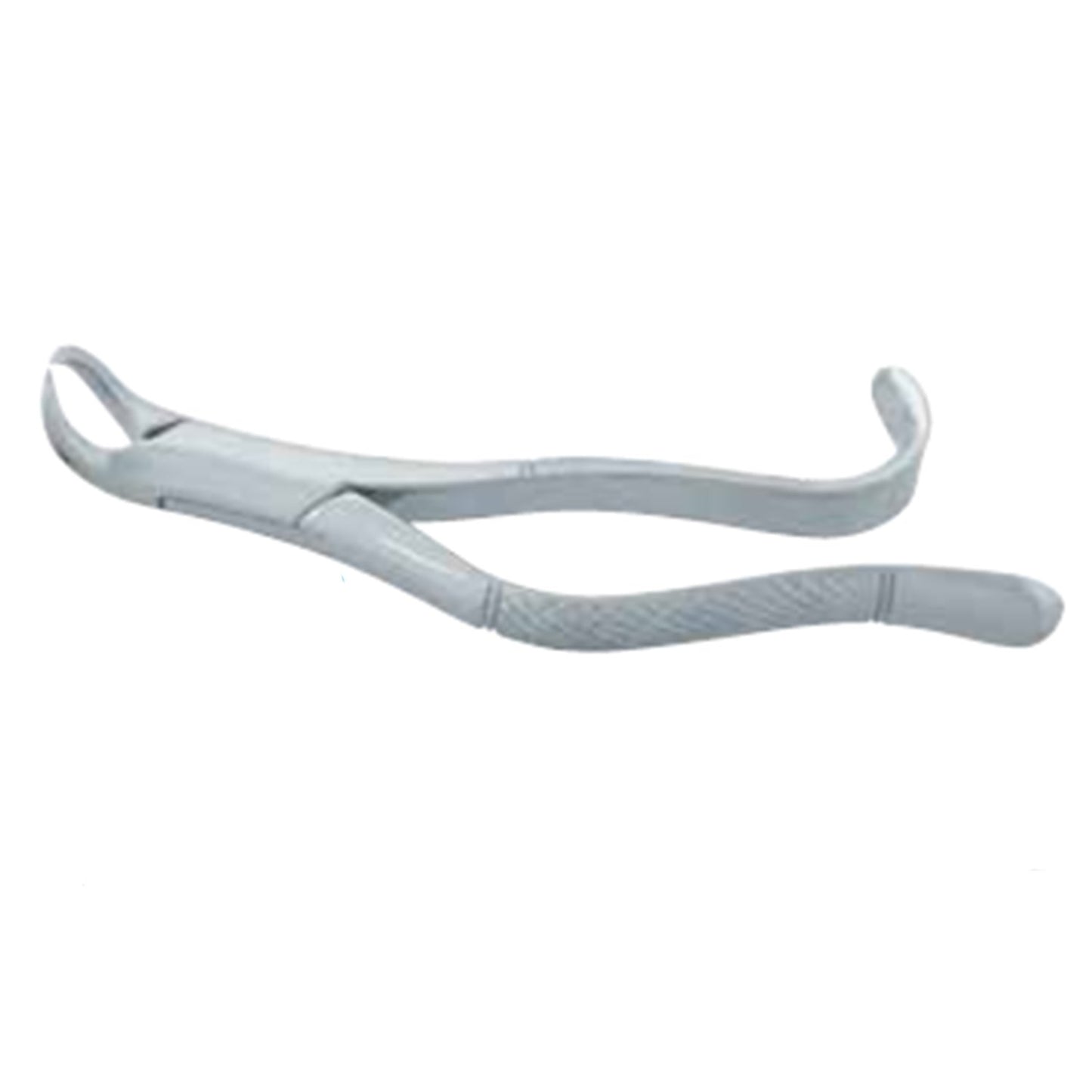

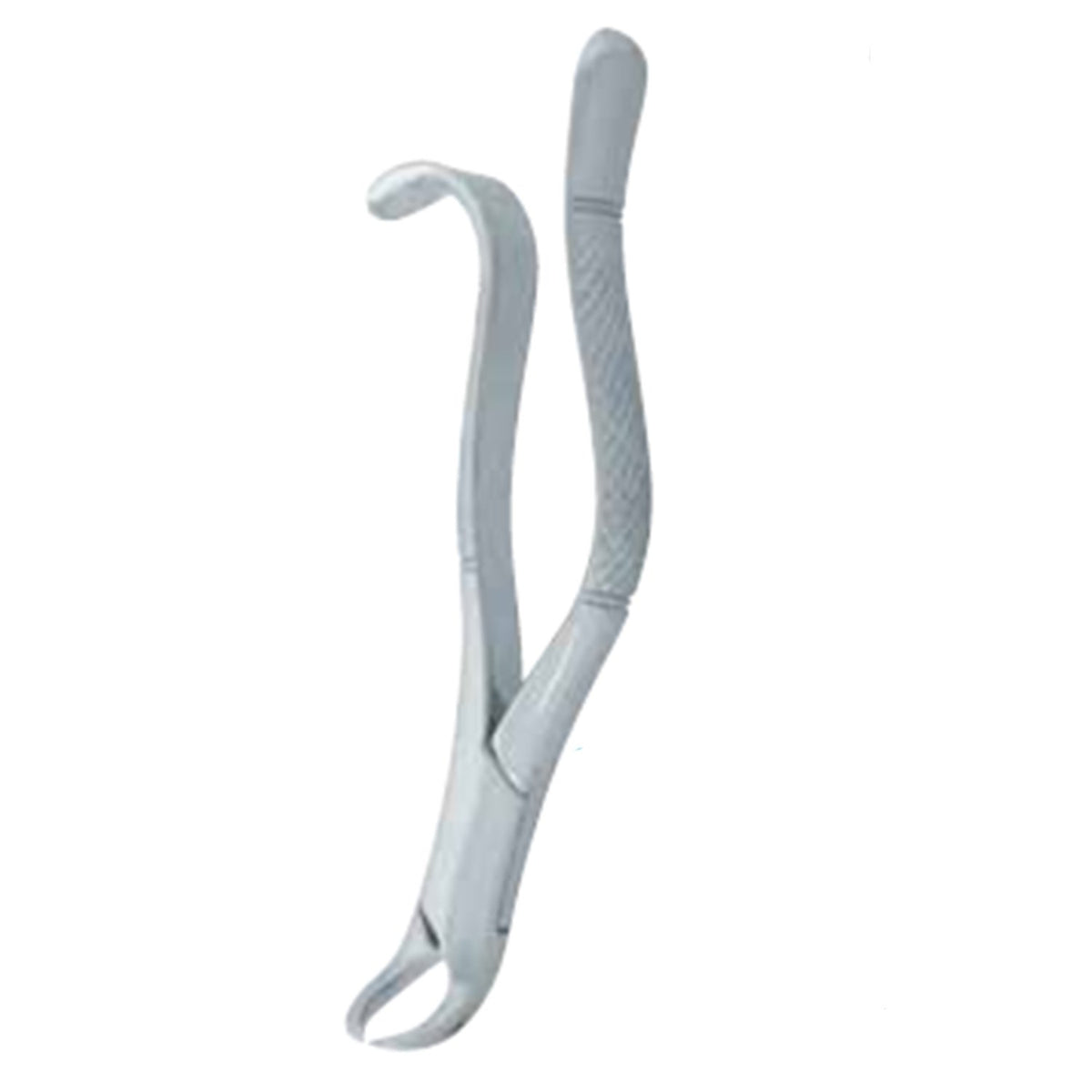
The Maxillary Molar Forceps (PS-6931, No. 203) is a reusable German stainless steel dental extraction forceps specifically designed for the extraction of maxillary first and second molars — the upper posterior molars whose trifurcated root anatomy, with one palatal root and two buccal roots (mesiobuccal and distobuccal), requires a beak geometry fundamentally different from any mandibular molar or premolar forceps. The No. 203 beak design is asymmetric: one beak is broader and curved to engage the single palatal root on the palatal side of the tooth, while the opposing beak carries a projection or furcation-engaging profile designed to seat between and engage the two buccal roots at their furcation on the buccal aspect — providing bilateral root engagement that addresses the maxillary molar's trifurcated anatomy rather than the bifurcated root complex of mandibular molars. The handle geometry of the No. 203 reflects the upper arch approach: unlike lower forceps, whose beaks are angled steeply relative to the handle to allow the operator to reach up into the lower arch from above, upper molar forceps beaks are oriented more closely in line with the handle axis, allowing the operator to engage the upper molar from below or at a downward angle using a downward and outward force appropriate to the direction of maxillary socket dilation. Manufactured from German stainless steel for the structural strength and corrosion resistance required of a reusable instrument used in posterior maxillary extraction and undergoing repeated steam autoclave sterilization. Used by dentists, oral surgeons, and maxillofacial surgeons in dental clinics, oral surgery units, and hospital dental departments. Sold as 1 piece.
Maxillary molars — upper first and second molars — are anatomically distinct from every other tooth in the permanent dentition by virtue of their trifurcation: three roots, not two. The three roots are the mesiopalatal (or simply palatal) root, which is typically the largest, longest, and most conical in cross-section, projecting palatally and somewhat mesially from the root trunk; the mesiobuccal root, which is broader in the buccopalatal dimension and curves toward the buccal and mesial; and the distobuccal root, which is typically the smallest and most conical of the three, positioned at the distobuccal angle of the root complex. The buccal furcation — where the mesiobuccal and distobuccal roots diverge from the root trunk — is accessible from the buccal aspect and provides the engagement point for the buccal beak of the upper molar forceps. The palatal root, projecting on the opposite side of the tooth without an adjacent root to create a furcation, is engaged by the broader palatal beak of the forceps contacting the root trunk on the palatal aspect. This trifurcated anatomy with its two distinctly different beak-engagement situations — a furcation on the buccal side and a single large root on the palatal side — is the reason that upper molar forceps have an asymmetric beak design in which the two beaks are different from each other, in contrast to lower molar forceps whose two beaks engage equivalent furcation anatomy on the buccal and lingual sides. The No. 203 pattern encodes this asymmetric upper molar engagement geometry in its beak design.
The No. 203 pattern uses one broad, somewhat concave or flat beak on the palatal side to engage the palatal root of the maxillary molar — a beak designed to contact the curved surface of the large palatal root below the cervical margin, providing stable engagement against the root trunk while the extraction forces drive the beak apically and the palatal root is progressively loosened from the palatal socket wall by the buccal-to-palatal rocking movement. The buccal beak of the No. 203 incorporates a projection or furcation-engaging feature that is sized and positioned to engage the buccal furcation of the maxillary molar — the concave region between the mesiobuccal and distobuccal roots where the buccal beak tip seats. This engagement of the buccal furcation by the buccal beak, combined with the palatal root contact of the palatal beak, provides the complete bilateral engagement of the maxillary molar's root complex from which the extraction forces are applied. The primary extraction movement for maxillary molars with the No. 203 is buccal-to-palatal rocking, which progressively dilates the alveolus by alternately loading the buccal and palatal socket walls. Because the maxillary alveolar bone is generally less dense on the buccal aspect — the outer buccal cortex is thinner than the palatal plate — buccal rocking is often the more productive direction of socket dilation, and the No. 203 buccal beak's furcation engagement provides particularly reliable purchase for buccal displacement forces. Delivery of the tooth after socket dilation typically involves a combined buccal and rotational movement consistent with the palatal root's conical cross-section.
The handle geometry of upper molar forceps and the extraction forces applied with them differ fundamentally from mandibular forceps, and using one arch's forceps for the other is a clinical error that compromises the quality of beak engagement and the direction of force delivery. For upper teeth, the operator approaches from in front of and slightly below the patient's upper arch — typically with the patient reclined and the operator standing to the patient's side or behind — and the extraction forces are directed downward (apically) to seat the beaks and then outward toward the buccal with palatal rocking to dilate the socket. The handle of an upper forceps is held so that the beaks point upward toward the upper arch roots, with a handle orientation that allows the operator's hand and wrist to apply these downward-then-buccal-outward forces in an ergonomically comfortable and controlled manner. For lower teeth, the operator must apply forces upward into the lower arch and the handle is designed with a beak-to-handle angle that accommodates this. A lower molar forceps applied to an upper molar would present the beaks at the wrong angle for upper root engagement; an upper molar forceps applied to a lower molar would similarly fail to provide correct beak orientation for lower root access. The No. 203's handle geometry is calibrated for maxillary molar extraction from the superior approach, and it belongs exclusively to the upper arch instrument category.
Maxillary first and second molars are among the most commonly extracted posterior teeth in adult dental practice, frequently requiring removal due to advanced caries — particularly involving the furcation, where access for restoration is limited — periodontal disease with bone loss around one or more roots, irreparable crown fracture, failed endodontic treatment, or orthodontic treatment planning. The extraction of maxillary molars presents specific challenges beyond those of mandibular molar extraction: the proximity of the roots of the maxillary first molar — and occasionally the second molar — to the floor of the maxillary sinus means that the root tips of these teeth may be in close anatomical relationship with the sinus, and extraction of a root or delivery of an intact tooth must be performed with awareness of this relationship to avoid inadvertent displacement of root fragments or tooth into the sinus. The No. 203 forceps, with its beak engagement of both the palatal root and the buccal furcation, provides reliable bilateral grip on the maxillary molar root complex and supports the controlled, deliberate buccal-to-palatal rocking technique that is appropriate for maxillary molar delivery, minimizing the uncontrolled lateral forces that could cause root fracture or excessive tearing of the maxillary sinus membrane if a root tip extends into or near the sinus floor.
The Maxillary Molar Forceps No. 203 is manufactured from German stainless steel, providing the structural strength and corrosion resistance required of an instrument used in posterior maxillary molar extraction and undergoing repeated steam autoclave sterilization between procedures. The asymmetric beak design — with a broader palatal beak and a buccal beak with furcation-engaging features — means each beak has distinct geometry that should be maintained across the instrument's service life: the palatal beak should retain its broad, smooth contact surface without roughness that could damage the palatal root surface, and the buccal beak's furcation-engaging projection should remain correctly profiled to seat reliably in the buccal furcation. The hinge mechanism should be inspected at each reprocessing cycle for smooth, symmetric pivot action. All instruments are fully compatible with steam autoclave sterilization at 134°C pre-vacuum parameters, with ultrasonic cleaning recommended before terminal sterilization. Available in satin, dull, or mirror surface finish.
The Maxillary Molar Forceps PS-6931 No. 203 is manufactured under a quality management system certified to ISO 13485, governing German stainless steel material sourcing, precision forging and machining of the asymmetric No. 203 beak geometry — palatal beak and buccal furcation-engaging beak — hinge mechanism, and shank, dimensional and functional inspection, surface finishing, and packaging. CE Mark certification confirms conformity with European Medical Device Regulation requirements for Class I reusable dental surgical instruments distributed within EU and associated regulatory territories. FDA compliance documentation is maintained for United States distribution. These certifications satisfy procurement and tender documentation requirements of institutional buyers in the USA, India, Pakistan, Vietnam, and across international dental instrument supply frameworks. Certificates of conformity and quality management system documentation are available on request. OEM manufacturing is available within the same certified manufacturing framework.
| SKU (Storefront) | PS-OT-0506 |
|---|---|
| Model Number | PS-6930 (base) / PS-6931 No. 203 (variant) |
| Product Name | Maxillary Molar Forceps |
| Pattern Number | No. 203 |
| Price | $9.35 USD |
| Arch | Maxillary (upper) — upper first and second molars |
| Root Anatomy Addressed | Trifurcated: one palatal root + two buccal roots (mesiobuccal and distobuccal) |
| Beak Design | Asymmetric: broad palatal beak for palatal root engagement + buccal beak with furcation-engaging feature for buccal furcation |
| Handle Geometry | Upper arch (maxillary) — beaks oriented for downward-then-outward force delivery from operator approach below the upper arch |
| Critical Distinction | Upper arch only — not interchangeable with lower arch forceps; different root anatomy and handle geometry |
| Instrument Classification | Class I Reusable Dental Surgical Instrument |
| Primary Indications | Maxillary first and second molar extraction — trifurcated upper molar with palatal root and buccal furcation |
| Clinical Setting | Dental clinic, oral surgery unit, hospital dental department |
| Users | Dentists, oral surgeons, maxillofacial surgeons |
| Material | German Stainless Steel |
| Surface Finish | Satin / Dull / Mirror |
| Certifications | CE Mark, ISO 13485, FDA |
| Reusability | Reusable |
| Quantity | 1 Piece |
| Rust Resistance | Yes |
| Warranty | 1 Year |
| MOQ | 1 Piece |
| OEM / Custom Orders | Available |
| Packing | Carton Box |
| Place of Origin | Pakistan |
| Brand | Peak Surgicals |
| Primary Use | Extraction of maxillary (upper) first and second molars using asymmetric No. 203 beak — palatal root and buccal furcation engagement of trifurcated upper molar root complex |
| After-Sale Service | Return and Replacement |
What makes maxillary molar extraction different from mandibular molar extraction, and why does the No. 203 forceps have asymmetric beaks?
Maxillary (upper) molars have three roots — one palatal root and two buccal roots (mesiobuccal and distobuccal) — a trifurcated anatomy that requires the forceps to engage two different root structures in two different ways simultaneously. The palatal root is a single, relatively large, conical root projecting palatally from the root trunk, requiring a broader beak contact against its root trunk surface. The two buccal roots share a buccal furcation between them that provides a mechanical engagement point for the buccal beak. Because these two engagement situations are anatomically different, the No. 203 forceps has asymmetric beaks: one broader beak for the palatal root and one beak with a furcation-engaging feature for the buccal aspect. Mandibular molar forceps, by contrast, address a bifurcated (two-root) system with a buccal furcation and a lingual furcation that are anatomically equivalent — hence the symmetric dual-pointed beak design of patterns like the No. 88L/88R or the bilateral cowhorn (PS-6946 B). Mixing upper and lower molar forceps is a clinical error because the beak asymmetry of upper molar forceps is calibrated for the trifurcated upper anatomy and will not correctly engage the bifurcated lower molar anatomy.
What is the correct technique for extracting a maxillary molar with the No. 203 forceps?
After adequate periosteal elevation and elevator luxation to create initial mobility, the No. 203 beaks are seated with the broader palatal beak on the palatal aspect of the tooth and the buccal beak on the buccal aspect, applying apical pressure to drive the beaks as far down the root trunk as the alveolar crest permits — the buccal beak tip should seat into the buccal furcation and the palatal beak should engage the palatal root trunk below the cervical margin. With beaks fully seated, the primary extraction movement is buccal-to-palatal rocking: initial force is directed buccally to dilate the thinner buccal alveolar cortex, followed by palatal force, alternating with progressive force on each cycle as the socket dilates and the periodontal ligament fatigues. Because the palatal root is typically conical and may be amenable to rotation, a rotational component can be introduced once buccal-palatal mobility has been established, using controlled rotation in the direction the root's anatomy accommodates without risk of root fracture. Delivery follows once adequate mobility allows the tooth to be elevated from the socket with buccal and slightly downward traction.
Why is sinus proximity clinically relevant for maxillary molar extraction?
The roots of the maxillary first molar — and occasionally the second molar — are in close anatomical relationship with the floor of the maxillary sinus, which is the largest of the paranasal sinuses and sits immediately superior to the maxillary molar root region. In some patients, the root tips of the upper first molar actually project into the sinus floor, with the sinus membrane in direct contact with the root surface. During extraction, if a root tip fractures and is displaced superiorly, it may be pushed into the sinus cavity rather than delivered from the socket — a complication that requires immediate recognition and appropriate management. The controlled rocking technique appropriate to maxillary molar extraction with the No. 203 reduces the risk of uncontrolled force that could cause root fracture or displacement, and the furcation engagement of the buccal beak provides reliable grip that reduces beak slippage that might redirect forces superiorly toward the sinus rather than in the intended extraction direction. Pre-operative radiographic assessment of root-sinus proximity is standard practice before maxillary molar extraction.
What sterilization protocol is recommended for this instrument?
The Maxillary Molar Forceps No. 203 is manufactured from German stainless steel and is fully compatible with steam autoclave sterilization at 134°C pre-vacuum parameters. Ultrasonic cleaning before terminal sterilization is recommended for thorough removal of blood, tissue, and bone debris from the hinge area and the beak surfaces — the buccal beak's furcation-engaging feature should receive particular attention during cleaning to ensure any retained debris is removed. At each reprocessing cycle, both beaks should be inspected: the palatal beak for surface smoothness, and the buccal beak for the integrity of the furcation-engaging profile. The hinge should be checked for smooth, symmetric pivot action.
What certifications does this instrument carry, and are bulk or OEM orders available?
The Maxillary Molar Forceps PS-6931 No. 203 is manufactured under an ISO 13485-certified quality management system covering German stainless steel material procurement, precision forging and machining of the asymmetric No. 203 beak geometry and hinge, and packaging. CE Mark certification confirms conformity with European Medical Device Regulation requirements for Class I reusable dental surgical instruments. FDA compliance documentation supports United States distribution. Certificates of conformity are available on request for procurement and tender documentation. Bulk orders are accepted with a minimum of 1 piece, with volume pricing available for dental clinics, oral surgery units, hospital dental departments, and dental instrument distributors. OEM manufacturing for custom configurations or private-label branding is available within the same ISO 13485-certified framework. Free shipping applies on orders of $99 or more.


