
Featured Collection
Your cart
Featured Collection

PEAK SURGICAL
SKU:PS-128864
Couldn't load pickup availability
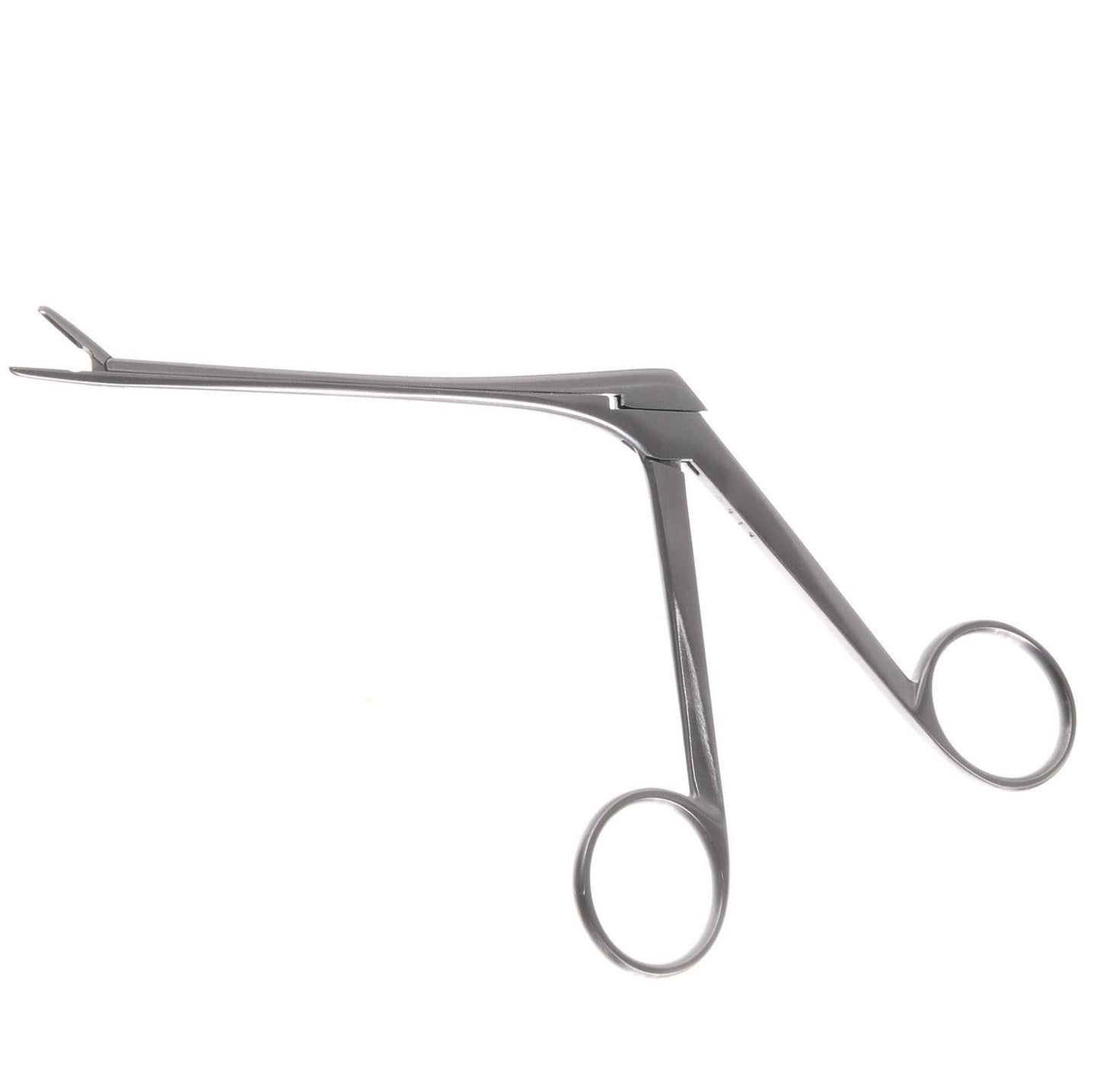

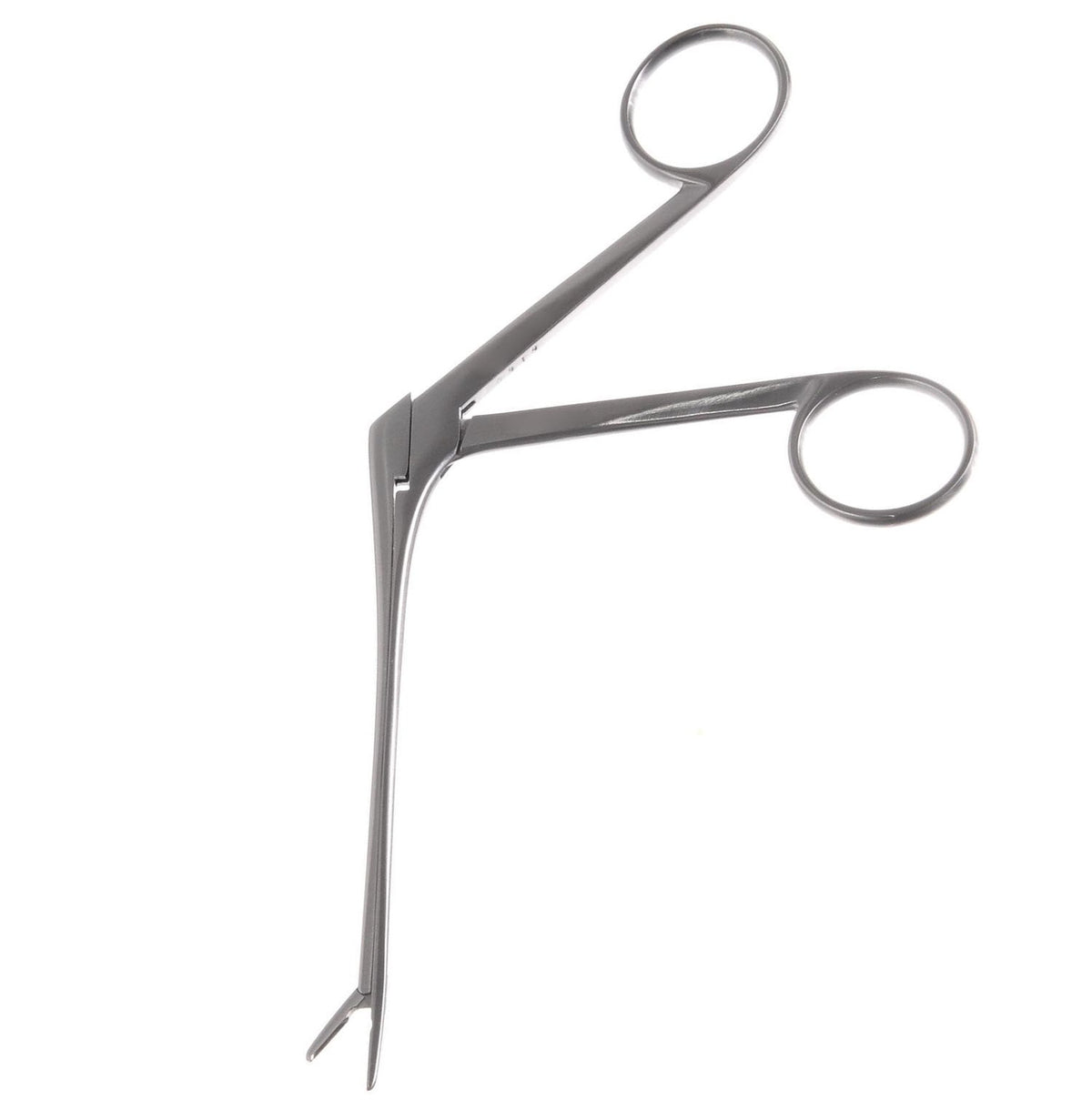
The Love-Gruenwald Forceps (PS-9337, PS-9338, PS-9339, PS-9340) is a German stainless steel pituitary rongeur, also known as a disc forceps, available in four configurations combining straight, upward-angled, and downward-angled jaw orientations with cup jaw widths of 2mm and 3mm — an instrument category functionally distinct from the bone-biting rongeurs (such as the Kleinert-Kutz and Leksell patterns) elsewhere in the Peak Surgicals range, designed instead for the grasping and removal of intervertebral disc material during spinal discectomy and related neurosurgical and spinal procedures. Where a bone rongeur removes hard, mineralized bone tissue through a shearing or biting action, the Love-Gruenwald forceps' cup-shaped jaws are designed to grasp and extract softer disc tissue — the nucleus pulposus and annulus fibrosus material removed during discectomy for herniated or degenerated intervertebral discs — through a scooping, grasping closure rather than a cutting action. The cup jaw geometry, with its concave inner surface, captures a volume of disc material with each closure and allows it to be withdrawn from the disc space, a fundamentally different mechanical task from bone removal. The three jaw orientations available — straight (PS-9337, PS-9338), angled up (PS-9339), and angled down (PS-9340) — allow the surgeon to reach different quadrants of the disc space from a fixed surgical approach and working corridor, a particularly important capability in minimally invasive and microdiscectomy procedures where the access window is narrow and the angle of approach cannot be adjusted once established. Manufactured from German stainless steel. CE Mark, ISO 13485, FDA certification. Sold as 1 piece per configuration selected, $33.00.
The Love-Gruenwald forceps belongs to a category of surgical instruments known as pituitary rongeurs or disc forceps, historically named for their original development for pituitary gland surgery before becoming a standard instrument for intervertebral disc surgery. Despite sharing the "rongeur" terminology with bone-biting instruments such as the Kleinert-Kutz and Leksell patterns, the functional mechanism and clinical application of the Love-Gruenwald forceps is entirely different. Bone rongeurs are designed with sharp cutting edges that shear through hard, mineralized bone tissue in an incremental biting action. The Love-Gruenwald forceps instead has cup-shaped jaws — typically described by their width (2mm or 3mm in this product range) and a fixed jaw length — with a smooth, concave inner surface designed to grasp soft tissue without cutting it, closing around a volume of disc material and withdrawing it intact or in fragments from the surgical field. This distinction matters clinically: disc material, unlike bone, is a soft, fibrocartilaginous and gelatinous tissue that a cutting-edge instrument would tend to shred or fragment unpredictably rather than grasp and remove cleanly, while the cup jaw geometry of the Love-Gruenwald pattern is specifically suited to controlled, deliberate removal of this tissue type.
Discectomy — the surgical removal of all or part of an intervertebral disc, most commonly performed for disc herniation causing nerve root or spinal cord compression, or for disc degeneration contributing to spinal instability or pain — is the primary clinical application of the Love-Gruenwald forceps. After surgical access to the disc space has been established, whether through an open posterior approach, a minimally invasive tubular retractor system, or microdiscectomy technique, the surgeon uses the pituitary rongeur to remove the herniated or degenerated disc fragment along with, in many cases, additional disc material from within the disc space to reduce the risk of recurrent herniation. The cup jaws are introduced into the disc space or directed at the herniated fragment, closed to grasp the tissue, and withdrawn, with this process repeated as needed to remove the targeted volume of disc material while preserving the surrounding anatomy — the adjacent nerve root, the dura, and the remaining healthy disc and vertebral endplate structures. The controlled, grasping action of the cup jaws, rather than a cutting action, allows the surgeon to remove disc material with reasonable precision regarding the volume and location of tissue extracted, which is clinically relevant both for adequate decompression of neural structures and for avoiding excessive disc removal that could compromise the disc's structural integrity.
The three jaw orientations available in this Love-Gruenwald forceps range — straight, angled up, and angled down — address a specific access challenge in disc surgery: the surgical corridor to the disc space, particularly in minimally invasive and microdiscectomy approaches using a fixed tubular retractor or a narrow surgical window, provides a single, fixed approach angle that cannot be adjusted once established. Within this fixed corridor, the disc space itself is a three-dimensional structure, and disc material requiring removal may be positioned in different quadrants relative to the straight-line approach available through the surgical corridor — material that has migrated superiorly or inferiorly relative to the disc space, or that lies at an angle not directly accessible to a straight instrument. The straight configuration (PS-9337, PS-9338) provides direct access along the line of the surgical corridor, suited to disc material positioned centrally or directly accessible from the approach angle. The angled-up configuration (PS-9339) directs the jaw tip upward relative to the handle, allowing the surgeon to reach disc material positioned more superiorly within the disc space or migrated cranially from a herniation, without needing to reposition the entire instrument or the surgical approach. The angled-down configuration (PS-9340) provides the corresponding capability for disc material positioned inferiorly or migrated caudally. A complete discectomy instrument set typically includes both straight and angled configurations to address the full range of disc material positions encountered across different herniation patterns and surgical approaches.
The two cup jaw width specifications available in this range — 2mm (PS-9338, PS-9339, PS-9340) and 3mm (PS-9337) — affect the volume of disc material captured with each closure and the precision available for selective tissue removal. The narrower 2mm cup jaw provides finer, more controlled grasping suited to situations where precise, incremental disc material removal is preferred — working close to the nerve root or dura, or removing small fragments without disturbing a larger volume of surrounding disc tissue. The wider 3mm cup jaw captures a larger volume of disc material per closure, providing more efficient bulk removal where the surgical objective is to clear a larger volume of disc material, such as during more extensive discectomy for disc degeneration with multiple fragment herniation. Surgeons performing discectomy procedures typically select the jaw width appropriate to the specific stage of the procedure and the volume and location of disc material requiring removal, often using a narrower jaw for the final, most delicate stages of decompression near neural structures.
All four configurations of the Love-Gruenwald Forceps are manufactured from German stainless steel, providing the structural strength and corrosion resistance required of a reusable instrument used in spinal and neurosurgical procedures, while undergoing repeated steam autoclave sterilization between procedures. The cup jaw inner surfaces, which must maintain a smooth, non-traumatic grasping surface to capture disc tissue without unintended shredding or damage to adjacent structures, should be inspected at each reprocessing cycle for any roughness, deformation, or damage that could compromise grasping precision. The hinge mechanism should be checked for smooth, secure pivot action, ensuring symmetric jaw closure that maintains the cup geometry's grasping effectiveness. Compatible with steam autoclave sterilization at 134°C pre-vacuum parameters, with ultrasonic cleaning recommended before terminal sterilization for thorough removal of tissue debris from the cup jaw and hinge areas. Available in satin, dull, or mirror surface finish.
The Love-Gruenwald Forceps (PS-9337, PS-9338, PS-9339, PS-9340) is manufactured under a quality management system certified to ISO 13485, governing German stainless steel material sourcing, precision forging and machining of the cup jaw geometry across all four configurations and orientations, dimensional inspection of the cup jaw width and angulation, hinge mechanism precision, and packaging. CE Mark certification confirms conformity with European Medical Device Regulation requirements for Class I reusable surgical instruments distributed within EU and associated regulatory territories. FDA compliance documentation is maintained for United States distribution, satisfying regulatory requirements for reusable spinal and neurosurgical instruments procured by US hospitals, neurosurgery and spine surgery practices, and surgical instrument distributors. These certifications satisfy procurement and tender documentation requirements of institutional buyers in the USA, India, Pakistan, Vietnam, and across international surgical instrument supply frameworks. Certificates of conformity and quality management system documentation are available on request. OEM manufacturing is available within the same certified manufacturing framework.
| SKU (Storefront) | PS-128864 |
|---|---|
| Model Numbers | PS-9337 / PS-9338 / PS-9339 / PS-9340 |
| Product Name | Love-Gruenwald Forceps |
| Price | $33.00 USD per piece |
| PS-9337 | Straight, 3mm x 10mm cup jaws |
| PS-9338 | Straight, 2mm x 10mm cup jaws |
| PS-9339 | Jaws angled up, 2mm x 10mm cup jaws |
| PS-9340 | Jaws angled down, 2mm x 10mm cup jaws |
| Instrument Function | Pituitary rongeur / disc forceps — soft tissue grasping for disc material removal, not bone resection |
| Distinction from Bone Rongeurs (Kleinert-Kutz, Leksell, Lempert) | Love-Gruenwald = cup jaw grasping for soft disc tissue; bone rongeurs = cutting-edge biting for hard bone |
| Category | Spinal / Neurosurgical Surgical Instruments — Pituitary Rongeurs / Disc Forceps |
| Instrument Classification | Class I Reusable Surgical Instrument |
| Primary Indications | Discectomy — removal of herniated or degenerated intervertebral disc material; microdiscectomy and minimally invasive spine surgery |
| Clinical Setting | Operating room, spine surgery unit, neurosurgery unit |
| Users | Neurosurgeons, spine surgeons, orthopedic spine surgeons |
| Material | German Stainless Steel |
| Surface Finish | Satin / Dull / Mirror |
| Certifications | CE, ISO 13485, FDA |
| Reusability | Reusable |
| Quantity | 1 Piece per configuration selected |
| Rust Resistance | Yes |
| Warranty | 1 Year |
| MOQ | 1 Piece |
| OEM / Custom Orders | Available |
| Packing | Carton Box |
| Place of Origin | Pakistan |
| Brand | Peak Surgicals |
| Primary Use | Pituitary rongeur for discectomy — select jaw angulation (straight, angled up, or angled down) and cup width (2mm or 3mm) based on disc material location and removal precision required |
| After-Sale Service | Return and Replacement |
What is a pituitary rongeur, and how does the Love-Gruenwald forceps differ from bone rongeurs like the Leksell pattern?
A pituitary rongeur, also called a disc forceps, is designed to grasp and remove soft tissue rather than to cut or bite through bone. The Love-Gruenwald forceps has cup-shaped jaws with a smooth, concave inner surface that closes around a volume of soft tissue — most commonly intervertebral disc material during discectomy — and withdraws it from the surgical field through a grasping action. This is mechanically and functionally distinct from bone rongeurs such as the Leksell pattern, which have sharp cutting edges designed to shear through hard, mineralized bone in an incremental biting action. While both instrument types use the general "rongeur" terminology, they address fundamentally different tissue types and surgical tasks: the Love-Gruenwald forceps for disc material removal in spinal surgery, and bone rongeurs for hard bone removal in spinal, cranial, or other orthopedic procedures. These instruments are not interchangeable — a bone rongeur's cutting edges are not suited to gentle disc tissue grasping, and a pituitary rongeur's cup jaws are not designed to cut through bone.
When is the Love-Gruenwald forceps used, and what procedures rely on it?
The Love-Gruenwald forceps is primarily used in discectomy — surgical removal of all or part of an intervertebral disc, most commonly performed for disc herniation causing nerve root or spinal cord compression, or for symptomatic disc degeneration. After surgical access to the disc space is established, whether through open posterior approach, minimally invasive tubular retractor technique, or microdiscectomy, the surgeon uses the pituitary rongeur to grasp and remove the herniated or degenerated disc fragment, along with additional disc material as clinically indicated to reduce the risk of recurrent herniation. This instrument is a standard component of spinal surgical instrument sets used in lumbar and cervical discectomy procedures.
How do I choose between straight, angled-up, and angled-down jaw configurations?
The choice depends on the position of the disc material relative to the fixed surgical approach angle, which is particularly important in minimally invasive and microdiscectomy procedures where the surgical corridor cannot be repositioned once established. The straight configuration (PS-9337, PS-9338) provides direct access along the line of the surgical approach, suited to disc material positioned centrally or directly accessible from this angle. The angled-up configuration (PS-9339) directs the jaw tip upward relative to the handle, reaching disc material positioned more superiorly within the disc space or migrated cranially from a herniation site, without requiring repositioning of the surgical approach. The angled-down configuration (PS-9340) provides the corresponding capability for inferiorly positioned or caudally migrated disc material. A complete discectomy instrument set typically includes straight and both angled configurations to address the range of disc material positions encountered across different herniation patterns.
What is the difference between the 2mm and 3mm cup jaw widths?
The cup jaw width determines the volume of disc material captured with each grasping closure and the precision available for selective tissue removal. The narrower 2mm cup jaw (available on PS-9338, PS-9339, and PS-9340) provides finer, more controlled grasping suited to precise, incremental disc material removal, particularly when working close to the nerve root or dura where precision matters most. The wider 3mm cup jaw (PS-9337) captures a larger volume of disc material per closure, providing more efficient bulk removal for situations requiring clearance of a larger volume of disc tissue. Surgeons often select the wider jaw for the initial bulk removal phase of a discectomy and the narrower jaw for the final, more delicate stages of decompression near neural structures.
What certifications does this instrument carry, and are bulk or OEM orders available?
The Love-Gruenwald Forceps (PS-9337, PS-9338, PS-9339, PS-9340) is manufactured under an ISO 13485-certified quality management system covering German stainless steel material procurement, precision forging and machining of the cup jaw geometry across all four configurations, and packaging. CE Mark certification confirms conformity with European Medical Device Regulation requirements for Class I reusable surgical instruments. FDA compliance documentation supports United States distribution. Certificates of conformity are available on request for hospital and surgical practice procurement and tender documentation. Bulk orders are accepted with a minimum of 1 piece per configuration, with volume pricing available for hospitals, neurosurgery and spine surgery practices, and surgical instrument distributors — spine surgery units typically order multiple configurations together to cover the full range of disc material positions and removal precision needs across a discectomy procedure. OEM manufacturing for custom configurations or private-label branding is available within the same ISO 13485-certified framework. Free shipping applies on orders of $99 or more.


