
Featured Collection
Your cart
Featured Collection

PEAK SURGICALS
SKU:PS-OP-6032
Couldn't load pickup availability


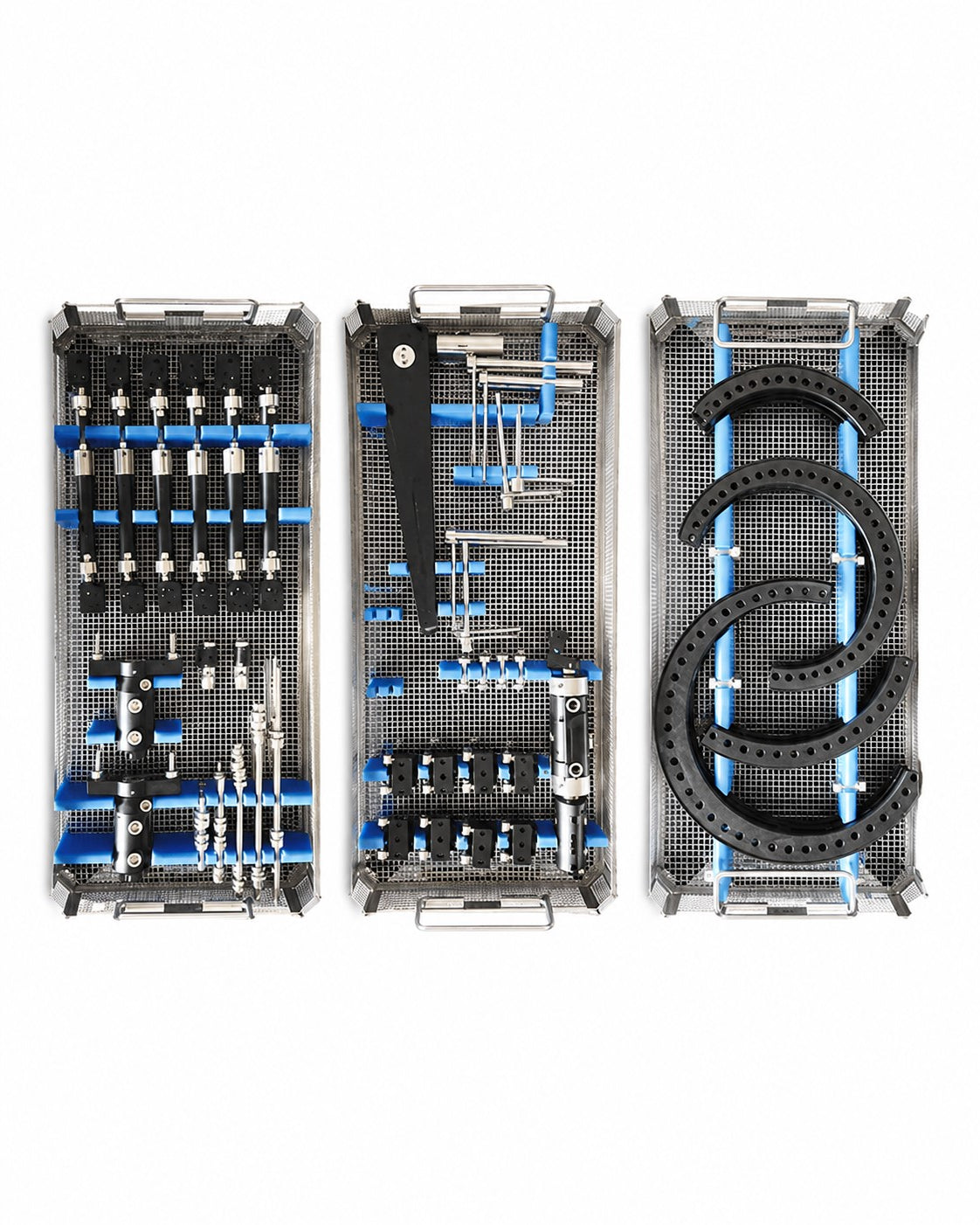
Hybrid Fixation System Sterilization Box, SKU PS-OP-6032, is a reusable orthopedic external fixation system manufactured from German-forged stainless steel for construction of hybrid circular and linear fixation frames. The set combines three trays with Ø220 mm and Ø175 mm partial rings, clamps, reduction units, 80 mm and 100 mm screw guides, Ø4.8 mm drill guides, 60 mm bolts, 80–200 mm threaded bars, wire tensioning and securing components, and a Hybrid Fixator Short Assembly Kit containing a D.A.F. straight clamp, D.A.F. short central body, short compression-distraction unit, and hybrid coupling with ball-joint. Its hybrid architecture allows a periarticular bone segment to be controlled through compatible tensioned-wire ring fixation while a diaphyseal segment can be connected to a linear fixation construct using compatible half-pin instrumentation. The system is configured for orthopedic trauma workflows involving tibial plateau fractures, distal tibial and pilon fractures, selected periarticular knee and ankle injuries, bone transport, limb lengthening, and gradual angular or translational deformity correction. It is intended for orthopedic trauma surgeons, limb reconstruction specialists, hospital operating rooms, and external-fixation services managing complex staged reconstruction.
The Hybrid Fixation System Sterilization Box combines partial circular ring geometry with linear-frame connection components so different bone segments can be controlled through distinct fixation strategies within one construct. The 2/3 and 1/3 rings can be assembled around the selected periarticular region while maintaining surgical access that a complete preassembled ring could restrict. Compatible transosseous wires are positioned through the targeted metaphyseal or epiphyseal segment and are secured to the ring using the Two-Hole X-Wire Securing Pins and Three-Hole Wire Clamp Slider Units. The Wire Tensioner applies controlled tension to compatible wires before final locking, increasing the mechanical stability of the wire-ring relationship. Ring Locking Screws secure the selected frame connections after alignment has been established. Threaded bars link ring or frame elements across the required distance, while Reduction Units provide controlled positional adjustment between connected components. The Hybrid Fixator Short Assembly Kit provides the transition between circular and linear fixation architecture. Its Hybrid Coupling with Ball-Joint permits angular alignment between the ring plane and D.A.F. linear component before locking, while the short compression-distraction unit provides controlled longitudinal adjustment within the assembled frame.
In periarticular external fixation, the system is assembled after fracture assessment, reduction planning, and determination of safe wire and compatible half-pin corridors. For a complex tibial plateau fracture, the selected Ø220 mm or Ø175 mm ring configuration can be positioned around the proximal tibia while compatible wires capture the metaphyseal or epiphyseal fragment under appropriate imaging guidance. The wires are secured to the ring components and tensioned before definitive locking. The tibial shaft can then be stabilized through the linear portion of the hybrid construct using compatible half-pins placed with the supplied screw and drill guidance components. The Hybrid Coupling with Ball-Joint connects the ring plane to the linear fixation segment while allowing the surgeon to reconcile differences between periarticular orientation and the diaphyseal axis. Similar principles apply to distal tibial and pilon fractures where the ring controls a short articular segment and the linear component stabilizes the shaft. Reduction Units permit incremental adjustment of frame relationships after initial assembly. During bone transport, limb lengthening, or deformity correction, threaded bars and the short compression-distraction unit provide the structural pathways required for planned gradual frame adjustment according to the reconstructive protocol.
The system provides two internal ring diameters and multiple connection lengths so frame geometry can be matched to anatomy and fixation level. Ø220 mm 2/3 and 1/3 rings provide the larger circular envelope for adult periarticular fixation where limb circumference and expected soft-tissue swelling require greater clearance. Ø175 mm equivalents provide a more compact frame for smaller limb dimensions where the larger ring would create unnecessary offset between bone and fixation structure. Screw Guides are supplied in 80 mm and 100 mm lengths, with three of each included, allowing the surgeon to select guidance depth according to soft-tissue thickness and the position of the linear fixation component. Ø4.8 mm Drill Guides are provided in 80 mm and 60 mm lengths for compatible drilling pathways. Threaded Bars are supplied as sets of three at 80, 120, 160, and 200 mm, providing progressively greater separation between connected frame levels. The 60 mm bolt set addresses shorter structural connections. Two standard clamps, two single screw clamps, six total reduction units, eight X-wire securing pins, eight three-hole wire clamp sliders, and eight ring locking screws provide repeated connection points for constructing and adjusting complex hybrid configurations.
Set Includes:
| Code No. | Set Consisting of | Units |
|---|---|---|
| Q.441.001 | Tray | 3 |
| Q.441.003 | 2/3 Ring, inner Ø220 mm | 2 |
| Q.441.005 | 1/3 Ring, inner Ø220 mm | 2 |
| Q.441.007 | 2/3 Ring, inner Ø175 mm | 2 |
| Q.441.009 | 1/3 Ring, inner Ø175 mm | 2 |
| Lower Tray Consisting of: | ||
| Q.441.011 | Clamp | 2 |
| Q.441.013 | Single Screw Clamp | 2 |
| Q.441.015 | Reduction Unit | 3 |
| Q.441.017 | Screw Guide, length 80 mm | 3 |
| Q.441.019 | Screw Guide, length 100 mm | 3 |
| Q.441.021 | Drill Guide Ø4.8 mm, length 80 mm | 1 |
| Q.441.023 | Drill Guide Ø4.8 mm, length 60 mm | 1 |
| Q.441.025 | Bolts 60 mm, set of 3 | 1 |
| Q.441.027 | Threaded Bars, length 80 mm, set of 3 | 1 |
| Q.441.029 | Threaded Bars, length 120 mm, set of 3 | 1 |
| Q.441.031 | Threaded Bars, length 160 mm, set of 3 | 1 |
| Q.441.033 | Threaded Bars, length 200 mm, set of 3 | 1 |
| Upper Tray Consisting of: | ||
| Q.441.035 | Wire Tensioner | 1 |
| Q.441.037 | Ring Locking Screw | 8 |
| Q.441.039 | Two-Hole X-Wire Securing Pin | 8 |
| Q.441.041 | Hybrid Fixator Short Assembly Kit consisting of D.A.F. Straight Clamp, D.A.F. Short Central Body, Compression-Distraction Unit Short, and Hybrid Coupling with Ball-Joint | 1 Set |
| Q.441.043 | Reduction Unit | 3 |
| Q.441.045 | Three-Hole Wire Clamp Slider Unit | 8 |
The Hybrid Fixation System Sterilization Box is built around reusable German-forged medical-grade stainless steel components intended to withstand repeated orthopedic handling, frame assembly, cleaning, inspection, and hospital sterilization. Rings and threaded bars require dimensional stability because deformation can alter frame alignment, while locking screws, clamps, reduction units, sliders, and ball-joint interfaces depend on controlled mechanical engagement. The wire tensioner and compression-distraction mechanism should be inspected after every use for free movement and secure locking without excessive play. Cleaning requires separation or opening of accessible frame components so blood, tissue residue, and environmental contamination can be removed from threaded interfaces, clamp surfaces, guide bores, joints, and adjustment mechanisms. The three trays provide organized containment for component reconciliation before packaging and sterilization. Reprocessing should follow the healthcare facility's validated reusable orthopedic instrument cycle and applicable manufacturer instructions. Peak Surgicals operates within an ISO 13485 medical-device quality-management framework and supplies CE-marked instrumentation for applicable markets. U.S. procurement should use the relevant FDA registration, listing, labeling, and regulatory documentation rather than describing the complete system with a blanket individual approval claim. The current commercial listing includes a one-year warranty, MOQ of one set, OEM/custom ordering, and return or replacement support.
| Specification | Details |
|---|---|
| SKU | PS-OP-6032 |
| Product Name | Hybrid Fixation System Sterilization Box |
| Price | $1,758.90 USD |
| Size/Gauge Variants | Ø220 mm and Ø175 mm partial rings; 80 mm and 100 mm screw guides; Ø4.8 mm drill guides in 60 mm and 80 mm lengths; threaded bars in 80, 120, 160 and 200 mm lengths |
| Instrument Count | 23 catalog references; 60 listed units, expanding to approximately 73 physical components when supplied sets of three and the four-piece Hybrid Fixator Short Assembly Kit are counted individually |
| Instrument Category | Orthopedic Hybrid Circular and Linear External Fixation System |
| Procedure | Tibial plateau fracture fixation, pilon and distal tibial fixation, periarticular external fixation, bone transport, limb lengthening and gradual deformity correction |
| Material | German-forged medical-grade stainless steel |
| Finish | Machined surgical stainless-steel finish with functional threaded, clamping, guiding and adjustment interfaces |
| Sterilization | Reusable; suitable for validated institutional cleaning and steam-sterilization workflows |
| Instrument Classification | Reusable orthopedic external fixation instrument and frame system |
| Reusable | Yes |
| Certifications | CE-marked procurement, ISO 13485 quality-management framework and applicable FDA regulatory documentation |
| Warranty | 1-Year Limited Warranty |
| MOQ | 1 Set |
| OEM / Custom Orders | Available for hospitals, orthopedic trauma centers, distributors and institutional procurement requirements |
| After-Sale Service | Return, replacement and warranty support under Peak Surgicals commercial terms |
How does the Hybrid Fixation System differ from a conventional unilateral external fixator?
The Hybrid Fixation System combines circular wire fixation with a linear external fixation segment, whereas a conventional unilateral external fixator relies primarily on half-pins connected along one side of the limb. Circular fixation is particularly useful when the periarticular fragment is short and cannot accommodate multiple conventional half-pins without encroaching on the joint. Thin compatible wires can cross the metaphyseal or epiphyseal segment and attach to the ring while the diaphyseal segment is controlled through the linear frame. The Hybrid Fixation System then connects these two fixation strategies through the short assembly and ball-joint interface. A unilateral frame generally has a simpler single-plane architecture but provides less flexibility for constructing a ring around a small periarticular fragment. Selection depends on fracture location, available bone stock, soft-tissue condition, reconstruction objective, and the surgeon's external-fixation plan.
How should Ø175 mm and Ø220 mm rings and threaded bar lengths be selected?
Ring diameter is selected according to limb circumference, operative level, soft-tissue envelope, and the clearance required between the patient and frame. The Ø220 mm configuration provides a larger internal space for adult proximal tibial, knee-region, or distal limb applications where a Ø175 mm ring would sit too close to the skin. The Ø175 mm pattern provides a smaller frame envelope for patients or anatomical levels with reduced limb circumference. Threaded bars at 80, 120, 160, and 200 mm determine the separation available between connected fixation levels. Shorter bars create a compact relationship between nearby ring or frame elements, while longer bars span greater inter-level distances. During tibial plateau, pilon, limb-lengthening, or bone-transport procedures, the surgeon selects the combination that preserves soft-tissue clearance while maintaining the planned mechanical frame geometry.
What do CE, ISO 13485 and FDA requirements mean when procuring this fixation system?
The Hybrid Fixation System Sterilization Box is supplied within Peak Surgicals' medical-device quality and procurement framework. ISO 13485 relates to the documented quality-management system governing medical-device manufacturing and process control. CE marking addresses conformity requirements for applicable regulated markets where the system is supplied. For United States procurement, FDA compliance concerns applicable establishment registration, device listing, labeling, quality-system requirements, and supporting regulatory records. FDA approved should not be applied as a blanket description to every component unless that exact regulatory status applies to the individual device. Hospitals and distributors can maintain the relevant regulatory documentation with vendor qualification, purchasing, reusable-instrument, and external-fixation inventory records.
How do the Wire Tensioner, Reduction Units and Hybrid Coupling with Ball-Joint function?
The Wire Tensioner applies controlled tension to compatible transosseous wires after they have been positioned through the bone and attached to the ring. Tension improves the mechanical relationship between the wire and circular fixation structure before the securing components are definitively locked. The Reduction Units create adjustable connections between frame elements, allowing positional relationships to be altered during reduction or subsequent frame adjustment. The Hybrid Coupling with Ball-Joint joins the circular portion of the construct to the short linear D.A.F. assembly. Its multi-directional joint allows the ring plane and linear frame axis to be aligned before the coupling is locked. The short compression-distraction unit then provides a dedicated mechanism for controlled longitudinal adjustment when that function is required by the treatment plan.
How should hospitals sterilize and manage the complete Hybrid Fixation System Sterilization Box?
The Hybrid Fixation System Sterilization Box contains numerous threaded, hinged, clamping, guiding, and adjustment interfaces that require direct cleaning after use. Components should be disassembled or opened to the extent specified by the applicable reprocessing instructions so residue can be removed from threads, clamps, guide bores, sliders, locking screws, ball-joint surfaces, and reduction mechanisms. After cleaning and rinsing, every component should be completely dried and inspected for corrosion, deformation, damaged threads, impaired locking, or abnormal mechanical play. Sterile processing teams should reconcile the three trays against the Q.441 component table before the set is packaged for the facility's validated sterilization cycle. The inventory should include both ring diameters, all four threaded-bar lengths, six reduction units, eight ring locking screws, eight X-wire securing pins, eight three-hole slider units, and the complete four-component short assembly kit. Procurement teams can use Shopify SKU PS-OP-6032 together with the individual Q.441 references to manage replacement parts, tray reconciliation, OEM inquiries, and institutional stock.


