
Featured Collection
Your cart
Featured Collection

PEAK SURGICALS
SKU:PS-OP-6031
Couldn't load pickup availability


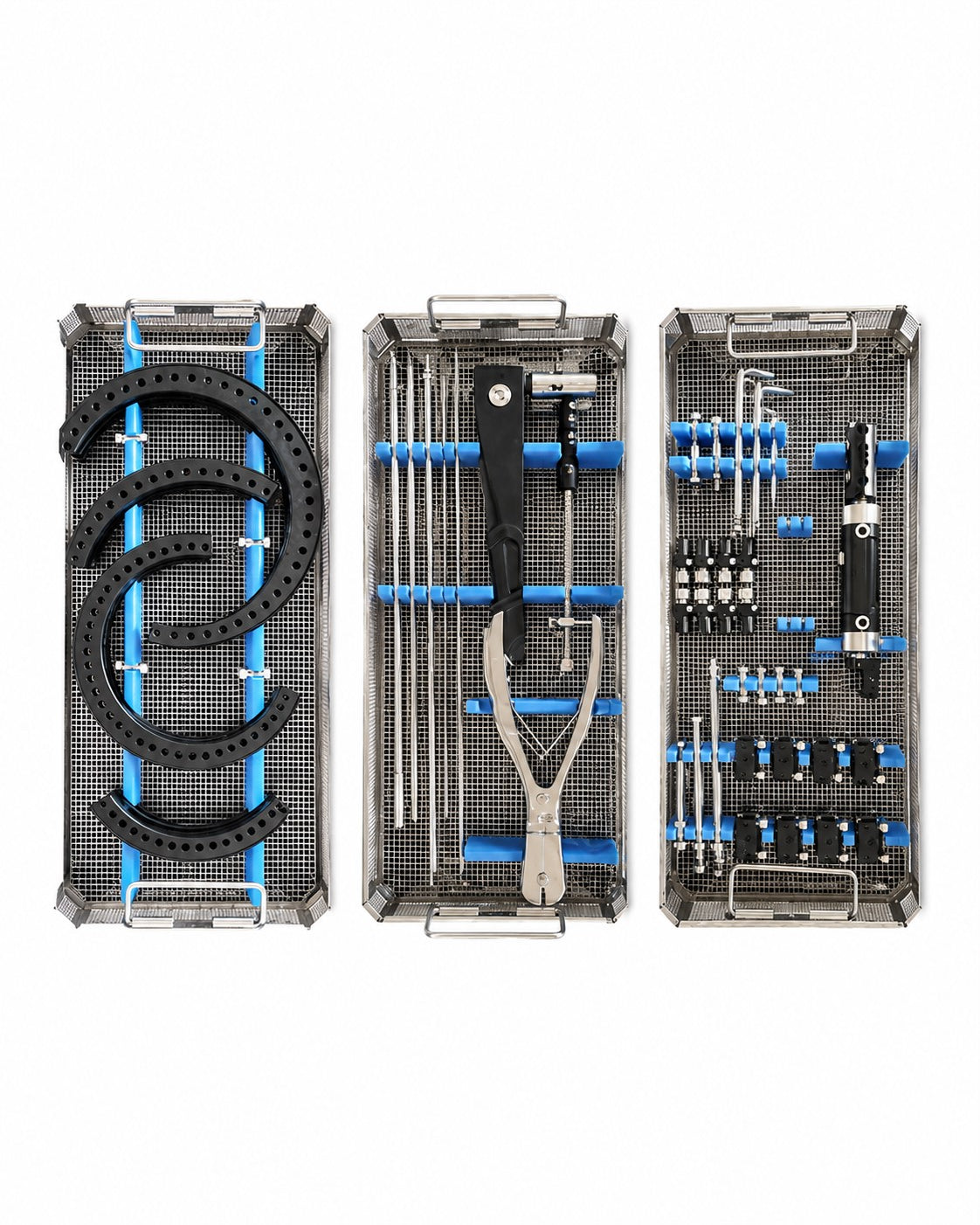
Hybrid Fixation System Sterilization Box, SKU PS-OP-6031, is a reusable orthopedic circular-linear external fixation system manufactured from German-forged stainless steel for periarticular fracture stabilization, frame-assisted reduction, compression-distraction, and limb reconstruction. The Q.440 configuration combines three trays with Ø150 mm and Ø190 mm partial rings, ring locking screws, X-wire securing pins, three-hole wire clamp slider units, wire guide, wire tensioner, supplementary screw-holder clamps, independent wire clamps, 50–150 mm posts, and Ø2 mm X-wires in 400 mm and 450 mm lengths. The Standard Hybrid Fixator Assembly contains a D.A.F. Standard Central Body, Compression-Distraction Unit Standard, D.A.F. Straight Clamp, and Hybrid Coupling with Ball-Joint. Lateral-olive, central-olive, and non-olive wires provide different fixation and reduction functions within the circular frame. The system is configured for orthopedic trauma and limb-reconstruction procedures including complex tibial plateau fractures, distal tibial and pilon fractures, selected periarticular injuries with compromised soft tissue, staged external fixation, gradual deformity correction, and other circular fixation workflows. It is intended for orthopedic trauma surgeons, limb reconstruction specialists, hospital operating rooms, and external-fixation services.
The Q.440 Hybrid Fixation System combines partial circular rings with tensioned transosseous wire fixation and a standard linear hybrid assembly. Ø2 mm X-wires pass through the selected bone segment and are connected to the ring using Two-Hole X-Wire Securing Pins, Three-Hole Wire Clamp Slider Units, or Independent Wire Clamps according to the planned construct. The Wire Tensioner applies controlled tension after wire placement so the wire becomes a mechanically active part of the ring frame rather than remaining a loose transosseous pin. Olive wires add a fixed enlargement along the shaft that can bear against cortical bone or a fragment during reduction. When an appropriately positioned olive wire is tensioned, it can draw a fragment toward the ring or opposing fixation element; lateral-olive and central-olive configurations provide different positions of that reduction feature along the wire. Ring Locking Screws stabilize assembled ring connections. The Hybrid Fixator Standard Assembly creates the transition to the linear portion of the construct. Its ball-joint coupling allows angular orientation between frame sections before locking, while the standard compression-distraction unit provides controlled longitudinal adjustment. The D.A.F. central body and straight clamp create the structural pathway between the circular fixation level and compatible linear fixation components.
In periarticular external fixation, the Hybrid Fixation System is assembled after fracture morphology, soft-tissue condition, reduction requirements, and safe wire corridors have been assessed. For a complex tibial plateau fracture, a Ø150 mm or Ø190 mm partial-ring configuration can be positioned around the proximal tibia while compatible Ø2 mm wires stabilize the metaphyseal or periarticular fragment. Lateral-olive or central-olive wires can be incorporated where directional fragment control or compression is required, while non-olive wires provide transosseous fixation without an integral reduction stop. The Wire Guide assists controlled positioning and the Wire Tensioner establishes the required tension before the securing hardware is definitively locked. Supplementary Screw Holder Clamps and the Standard Hybrid Fixator Assembly allow the circular fixation level to integrate with compatible linear fixation elements used along the diaphyseal segment. The ball-joint permits adjustment between the periarticular ring plane and shaft fixation axis before final frame locking. During distal tibial or pilon reconstruction, the same principles allow fixation to be established while minimizing additional surgical exposure through compromised soft tissue. Reduction and subsequent compression-distraction adjustments are performed according to the fracture pattern, frame plan, radiographic assessment, and treating surgeon’s reconstruction protocol.
The Q.440 configuration provides different ring envelopes, wire patterns, post lengths, and adjustment components so the frame can be adapted to anatomical size and fracture geometry. The Ø150 mm group includes three 2/3 rings and two 1/3 rings, providing a compact circular envelope where limb circumference permits. The supplied table separately identifies Q.440.007 and Q.440.009 as Ø190 mm 2/3 rings, with two units under each catalog reference. Larger internal diameter increases clearance around a greater soft-tissue envelope. Posts are supplied at 50, 100, and 150 mm, three of each, allowing different offsets and connection distances within the construct. Eight lateral-olive X-wires measure Ø2 mm × 400 mm. Central-olive variants include four 400 mm and four 450 mm wires, while non-olive wires are supplied as four 400 mm and four 450 mm pieces. Eight Ring Locking Screws, eight Two-Hole X-Wire Securing Pins, eight Three-Hole Wire Clamp Slider Units, eight Supplementary Screw Holder Clamps, and two Independent Wire Clamps provide repeated fixation points. Three Allen wrench sizes support mechanical adjustment of compatible connections throughout frame assembly and revision.
Set Includes:
| Code No. | Set Consisting of | Units |
|---|---|---|
| Q.440.001 | Tray | 3 |
| Q.440.003 | 2/3 Ring, inner Ø 150 mm | 3 |
| Q.440.005 | 1/3 Ring, inner Ø 150 mm | 2 |
| Q.440.007 | 2/3 Ring, inner Ø 190 mm | 2 |
| Q.440.009 | 2/3 Ring, inner Ø 190 mm | 2 |
| Q.440.011 | Ring Locking Screw | 8 |
| Q.440.013 | Two-Hole X-Wire Securing Pin | 8 |
| Q.440.015 | Three-Hole Wire Clamp Slider Unit | 8 |
| Lower Tray Consisting of: | ||
| Q.440.017 | Wire Guide | 1 |
| Q.440.019 | Wire Tensioner | 1 |
| Q.440.021 | Hybrid Fixxator Standard Assembly Kit Consisting of: 1 D.A.F. Standard Central Body, 1 Compression-Distraction Unit Standard, 1 D.A.F. Straight Clamp, 1 Hybrid Coupling with Ball-Joint | 1 set |
| Q.440.023 | Wire Cutter | 1 |
| Q.440.025 | Suppliementary Screw Holder Clamp | 8 |
| Upper Tray Consisting of: | ||
| Q.440.027 | Allen Wrench 6 mm | 2 |
| Q.440.029 | Allen Wrench 5 mm | 2 |
| Q.440.031 | Allen Wrench 3 mm | 2 |
| Q.440.033 | Independent Wire Clamp | 2 |
| Q.440.035 | Post, length 50 mm | 3 |
| Q.440.037 | Post, length 100 mm | 3 |
| Q.440.039 | Post, length 150 mm | 3 |
| Q.440.041 | X-Wire with lateral olive Ø2 mm, length 400 mm | 8 |
| Q.440.043 | X-Wire with central olive Ø2 mm, length 400 mm | 4 |
| Q.440.045 | X-Wire with central olive Ø2 mm, length 450 mm | 4 |
| Q.440.047 | X-Wire without olive Ø2 mm, length 400 mm | 4 |
| Q.440.049 | X-Wire without olive Ø2 mm, length 450 mm | 4 |
The Hybrid Fixation System Sterilization Box uses reusable orthopedic components manufactured within Peak Surgicals’ German-forged stainless-steel platform for repeated assembly, adjustment, cleaning, inspection, and hospital sterilization. Ring segments, posts, locking screws, clamps, securing pins, wire sliders, and the Standard Hybrid Fixator Assembly require dimensional stability because distortion or damaged threads can alter frame alignment or locking security. The Wire Tensioner, ball-joint coupling, and compression-distraction mechanism should be inspected after every clinical cycle for free controlled movement, positive locking, and abnormal mechanical play. Olive and non-olive X-wires should be treated according to the device labeling and institutional handling protocol applicable to transosseous fixation components. Reusable hardware requires direct cleaning around threads, clamp faces, slider channels, coupling interfaces, wrench recesses, and moving mechanisms before rinsing, drying, inspection, packaging, and sterilization. The three-tray configuration supports component separation and inventory reconciliation. Peak Surgicals operates within an ISO 13485 medical-device quality-management framework and supports CE-marked instrumentation for applicable markets. FDA-related U.S. procurement should be documented through the applicable registration, listing, labeling, and regulatory records rather than interpreted as blanket individual product approval.
| Specification | Details |
|---|---|
| SKU | PS-OP-6031 |
| System Reference | Q.440 Series |
| Product Name | Hybrid Fixation System Sterilization Box |
| Price | $1,648.90 USD |
| Size/Gauge Variants | Ø150 mm and Ø190 mm partial rings; Ø2 mm X-wires in 400 mm and 450 mm lengths; posts in 50 mm, 100 mm, and 150 mm lengths |
| Instrument Count | 25 coded Q.440 references; 89 listed units, corresponding to approximately 92 individual physical components when the four-piece Standard Assembly Kit is counted separately |
| Instrument Category | Orthopedic Hybrid Circular and Linear External Fixation System |
| Procedure | Complex periarticular fracture stabilization, tibial plateau and distal tibial fixation, staged external fixation, compression-distraction, and selected limb-reconstruction workflows |
| Material | German-forged medical-grade stainless steel |
| Finish | Machined surgical finish with functional threaded, clamping, wire-securing, and adjustment interfaces |
| Sterilization | Reusable system components processed through validated institutional cleaning and sterilization protocols according to applicable device instructions |
| Instrument Classification | Orthopedic circular-linear external fixation system and reusable fixation instrumentation |
| Reusable | Reusable system hardware; X-wire handling and reuse status follow applicable product labeling |
| Certifications | CE and ISO 13485 procurement framework with applicable FDA regulatory documentation |
| Warranty | 1-Year Limited Warranty |
| MOQ | 1 Set |
| OEM / Custom Orders | Available for hospitals, orthopedic trauma centers, distributors, and institutional procurement requirements |
| After-Sale Service | Return, replacement, and warranty support under Peak Surgicals commercial terms |
How does this Hybrid Fixation System differ from a conventional unilateral external fixator?
The Hybrid Fixation System combines tensioned wire-based circular fixation with a linear external-fixation assembly in one construct. A conventional unilateral frame predominantly uses fixation screws or half-pins connected to a bar positioned along one side of the limb. The hybrid arrangement allows a short metaphyseal or periarticular fragment to be stabilized with thin transosseous wires attached to partial rings. The diaphyseal portion can then be connected through the D.A.F. Standard Assembly and compatible linear fixation components. This architecture is particularly relevant when the fragment close to the knee or ankle provides limited space for several conventional half-pins. The ball-joint coupling also allows the orientation of the circular and linear sections to be reconciled before definitive frame locking.
How are the Ø150mm and Ø190mm rings and Ø2mm X-wire lengths selected?
Ring diameter is selected according to limb circumference, operative level, soft-tissue swelling, and the clearance required between skin and frame. The Ø150 mm ring group creates the more compact external envelope where adequate soft-tissue clearance can still be maintained. The Ø190 mm references provide a larger internal space for a greater limb circumference or more substantial postoperative swelling. The 400 mm and 450 mm X-wire lengths provide different working spans across the limb and external frame. Olive configuration is selected separately according to whether the wire is intended primarily for fixation or also to generate directional fragment control during tensioning. The supplied configuration includes lateral-olive, central-olive, and non-olive Ø2 mm wires so the surgeon can construct the wire arrangement according to anatomy and the planned reduction strategy.
What do CE, ISO 13485 and FDA requirements mean when purchasing this system?
The Hybrid Fixation System Sterilization Box is supplied within Peak Surgicals’ medical-device manufacturing and procurement framework. ISO 13485 relates to the quality-management system used to control medical-device manufacturing and associated production processes. CE documentation addresses conformity requirements applicable to regulated markets where the system is supplied. For United States procurement, FDA compliance concerns applicable manufacturer registration, device listing, labeling, quality-system requirements, and supporting regulatory records. FDA approved should not be applied automatically as a blanket description to every component unless that exact regulatory status applies to the individual device. Hospitals and distributors can maintain the applicable documentation alongside vendor qualification, purchasing, external-fixation inventory, sterilization, and traceability records.
How do the Wire Tensioner, olive wires, ball-joint and compression-distraction unit function?
The Wire Tensioner applies controlled tension to a compatible X-wire after it has been secured within the planned circular frame. An olive creates a mechanical stop along the wire that can bear against bone, allowing appropriately directed tension to assist fragment translation or compression. The Hybrid Coupling with Ball-Joint connects the circular frame section with the D.A.F. linear assembly while allowing angular adjustment before locking. This permits the surgeon to align the periarticular ring plane with a different diaphyseal frame axis. The Standard Compression-Distraction Unit provides controlled longitudinal adjustment between connected frame elements when compression or distraction forms part of the reconstruction plan. These mechanisms should be inspected for free motion and secure locking before assembly because each controls a different aspect of reduction or frame geometry.
How should hospitals manage and sterilize the complete Q.440 Hybrid Fixation System?
The Q.440 system contains numerous threaded, clamping, sliding, and adjustment interfaces that require direct cleaning after use. Ring locking screws, securing pins, wire clamps, posts, Allen-key interfaces, the ball-joint coupling, and compression-distraction mechanism should be opened or separated to the extent permitted by the applicable reprocessing instructions. Components should then be rinsed, completely dried, and inspected for corrosion, deformation, damaged threads, impaired clamping, or abnormal mechanical play. The Wire Tensioner and Wire Cutter require functional inspection before they are returned to the tray. Sterile processing teams should reconcile the inventory against all 25 Q.440 catalog references and the three tray sections before packaging. The current supplied configuration represents 89 listed units and approximately 92 individual physical pieces when the four components inside the Standard Hybrid Fixator Assembly Kit are counted separately.


