
Featured Collection
Your cart
Featured Collection

PEAK SURGICAL
SKU:PS-6935-1
Couldn't load pickup availability
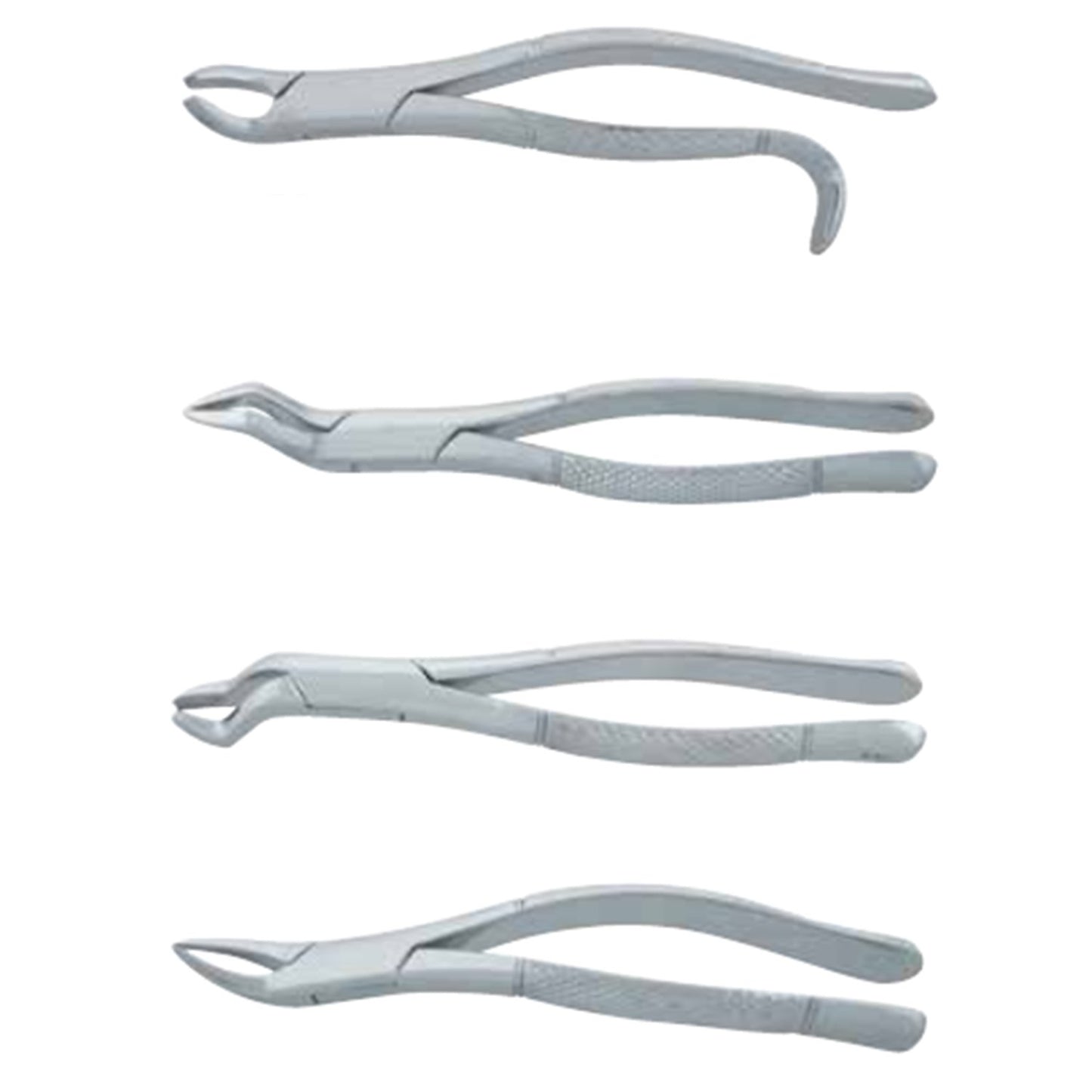

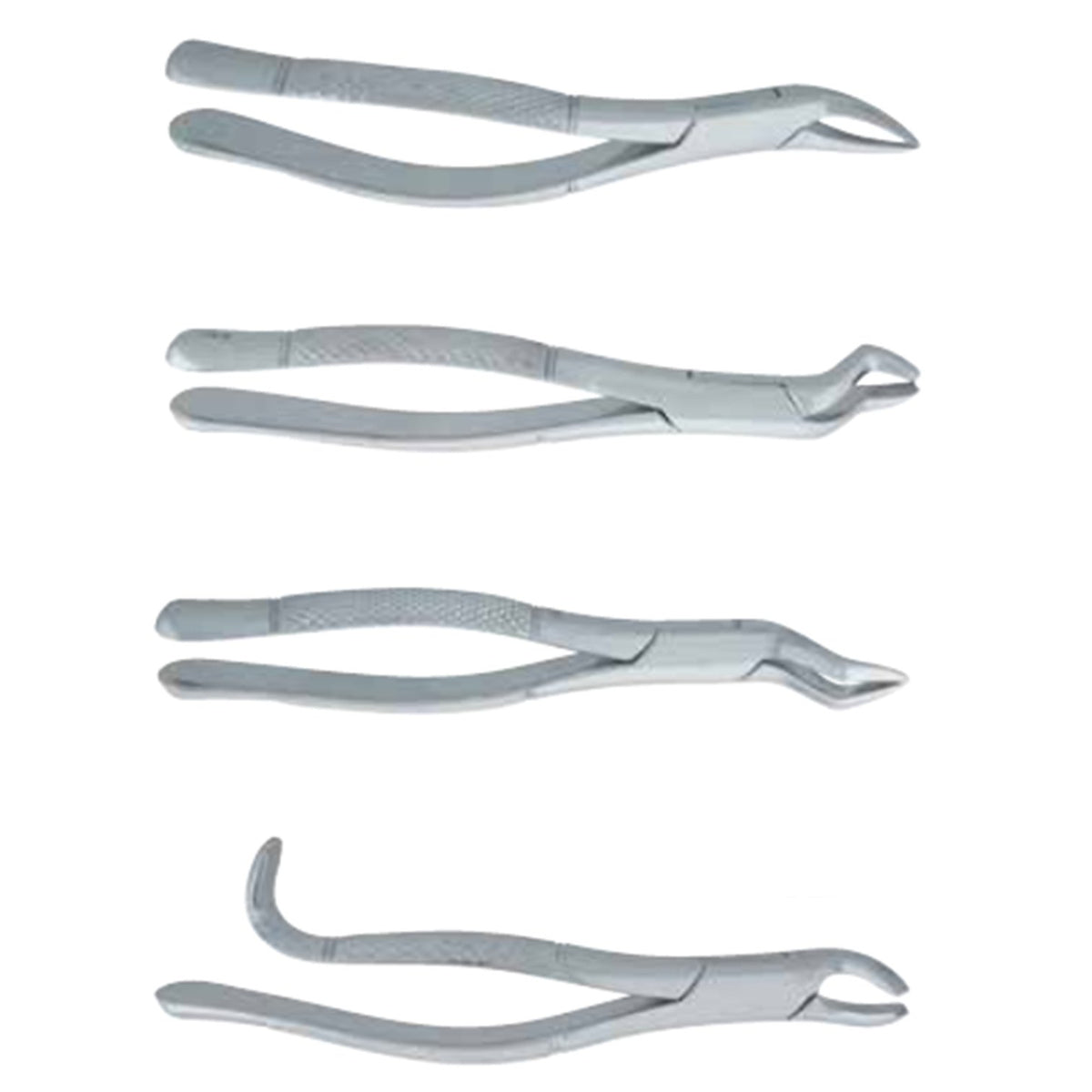
The Extracting Forceps 4pcs Set (PS-6935 series) is a selection of four German stainless steel dental extraction forceps identified by established international pattern numbers — No. 18L (PS-6935), No. 286 (PS-6936), No. 53L (PS-6937), and No. 69 (PS-6938) — each with a beak geometry specific to a defined tooth type and arch position, allowing dentists and oral surgeons to select the clinically correct forceps for upper molar, lower molar, premolar, and anterior tooth extractions. Unlike a generic forceps identified only by overall length, these four pattern numbers carry precise tooth-type and arch-specific clinical designations that have been standardized in dental instrument manufacturing: No. 18L for upper left molar extraction with the beak geometry configured for maxillary molar furcation anatomy; No. 286 for lower molar extraction with dual-pointed beaks engaging the buccal furcation of mandibular molars; No. 53L for upper left premolar extraction; and No. 69, a root fragment forceps pattern for the retrieval of retained root tips or fractured root segments. Manufactured from German stainless steel for the corrosion resistance and structural integrity required of reusable dental instruments that bear substantial extraction forces and undergo repeated steam autoclave sterilization. Used by dentists, oral surgeons, and maxillofacial surgeons in dental clinics, oral surgery units, and hospital dental departments. Each pattern is sold individually at $12.10 per piece — select the pattern number required for your extraction case.
Each of the four pattern numbers in this set has a specific beak design corresponding to the anatomical requirements of the tooth or tooth group it is designed for. No. 18L is an upper molar forceps configured for the left side of the maxillary arch — the "L" designation indicates left, meaning the beak geometry is asymmetric and designed to engage the palatal and buccal roots of upper left molars; the corresponding right-side pattern is No. 18R. Upper molar forceps beaks are designed with one broader beak that engages the palatally-positioned palatal root and one beak that engages the buccal furcation between the mesiobuccal and distobuccal roots, with the asymmetric beak geometry of the 18L oriented specifically for the upper left second and first molar anatomy. No. 286 is a lower molar forceps with dual-pointed beaks — both beaks terminate in a projection or point that is designed to engage the buccal and lingual furcations of mandibular molars, providing positive mechanical engagement at the furcation rather than relying on smooth beak-to-root contact alone, which is the defining feature of mandibular molar forceps compared to anterior or premolar patterns. No. 53L is an upper left premolar forceps, with a narrower beak profile than the molar patterns, designed to engage the narrower root of a maxillary premolar; the "L" designation again indicates the left-side beak orientation. No. 69 is a root forceps — a pattern designed not for intact crown-and-root tooth delivery but for the retrieval of retained root tips or fractured root segments that remain in the socket after crown separation, with fine, closely approximating beaks designed to engage small root fragments at or below the alveolar crest level without the broad beak engagement area of a full tooth extraction forceps.
Upper molar extraction is recognized as one of the more technically demanding routine extractions in dental practice, because maxillary molars are typically trifurcated — they have three roots (one palatal root and two buccal roots, the mesiobuccal and distobuccal) — and their extraction requires either successful delivery of the intact tooth with all three roots attached, or surgical sectioning into segments for multi-rooted extraction when root morphology, root curvature, or root divergence makes intact delivery inadvisable. The No. 18L beak design addresses the asymmetric root anatomy of the upper left maxillary molar: the beaks are configured to engage the palatal root on the palatal aspect and the buccal furcation between the two buccal roots on the buccal aspect, seating as far apically as the alveolar crest permits on each side to maximize root engagement. The extraction movements for upper molars involve primarily buccal-to-palatal rocking to progressively dilate the socket walls and disrupt the periodontal ligament in the direction of least resistance — typically toward the buccal, where the outer alveolar plate is thinner than the palatal plate — before rotating or delivering the tooth. The "L" designation is critical to selecting the correct forceps: a No. 18L beak applied to an upper right molar would engage the roots in the wrong orientation, reducing beak seating and root engagement and potentially misdirecting extraction forces.
The No. 286 lower molar forceps pattern is characterized by its dual-pointed beak design — both beaks terminate in a projecting point rather than a smooth, broad contact surface. This design reflects the anatomy of mandibular molars, which are bifurcated with a mesial and distal root separated by a furcation on both the buccal and lingual surfaces of the root complex, and the furcation provides the most anatomically reliable purchase point for extraction forces. The pointed beak projections of the No. 286 are designed to engage these furcations — one beak engages the buccal furcation and one engages the lingual furcation — providing a positive mechanical lock between the beak tips and the furcation anatomy that resists beak slippage during the sustained extraction forces required for mandibular molar delivery. The mandibular molar forceps handle is typically angled relative to the beaks to allow the dentist to approach the lower molar along the long axis of the teeth without the handle impeding access from the mandibular arch angle, a geometric requirement that distinguishes mandibular molar patterns from maxillary patterns. Mandibular molar extraction movements rely primarily on buccal-lingual rocking to progressively dilate the socket, with buccal rocking typically less productive than lingual rocking given the thicker lingual cortical plate of the mandible, followed by delivery with a combination of outward and rotational force once adequate socket dilation has been achieved.
Root tip or root fragment retention in the socket after crown separation during extraction — whether from fracture of a brittle or endodontically treated tooth, iatrogenic separation, or failure to deliver a divergent root intact — is a recognized complication of dental extractions that requires either retrieval of the retained fragment or, in specific clinical circumstances, deliberate retention under informed patient consent with radiographic documentation. The No. 69 root forceps addresses the retrieval scenario: with fine, closely approximating beaks designed to engage a small root fragment at or below the alveolar crest level, this instrument can grip and deliver root tips that have separated from the crown and cannot be gripped by standard extraction forceps, whose broader beaks are designed for intact crown-and-root engagement. The No. 69's beak geometry allows the clinician to slide the beaks along the bony socket wall to access the root fragment below the alveolar crest, engaging the fragment's apical surface or its wall for retrieval. This pattern complements the other three forceps in this set — No. 18L and No. 53L for maxillary teeth and No. 286 for mandibular molars — by providing the root fragment retrieval instrument needed when extraction with those patterns results in an intraoperative root fracture.
All four forceps patterns in this set are manufactured from German stainless steel, providing the structural strength and corrosion resistance required of reusable dental extraction instruments that bear significant torsional and tensile forces during the luxation and delivery phases of tooth extraction, and undergo repeated steam autoclave sterilization between procedures. The hinge mechanism of each forceps — the pivot connecting the two arms — is subject to the greatest mechanical stress during extraction and should be inspected at each reprocessing cycle for wear, looseness, or deformation. The beak gripping surfaces and, for the No. 69 root forceps and No. 286, the beak tip projections, should be inspected for any damage or dulling that could compromise the security of tooth or root engagement during extraction. All four instruments are fully compatible with steam autoclave sterilization at 134°C pre-vacuum parameters, the standard method for reusable dental instruments. Available in satin, dull, or mirror surface finish.
The Extracting Forceps 4pcs Set (PS-6935 series) is manufactured under a quality management system certified to ISO 13485, governing German stainless steel material sourcing, precision forging and machining of the forceps shanks, beaks, and hinge mechanisms across all four pattern numbers, dimensional and functional inspection of beak geometry for each pattern's specific tooth-type indication, surface finishing, and packaging. CE Mark certification confirms conformity with European Medical Device Regulation requirements for Class I reusable dental surgical instruments distributed within EU and associated regulatory territories. FDA compliance documentation is maintained for United States distribution, satisfying regulatory requirements for reusable dental extraction instruments procured by US dental clinics, oral surgery units, and dental instrument distributors. These certifications satisfy procurement and tender documentation requirements of institutional buyers in the USA, India, Pakistan, Vietnam, and across international dental instrument supply frameworks. Certificates of conformity and quality management system documentation are available on request. OEM manufacturing is available within the same certified manufacturing framework.
| SKU (Set) | PS-6935-1 |
|---|---|
| Product Name | Extracting Forceps 4pcs Set |
| Price | $12.10 USD per piece |
| No. 18L (PS-6935) | Upper left molar forceps — asymmetric beak for maxillary left molar palatal/buccal root engagement |
| No. 286 (PS-6936) | Lower molar forceps — dual-pointed beaks for mandibular molar buccal/lingual furcation engagement |
| No. 53L (PS-6937) | Upper left premolar forceps — narrower beak profile for maxillary left premolar root |
| No. 69 (PS-6938) | Root forceps — fine approximating beaks for retained root tip and fractured root fragment retrieval |
| Instrument Classification | Class I Reusable Dental Surgical Instrument |
| Clinical Settings | Dental clinic, oral surgery unit, hospital dental department |
| Users | Dentists, oral surgeons, maxillofacial surgeons |
| Material | German Stainless Steel |
| Surface Finish | Satin / Dull / Mirror |
| Certifications | CE Mark, ISO 13485, FDA |
| Reusability | Reusable |
| Quantity | 1 Piece per pattern selected |
| Rust Resistance | Yes |
| Warranty | 1 Year |
| MOQ | 1 Piece |
| OEM / Custom Orders | Available |
| Packing | Carton Box |
| Place of Origin | Pakistan |
| Brand | Peak Surgicals |
| Primary Use | Tooth-specific dental extraction using internationally standardized pattern numbers — No. 18L upper left molar, No. 286 lower molar, No. 53L upper left premolar, No. 69 root fragment retrieval |
| After-Sale Service | Return and Replacement |
What do the pattern numbers 18L, 286, 53L, and 69 mean, and how are they used to select the correct forceps?
Dental extraction forceps pattern numbers are standardized designations used internationally by dental instrument manufacturers to identify forceps by their beak geometry and corresponding tooth-type indication. No. 18L identifies an upper left molar forceps, with the "18" pattern indicating a maxillary molar beak geometry and the "L" indicating left-side orientation — the beak is asymmetric and positioned for correct engagement of upper left molar roots; the right-side counterpart is No. 18R. No. 286 identifies a lower molar forceps with dual-pointed beaks designed to engage the buccal and lingual furcations of mandibular molars, providing positive mechanical purchase at the furcation. No. 53L identifies an upper left premolar forceps with a narrower beak profile appropriate for the single-rooted maxillary premolar. No. 69 identifies a root forceps — a pattern designed for retrieving retained root tips or fractured root segments, with fine closely approximating beaks rather than the broad beak of a standard tooth extraction forceps. Pattern number selection is the primary means by which a dentist or procurement officer identifies the correct forceps for a specific clinical task, and the pattern numbers in this set cover four distinct and common extraction scenarios.
Why does the lower molar forceps (No. 286) have pointed beaks while the upper molar forceps (No. 18L) does not?
The beak geometry difference between upper and lower molar forceps reflects the different anatomy of maxillary and mandibular molar roots. Maxillary molars have three roots — one palatal and two buccal — arranged in a configuration where the palatal root is the largest and strongest. The No. 18L beak geometry is designed to engage the palatal root on one side and the buccal furcation between the two buccal roots on the other, without requiring pointed beak projections — the broad beak surface areas engage the root trunk and furcation area adequately given the three-root configuration. Mandibular molars have two roots — mesial and distal — with a clear buccal and lingual furcation between them. The furcation between mandibular molar roots is typically more accessible and provides the most reliable purchase point for extraction forces. The dual-pointed beaks of the No. 286 are designed specifically to engage these buccal and lingual furcations with pointed projections that lock mechanically into the furcation space, providing a more positive grip than smooth beaks would achieve on the divergent mandibular molar root trunk.
When is the No. 69 root forceps used, and how does it differ from the other three patterns?
The No. 69 root forceps is used when a tooth root or root fragment has separated from the crown and remains in the socket — a common intraoperative complication when extracting teeth with brittle or curved roots, endodontically treated teeth (which may be more prone to fracture), or when excessive or misdirected force during extraction with a standard forceps causes root separation. Unlike the No. 18L, No. 286, and No. 53L patterns, which are designed to grip a tooth's crown and root complex for delivery of the intact tooth, the No. 69 has fine, closely approximating beaks designed to access and grip a root fragment at or below the alveolar crest level, where the fragment may be located after crown separation. The fine beak profile allows the operator to slide the beaks along the bony socket wall to access the root fragment, engaging it for retrieval. This instrument is a standard component of an oral surgical extraction armamentarium because root tip retention — however managed — requires a deliberate decision and, when retrieval is chosen, a dedicated instrument with appropriate beak geometry for subcrestal root engagement.
What sterilization protocol is recommended for these instruments?
All four forceps patterns are manufactured from German stainless steel and are fully compatible with steam autoclave sterilization at 134°C pre-vacuum parameters, the standard method for reusable dental instruments. Before sterilization, each forceps should be cleaned of blood, tissue debris, and bone fragments from the extraction procedure, with particular attention to the hinge area and beak gripping surfaces, both of which can retain organic material in crevices that standard rinsing may not fully remove. Ultrasonic cleaning before terminal sterilization is recommended for thorough debris removal from the hinge mechanism and beak surfaces. The pointed beak projections of the No. 286 and the fine approximating beaks of the No. 69 should be inspected at each reprocessing cycle for any damage, as compromised beak geometry directly affects the instrument's grip and extraction control.
What certifications does this set carry, and are bulk or OEM orders available?
All four forceps in this set are manufactured under an ISO 13485-certified quality management system covering German stainless steel material procurement, precision forging and machining of the shanks, beaks, and hinge mechanisms across all four pattern numbers, and packaging. CE Mark certification confirms conformity with European Medical Device Regulation requirements for Class I reusable dental surgical instruments. FDA compliance documentation supports United States distribution. Certificates of conformity are available on request for dental practice procurement and tender documentation. Bulk orders are accepted with a minimum of 1 piece per pattern, with volume pricing available for dental clinics, oral surgery units, hospital dental departments, and dental instrument distributors. Peak Surgicals also offers OEM manufacturing for custom pattern configurations or private-label branding within the same ISO 13485-certified framework. Free shipping applies on orders of $99 or more.


