
Featured Collection
Your cart
Featured Collection

PEAK SURGICAL
SKU:PS-TPCIS-00109
Couldn't load pickup availability
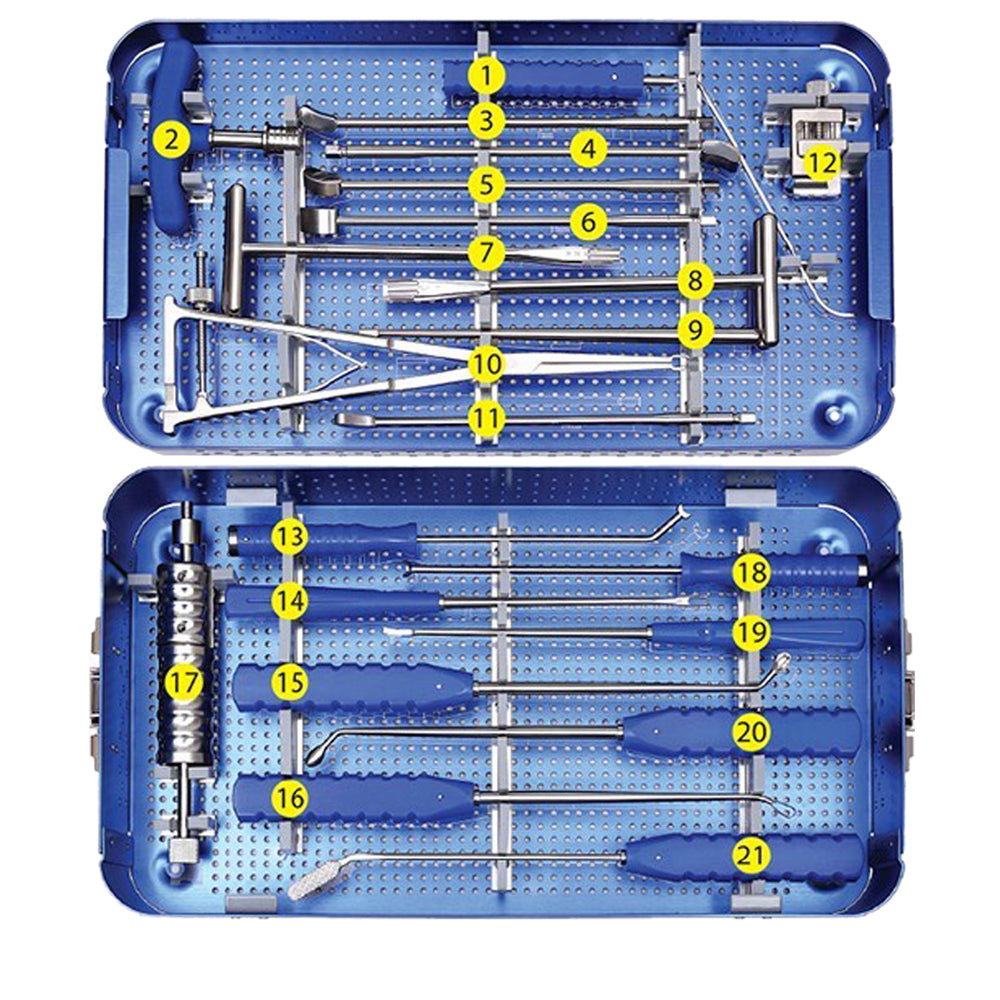
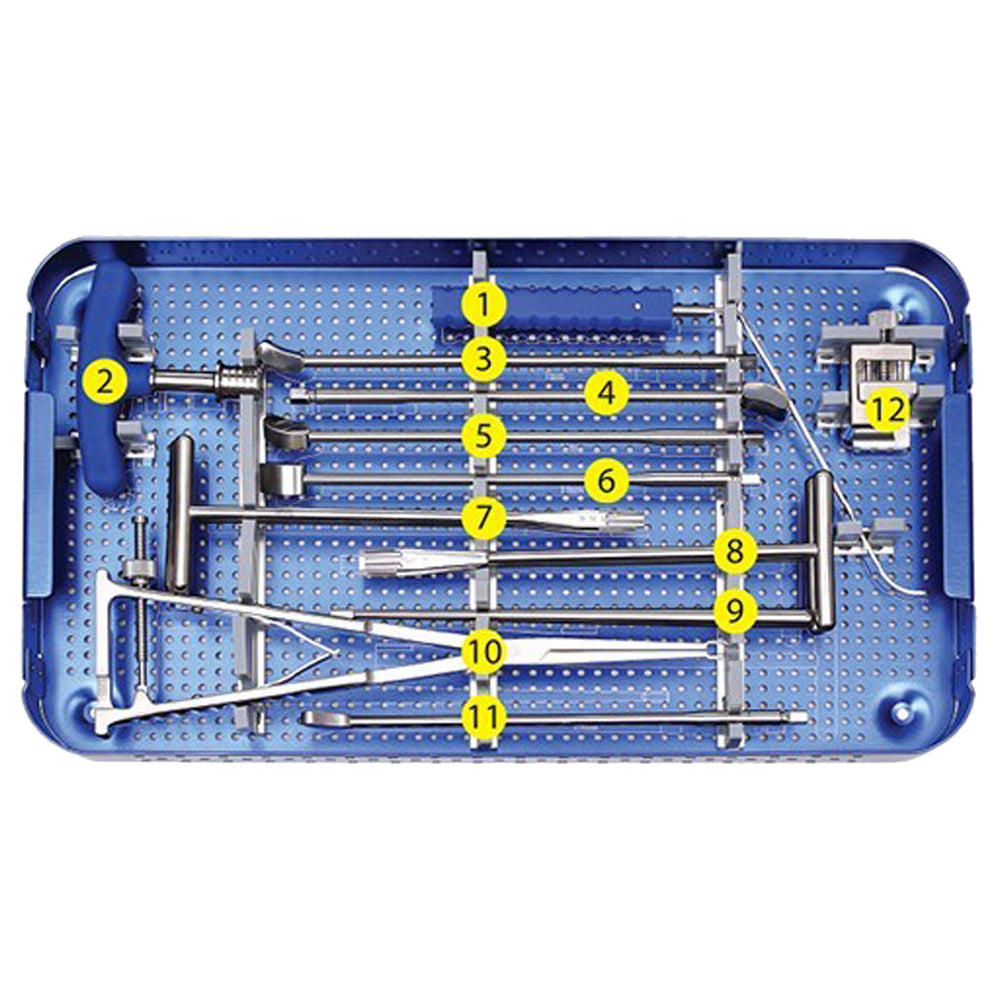
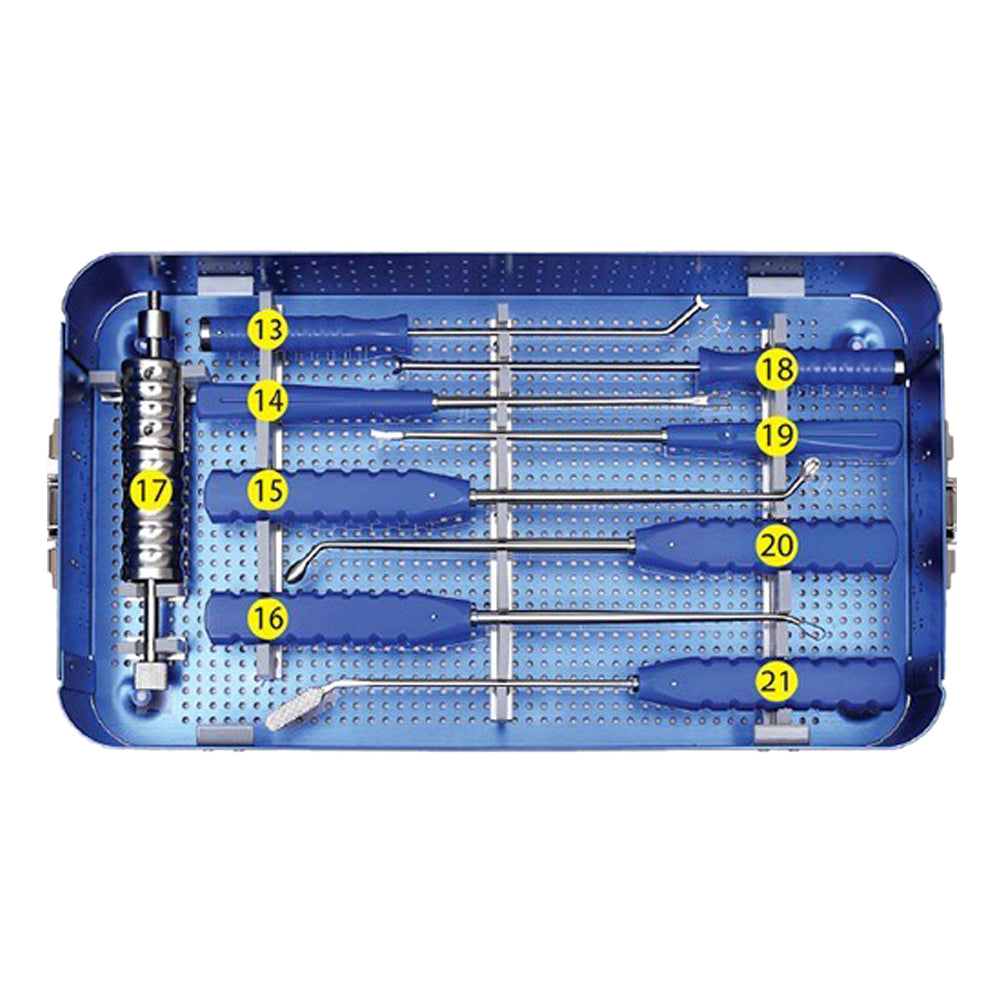
The TLIF PEEK Cage Instrument Set (PS-TPCIS-00109) is a 22-piece stainless steel surgical instrumentation kit supplied in an aluminium case, designed for disc space preparation, trial sizing, and cage insertion in transforaminal lumbar interbody fusion (TLIF) procedures. The set provides the complete sequence of instruments needed from initial disc space access through final cage placement: a five-size trial series (7×25mm, 9×25mm, 11×25mm, 13×25mm, and 15×25mm) for progressive disc space sizing and height confirmation under fluoroscopic guidance; a four-size flat reamer series (7mm, 9mm, 11mm, and 13mm) for end-plate decortication and disc space preparation; an insert guider and T-handle quick coupling for reamer and trial driveshaft control; a cage holding forceps, curved implanter, and straight implanter for cage positioning and final seating; a bone graft inserter and bone graft cage component for delivering osteoinductive material into the prepared disc space; a set of bone curettes — side curettes in 6mm and 8mm, curettes in 8mm right and left configurations, and a 7mm ring curette — for manual disc material removal and end-plate preparation in the corners of the disc space that reamers cannot reach; a bone file for end-plate surface refinement; and a sliding hammer for controlled impaction during cage delivery. Manufactured from surgical-grade stainless steel for autoclave sterilization compatibility across the operative service life of the set. This is a 22-piece set distinct from the Peak Surgicals 44-piece TLIF PEEK Cage T-PAL Spacer Set, which additionally includes a full range of PEEK interbody cage implants and a broader instrument complement. Used by spine surgeons and neurosurgeons performing TLIF procedures in hospital spine surgery suites and neurosurgical operating rooms. Supplied complete in the aluminium case.
Transforaminal lumbar interbody fusion involves accessing the disc space through a unilateral transforaminal corridor, removing the disc material and cartilaginous end-plate, preparing the bony end-plates to bleeding bone for fusion, sizing the disc space for the appropriate interbody cage height, delivering bone graft material, and inserting the definitive cage. This 22-piece instrument set is configured to support each of these steps in sequence. Initial disc material removal and annulotomy is performed with standard discectomy instruments, after which the side curettes (6mm and 8mm), the 8mm curettes in right and left configurations, and the 7mm ring curette are used to remove residual disc material and begin end-plate decortication — the curved and angled profiles of these curettes allow access to the contralateral disc space and the posterior corners of the disc space that are difficult to reach from a unilateral transforaminal approach. The flat reamer series (7mm, 9mm, 11mm, 13mm) is then used, mounted on the insert guider and driven via the T-handle quick coupling, to decorticate the vertebral end-plates across the central disc space in progressively larger steps, removing the cartilaginous end-plate to expose bleeding subchondral bone while preserving the structural end-plate integrity needed to resist cage subsidence. The bone file provides final manual refinement of the end-plate surface in areas the reamers cannot fully address. The trial series (7×25mm through 15×25mm) is then sequentially inserted under fluoroscopic guidance to determine the disc space height and confirm the appropriate cage size before bone graft delivery via the bone graft inserter and cage insertion using the curved or straight implanter, with the cage holding forceps providing controlled cage manipulation during positioning and the sliding hammer providing controlled impaction force for final cage seating.
The five trial spacers in this set — sized 7×25mm, 9×25mm, 11×25mm, 13×25mm, and 15×25mm — represent the disc height options that the surgeon trials sequentially to determine the correct interbody cage height for the patient's prepared disc space, with the 25mm dimension representing the cage length/footprint that this trial series is matched to. Trial sizing is performed after disc space preparation is complete: the smallest trial that the surgeon expects to be appropriate based on preoperative imaging and intraoperative disc space assessment is inserted first, and the fluoroscopic appearance of disc space height restoration, foraminal height, and trial-end-plate contact is assessed. If the trial appears under-sized — insufficient restoration of disc height or foraminal height, or visible gap between the trial and the end-plates — the next larger trial is inserted and reassessed. This sequential process continues until the trial that achieves adequate disc space distraction, restores foraminal height sufficient to decompress the exiting and traversing nerve roots, and achieves firm end-plate contact without over-distraction is identified. Over-distraction — selecting a trial or cage that is too tall for the disc space — increases the risk of facet joint violation, excessive segmental kyphosis or lordosis correction beyond the planned target, and increased tension on the exiting nerve root that can produce postoperative radicular pain. Under-sizing risks inadequate fusion construct stability and persistent foraminal stenosis. The five-height range (7–15mm in 2mm increments) covers the disc height range from significantly collapsed degenerative discs through near-normal disc heights encountered in TLIF candidates, with the corresponding PEEK or other interbody cage selected to match the trial that achieves optimal fit.
The four flat reamers in this set — 7mm, 9mm, 11mm, and 13mm — provide progressive end-plate decortication that is one of the most clinically significant steps in achieving successful interbody fusion. The flat reamer design is specific to TLIF and other interbody fusion techniques where the goal is to remove the cartilaginous end-plate — a layer of hyaline cartilage covering the vertebral body end-plates that does not support bone-to-bone fusion if left in place — while preserving the underlying bony end-plate, which provides the structural support that resists cage subsidence under the axial loads of standing and ambulation. The flat profile of these reamers, in contrast to spherical or barrel-shaped reamers used in other applications, is designed to address the relatively flat geometry of the vertebral end-plate surfaces in the disc space, removing cartilage in a controlled planar pass rather than gouging into the subchondral bone. The progressive sizing from 7mm through 13mm allows the surgeon to begin with a smaller reamer appropriate to the access corridor width and progressively increase the reaming diameter as the disc space is cleared and access improves, achieving end-plate preparation across the full disc space surface area that will be in contact with the definitive cage. Inadequate end-plate preparation — residual cartilage left in place — is a recognized contributor to pseudarthrosis (failed fusion) in TLIF, making the reamer series a critical determinant of long-term fusion success independent of the cage material or design selected.
The cage insertion phase of TLIF places the definitive interbody cage — loaded with bone graft material via the bone graft inserter — into the prepared disc space, and this set provides the dedicated instruments for this phase. The cage holding forceps grips the cage securely during transfer from the back table to the surgical field and during initial positioning at the disc space entry point, providing the controlled grip needed to navigate the cage through the transforaminal corridor without dropping or misorienting it. The curved implanter and straight implanter provide two geometry options for cage delivery depending on the trajectory required: the curved implanter accommodates situations where the disc space access angle requires the cage to be guided along a curved path from the entry point to its final position across the disc space, while the straight implanter is used when a direct linear insertion trajectory is available. The sliding hammer provides controlled impaction force for final cage seating — a sliding weight mechanism that transmits a defined impact force along the implanter shaft to advance the cage the final millimetres into position without the uncontrolled force application that a standard mallet strike against the implanter handle would risk. This controlled impaction is particularly important during the final seating of the cage, where excessive force could drive the cage too far anteriorly, risking violation of the anterior longitudinal ligament or anterior vascular structures, while insufficient seating force leaves the cage in a suboptimal position with reduced end-plate contact area.
The TLIF PEEK Cage Instrument Set PS-TPCIS-00109 is manufactured under a quality management system certified to ISO 13485, governing surgical-grade stainless steel material sourcing, precision machining of all trial, reamer, curette, implanter, and ancillary instruments, dimensional inspection across all 22 components, aluminium case fabrication, and final set assembly and packaging. CE Mark certification confirms conformity with European Medical Device Regulation requirements for reusable spinal surgical instrument sets distributed within EU and associated regulatory territories. FDA compliance documentation is maintained for United States distribution, satisfying regulatory requirements applicable to reusable spinal instrumentation procured by US hospitals, spine surgery centers, and orthopedic and neurosurgical instrument distributors. These certifications satisfy procurement and tender documentation requirements of institutional buyers in the USA, India, Pakistan, Vietnam, and across international spinal surgical supply frameworks. Certificates of conformity and quality management system documentation are available on request. OEM manufacturing and custom set configurations are available within the same certified manufacturing framework.
| SKU | PS-TPCIS-00109 |
|---|---|
| Product Name | TLIF PEEK Cage Instrument Set |
| Price | $1,320.00 USD |
| Set Configuration | 22 pieces including aluminium case |
| Trial Series | 7×25mm, 9×25mm, 11×25mm, 13×25mm, 15×25mm (5 trials) |
| Flat Reamer Series | 7mm, 9mm, 11mm, 13mm (4 reamers) |
| Bone Curettes | Side Curette 6mm, Side Curette 8mm, Curette 8mm Right, Curette 8mm Left, Ring Curette 7mm (5 curettes) |
| Implanters | Curved Implanter, Straight Implanter |
| Driving Instruments | Insert Guider, T-handle Quick Coupling, Sliding Hammer |
| Graft Instruments | Bone Graft Inserter, Bone Graft Cage |
| Other Instruments | Cage Holding Forceps, Bone File |
| Storage Case | Aluminium Box (included) |
| Material | Surgical-Grade Stainless Steel |
| Procedure | Transforaminal Lumbar Interbody Fusion (TLIF) — disc space preparation, trial sizing, and cage insertion |
| Certifications | CE Mark, ISO 13485, FDA |
| Reusability | Reusable |
| Quantity | 1 Set (22 pieces) |
| Rust Resistance | Yes |
| Warranty | 1 Year |
| MOQ | 1 Set |
| OEM / Custom Orders | Available |
| Packing | Aluminium Case |
| Place of Origin | Pakistan |
| Brand | Peak Surgicals |
| Primary Use | Disc space preparation, trial sizing, and interbody cage insertion instrumentation for transforaminal lumbar interbody fusion procedures |
| After-Sale Service | Return and Replacement |
What procedure is this 22-piece instrument set designed for, and what does each instrument group do?
This set provides the instruments required for the disc space preparation, trial sizing, and cage insertion stages of transforaminal lumbar interbody fusion (TLIF). The bone curettes — side curettes (6mm, 8mm), curettes 8mm right and left, and a 7mm ring curette — are used early in the procedure to remove residual disc material and begin end-plate decortication, with their angled and curved profiles designed to reach the contralateral disc space and posterior corners that are difficult to access from a unilateral transforaminal approach. The flat reamer series (7mm, 9mm, 11mm, 13mm), driven via the insert guider and T-handle quick coupling, provides progressive end-plate decortication across the central disc space, removing cartilaginous end-plate to expose bleeding bone for fusion while preserving the structural end-plate. The bone file refines end-plate surfaces in areas the reamers cannot fully address. The trial series (7×25mm through 15×25mm) is sequentially inserted under fluoroscopy to determine the correct disc height and cage size. The bone graft inserter delivers osteoinductive graft material into the prepared disc space. Finally, the cage holding forceps, curved and straight implanters, and sliding hammer support cage positioning and controlled final seating. The aluminium case houses all 22 components for storage, transport, and sterilization.
How does this PS-TPCIS-00109 set differ from the Peak Surgicals TLIF PEEK Cage T-PAL Spacer Set with Surgical Instrumentation Kit?
Peak Surgicals offers two TLIF-related products that serve different procurement needs. This PS-TPCIS-00109 is a 22-piece instrument set focused on the core disc space preparation, trial sizing, and cage insertion instruments — a flat reamer series (7–13mm), a trial series (7×25mm through 15×25mm), bone curettes, implanters, and ancillary instruments, supplied without an extensive PEEK implant inventory. The T-PAL Spacer Set is a larger 44-component system that additionally includes 18 PEEK Cage-II interbody implants across two footprint widths (10mm and 12mm) and nine disc height increments (7mm through 17mm) with defined lordotic angles, along with a broader instrument complement including soft tissue retractors, a wider reamer range (7mm through 15mm, including duplicate 15mm reamers), bone graft funnel, spreader forceps, and dual T-PAL applicators, all at a correspondingly higher price point ($1,857.90 versus $1,320.00). A surgical facility that has an existing supply of PEEK interbody cages from another source, or that uses a different cage system, may select this PS-TPCIS-00109 instrument-focused set to equip their TLIF instrumentation without duplicating cage inventory. A facility seeking a complete cage-and-instrument package in a single procurement would consider the T-PAL Spacer Set. Both sets share the same fundamental TLIF disc preparation workflow — curettes, reamers, trials, and implanters — differing primarily in implant inclusion, reamer and trial range breadth, and total component count.
Why are there both flat reamers and bone curettes in this set, and what is the difference in their function?
Flat reamers and bone curettes both contribute to disc space and end-plate preparation, but they address different parts of the disc space and use different mechanical actions. The flat reamers are rotary instruments, driven via the insert guider and T-handle quick coupling, that decorticate the central portion of the vertebral end-plates in a controlled planar pass — they are effective across the open central disc space where a rotating instrument has clear access and where the flat geometry of the reamer matches the relatively flat end-plate surface. Bone curettes are hand-manipulated instruments with a cupped or ring-shaped cutting edge that the surgeon uses to scrape disc material and cartilage from areas the reamer cannot reach — particularly the posterior corners of the disc space near the annulus, the contralateral disc space beyond the reamer's rotational reach from a unilateral approach, and any residual disc material trapped against the posterior longitudinal ligament. The side curettes (angled cutting edge) and ring curette (circular cutting edge) in this set provide different access geometries for these peripheral preparation tasks. Comprehensive end-plate and disc space preparation typically uses both instrument types in combination — reamers for efficient central decortication and curettes for thorough peripheral and corner preparation — because incomplete preparation in any region of the disc space, even areas the reamer cannot efficiently address, can compromise fusion at that location.
What sterilization and instrument management protocol is recommended for this set?
All 22 instruments in this set are manufactured from surgical-grade stainless steel and are compatible with standard steam autoclave sterilization at 134°C pre-vacuum parameters. Before sterilization, the reamers, trials, and any instruments with cannulations or articulated joints require thorough cleaning to remove bone debris and tissue residue, typically using an enzymatic pre-soak followed by ultrasonic cleaning with brush access to cutting flutes and curette cup surfaces. The cutting edges of the curettes and the reaming surfaces of the flat reamers should be inspected at each reprocessing cycle for dulling or damage, as compromised cutting edges require increased force during use, which increases the risk of unintended tissue contact in the confined disc space environment. The aluminium case functions as both a transport container and a sterilization tray; before sterilization and immediately before opening the case in the operating theater, the case should be inspected to confirm all 22 components are present and correctly seated in their designated positions, as a missing trial size or reamer diameter discovered intraoperatively can delay the procedure at a critical decision point.
What certifications does this set carry, and are bulk or OEM orders available?
The TLIF PEEK Cage Instrument Set PS-TPCIS-00109 is manufactured under an ISO 13485-certified quality management system covering surgical-grade stainless steel procurement, precision machining of all trial, reamer, curette, implanter, and ancillary instruments, dimensional inspection across all 22 components, aluminium case fabrication, and final assembly. CE Mark certification confirms conformity with European Medical Device Regulation requirements for reusable spinal surgical instrument sets. FDA compliance documentation supports United States distribution. Certificates of conformity and quality management documentation are available on request for hospital procurement and tender processes. Bulk orders are accepted with a minimum of 1 set, with volume pricing available for hospitals, spine surgery centers, orthopedic and neurosurgical instrument distributors, and group purchasing organizations. OEM manufacturing for custom set configurations, alternative trial or reamer size ranges, or private-label branding is available within the same ISO 13485-certified framework. Free shipping applies on orders of $99 or more.
