
Featured Collection
Your cart
Featured Collection

PEAK SURGICAL
SKU:PS-NTINIS-00128
Couldn't load pickup availability
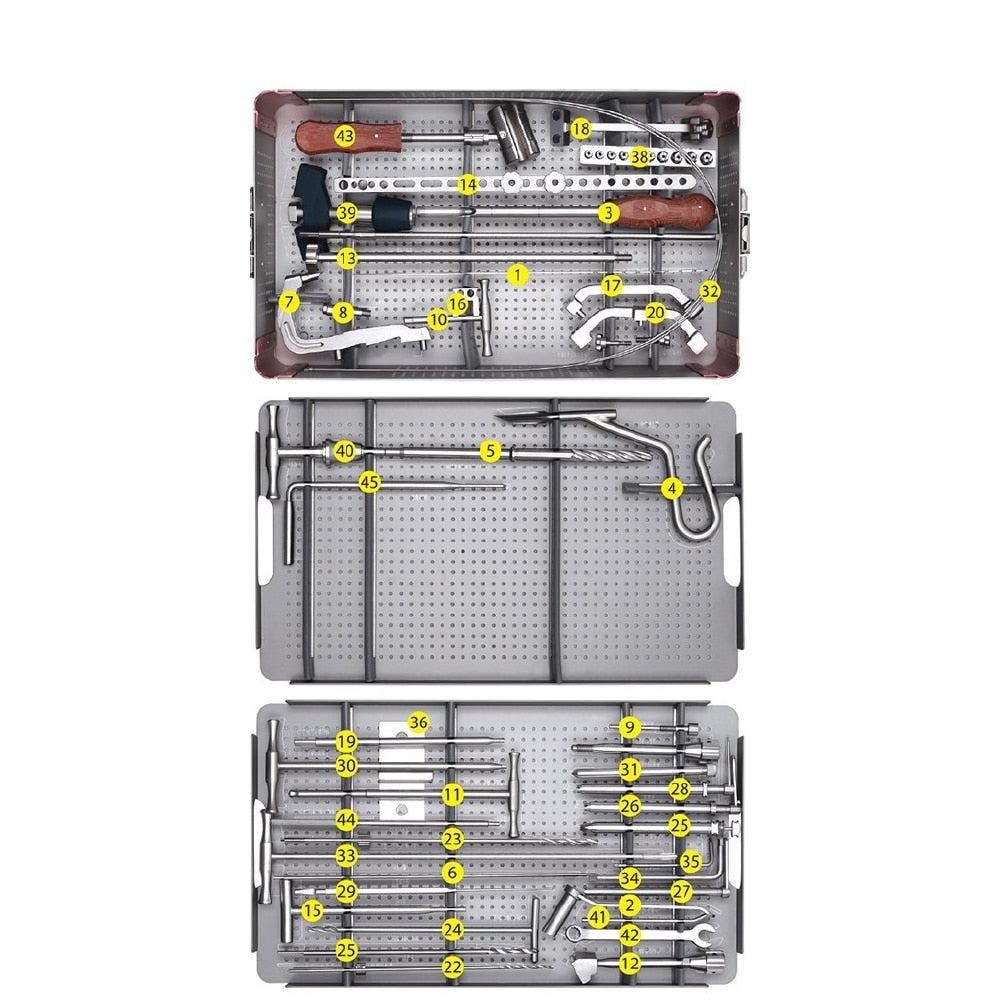
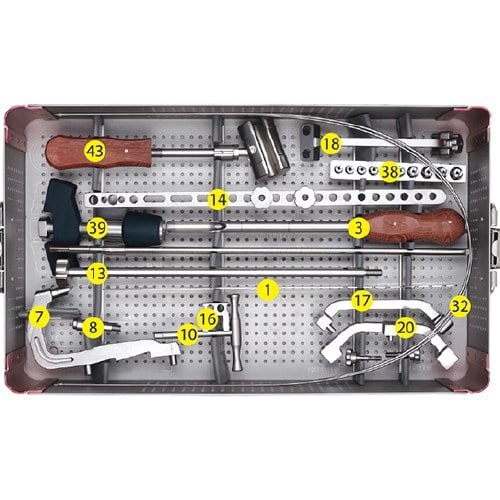
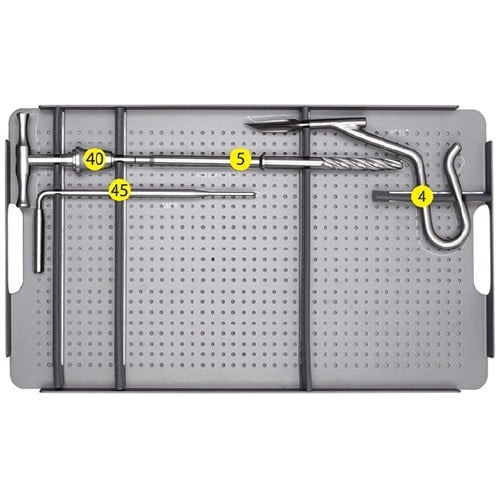
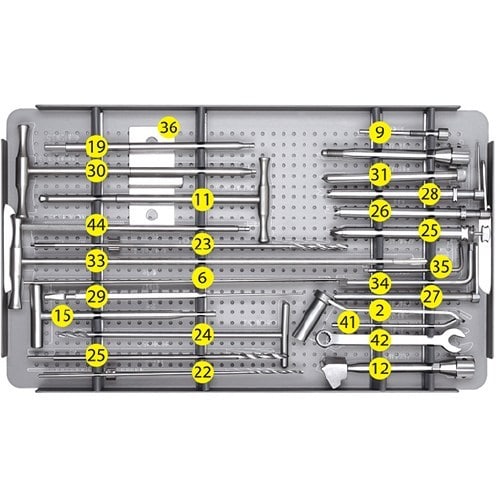
The Tibia Intramedullary Nail Instrument Set is a 47-piece stainless steel orthopedic instrument set engineered specifically for the insertion, proximal and distal locking, and extraction preparation of tibial intramedullary nails in the surgical fixation of tibial shaft fractures, proximal tibial fractures, and distal tibial fractures via both infrapatellar and suprapatellar entry portal approaches. The set is built around a tibia-specific entry system — comprising a cannulated AWL, proximal knife rod φ12/φ3.2, proximal knife rod T-handle, and cannulated chisel φ12/3.2 — and includes a flexible reamer bit spanning φ7.5 to φ12 for the narrower tibial medullary canal, a right-angle locking rod for the coronal-plane proximal locking geometry of tibial nail systems, separate proximal and distal target devices, a proximal cancellous target device with locking screw for metaphyseal fragment fixation, a developing calculator for intraoperative nail length determination, and a full complement of locking drill bits (φ3.2, φ4.0, φ5.2), drill sleeves, depth gauge, guide pins, and driving and extraction instruments. All instruments are housed in a labelled aluminium box. Used by orthopedic trauma surgeons, trauma fellows, and specialist scrub technicians in hospital trauma theaters, level-one trauma centers, and orthopedic surgery units. Sold as 1 complete set.
Tibial intramedullary nailing requires an entry portal at the proximal tibial metaphysis — either the traditional infrapatellar approach through the patellar tendon to the tibial tuberosity or the increasingly adopted suprapatellar approach through the patellofemoral joint with the knee in extension. Both approaches demand instruments that navigate the tibial plateau anatomy and establish the entry point precisely at the anterior cortex of the proximal tibia just medial to the lateral tibial spine, which is the anatomically correct entry axis for coaxial nail advancement down the medullary canal. The cannulated AWL in this set establishes initial cortical entry through the proximal tibia after the guide pin is positioned and confirmed under fluoroscopy, while the proximal knife rod φ12/φ3.2 and its T-handle provide the rotational drive to create a channel through the proximal cortex and cancellous metaphyseal bone large enough to accept the φ12 nail proximal end. The cannulated chisel φ12/3.2 expands the entry portal in denser bone where the knife rod alone does not achieve adequate opening without excessive force. The protection sleeve φ12 shields the patellar tendon and surrounding soft tissue from injury during AWL and knife rod insertion — a critical safeguard in the infrapatellar approach given the proximity of the tendon to the entry instruments. The protection plate provides additional peritendinous tissue protection during nail driving and locking steps. These entry instruments collectively represent the anatomically distinct feature of this set that distinguishes it from femoral nail instrument sets, where the piriformis fossa or greater trochanteric entry geometry requires entirely different entry tools.
The tibial intramedullary nail is the standard of care for displaced diaphyseal tibial fractures — AO/OTA type 42 fractures — and has an expanding role in proximal tibial (type 41) and distal tibial (type 43) fractures where the periarticular location complicates nail entry and locking geometry. For mid-shaft tibial fractures, nailing offers significantly faster mobilization and lower malunion rates compared to conservative management, with load-sharing fixation that allows early weight-bearing in stable fracture patterns. The proximal target device in this set guides the insertion of proximal locking screws in the coronal and oblique planes through dedicated nail holes at or near the tibial plateau, while the right-angle locking rod accommodates the 90° target angle required for coronal-plane proximal locking in standard tibial nail designs. The proximal cancellous target device and its dedicated locking screw address proximal tibial fractures with metaphyseal involvement where a cancellous-thread screw directed into the cancellous bone of the tibial plateau provides greater pullout resistance than a cortical-thread locking screw traversing thin metaphyseal cortex. Distally, the distal target device enables guided freehand locking at the distal tibia, where the medullary canal narrows and the nail-to-canal diameter ratio leaves less spatial tolerance for off-axis locking screw placement. The developing calculator provides a fluoroscopy-based method for intraoperative tibial nail length determination referenced to the entry point and distal extent of the planned nail, eliminating the reliance on pre-operative template measurements that can be inaccurate in the presence of tibial torsion or leg length inequality.
The 47-instrument set is organized across three functional sub-systems that address each phase of tibial nail insertion. The reaming sub-system comprises the reamer shaft, flexible reamer bit φ7.5–12, guide pin, guide pin guider, guide pin holder, threaded guide pin, and positioning rod, which together enable progressive medullary canal preparation from the entry portal to the distal canal using flexible reaming technique that accommodates the physiological anterior bow of the tibia without risking cortical perforation at the apex of the bow. The flexible reamer head range φ7.5–12 reflects the narrower tibial canal diameter compared to the femoral canal, where reaming typically starts at larger initial diameters. The locking sub-system comprises the proximal target device, distal target device, proximal cancellous target device, right-angle locking rod, frame guide rod, cancellous screw drill sleeve set φ3.2/8.6/11, drill sleeve set φ4.0, bone drills φ3.2, φ4.0, and φ5.2, drill stoppers, depth gauge, hex screw holders SW3.5, locking screw drivers SW3.5 and SW5, U-shaped locking block, and connecting bolt, providing every component required for proximal coronal, proximal oblique, proximal cancellous, and distal anteroposterior and mediolateral locking screw placement under both guided and freehand fluoroscopic technique. The driving and extraction sub-system comprises the nail driver extractor connector, insertion handle, sliding hammer, sliding hammer guide rod, nail extract connecting rod, compression bolt, cannulated AWL, proximal knife rod, right-angle locking rod, and wrench, supporting controlled nail advancement, dynamic compression, and extraction force delivery through the T-handle coupling at the proximal nail end.
All 47 instruments are manufactured from stainless steel and are reusable through standard hospital sterilization protocols. Steam autoclave sterilization at 134°C pre-vacuum cycle parameters is the recommended primary reprocessing method. The aluminium box should be confirmed as autoclave-compatible with the facility's sterilization equipment before direct processing; when uncertain, instruments should be transferred to a wrapped sterilization tray. The flexible reamer bit — the most mechanically demanding component in the set — should be inspected at each reprocessing cycle for shaft straightness, flute integrity, and coupling wear at the reamer shaft interface; any flexible reamer showing permanent deformation, cracked flutes, or loose coupling must be removed from service before the next case as a defective flexible reamer will deviate from the canal axis and can cause cortical perforation or instrument fracture under drive force. The drill stopper mechanisms should be verified for positive engagement before each set release. The protection sleeve φ12 should be inspected for internal surface wear that could indicate burring of the sleeve bore from repeated AWL and knife rod passage. All threaded interfaces — including the connecting bolt, compression bolt, and locking screwdriver tips — require thorough pre-cleaning via manual brushing and ultrasonic processing to remove bone debris and tissue from thread channels before terminal sterilization.
The Tibia Intramedullary Nail Instrument Set is manufactured under a quality management system certified to ISO 13485, governing all production stages from raw material sourcing through precision machining, assembly, dimensional inspection, and traceability documentation. CE Mark certification confirms conformity with European Medical Device Regulation requirements for reusable orthopedic surgical instrument sets distributed within EU and associated regulatory territories. FDA compliance documentation is maintained for United States distribution, satisfying regulatory requirements applicable to reusable surgical instruments procured by US hospitals, trauma centers, and group purchasing organizations. These three certifications together satisfy the institutional procurement and tender documentation requirements of buyers in the USA, India, Pakistan, Vietnam, and across major international tender frameworks. Certificates of conformity, quality management system records, and instrument declarations are available on request for vendor qualification and tender submission purposes. OEM and custom-configured tibial nail instrument sets are available within the same certified manufacturing framework.
| SKU | — (verify in Shopify admin) |
|---|---|
| Product Name | Tibia Intramedullary Nail Instrument Set |
| Price | $1,979.99 USD |
| Set Configuration | 47 Instruments + Aluminium Box |
| Nail Application | Tibial Intramedullary Nail — Infrapatellar and Suprapatellar Entry |
| Entry System | Cannulated AWL, Proximal Knife Rod φ12/φ3.2, Proximal Knife Rod T-Handle, Cannulated Chisel φ12/3.2, Protection Sleeve φ12, Protection Plate |
| Flexible Reamer Bit Range | φ7.5 – φ12 mm |
| Locking Drill Sizes | φ3.2 mm, φ4.0 mm, φ5.2 mm |
| Proximal Targeting | Proximal Target Device, Proximal Cancellous Target Device + Locking Screw, Right-Angle Locking Rod, Frame Guide Rod |
| Distal Targeting | Distal Target Device, Position Rod, Frame Rods Locking Screw Driver SW5 |
| Nail Length Measurement | Developing Calculator |
| Locking Screwdrivers | SW3.5 (Locking Screw Driver + Hex Screw Holder), SW6.5 (×2), SW3 (Drill Stopper) |
| Driving / Extraction | Nail Driver Extractor Connector, Insertion Handle, Sliding Hammer, Sliding Hammer Guide Rod, Nail Extract Connecting Rod, Compression Bolt |
| Storage / Sterilization Box | Aluminium Box (included) |
| Material | Stainless Steel |
| Certifications | CE Mark, ISO 13485, FDA |
| Reusability | Reusable |
| Quantity | 1 Set (47 Pieces + Aluminium Box) |
| Rust Resistance | Yes |
| Warranty | 1 Year |
| MOQ | 1 Piece |
| OEM / Custom Orders | Available |
| Packing | Carton Box |
| Place of Origin | Pakistan |
| Brand | Peak Surgicals |
| Primary Use | Tibial intramedullary nail insertion, proximal and distal interlocking, and extraction preparation for tibial shaft, proximal tibial, and distal tibial fracture fixation via infrapatellar or suprapatellar approach |
| After-Sale Service | Return and Replacement |
What fractures and surgical approaches is this instrument set designed for?
The Tibia Intramedullary Nail Instrument Set is designed for the insertion of tibial intramedullary nails in the fixation of tibial shaft fractures (AO/OTA type 42), proximal tibial fractures (type 41) with diaphyseal extension, and distal tibial fractures (type 43) where nail insertion is technically feasible based on fracture geometry and distal fragment dimensions. The set supports both the infrapatellar approach — through the patellar tendon to the tibial tuberosity entry point — and the suprapatellar approach — through the patellofemoral joint with the knee in extension — with the protection sleeve φ12 and protection plate providing the soft tissue protection required at the entry portal in either technique. The proximal cancellous target device addresses the specific challenge of proximal tibial fractures where the proximal fragment is predominantly cancellous, requiring a dedicated targeting system that directs cancellous-thread locking screws into the tibial plateau rather than relying on standard coronal-plane cortical locking screws alone. The developing calculator enables intraoperative nail length selection based on fluoroscopic reference measurements at the tibial entry point and the planned distal nail tip position, compensating for the variation in effective canal length created by the proximal bow of the tibia and the variable entry point height relative to the tibial plateau. The 47-piece instrument count reflects the complexity of tibial nail insertion compared to simpler IM nail systems — particularly the need for independent proximal and distal targeting devices and a separate proximal cancellous system.
How does this tibial nail instrument set differ from the femoral nail sets in the same range?
The Tibia Intramedullary Nail Instrument Set is anatomically and instrumentally distinct from the femoral nail sets in this range — the 28-piece Reversed Femoral Gama Set, the 54-piece Femoral Reconstruction Set — in every clinically significant dimension. The most important distinction is the entry system: tibial nailing requires a proximal anterior cortex entry portal at the tibial tuberosity or suprapatellar region, accessed with the cannulated AWL, proximal knife rod φ12/φ3.2, and cannulated chisel φ12/3.2 in this set — instruments that are absent from femoral nail sets, which instead use guide rods and reamers configured for the piriformis fossa or greater trochanteric entry geometry of the proximal femur. The tibial flexible reamer range starts at φ7.5 and reaches φ12, reflecting the narrower tibial medullary canal compared to femoral reamers that typically begin at φ9 or above. The right-angle locking rod and proximal cancellous target device are tibial-specific instruments that address the coronal-plane locking geometry and the cancellous proximal metaphysis of the tibia — clinical requirements that do not arise in femoral shaft nailing. Conversely, the femoral reconstruction set's femoral neck guide pin system, PFNA-equivalent blade components, and long reamer series for the femoral shaft are absent from the tibial set because they have no tibial application. For procurement planning, the Tibia IM Nail Set must be catalogued and stocked as a separate standalone tray from any femoral nail instrument set.
What is the proximal cancellous target device and when is it indicated?
The proximal cancellous target device is a specialized targeting attachment that directs a cancellous-thread locking screw from the nail's proximal locking hole into the cancellous bone of the proximal tibial metaphysis at an angle that maximises bone contact surface within the trabecular architecture of the tibial plateau region. It is indicated specifically for proximal tibial fractures where the nail is inserted with a short proximal fragment that consists predominantly of cancellous bone with minimal cortical thickness. In standard mid-shaft tibial nailing, proximal locking is achieved with cortical screws directed through the nail's locking holes in the coronal and oblique planes, engaging both cortices of the diaphysis for maximum pullout resistance. When the fracture is at or near the tibial plateau and the proximal fragment is metaphyseal, the cortical shell is too thin for reliable bicortical locking screw purchase, and a standard locking screw directed through thin cortex provides minimal resistance to axial and torsional loading. The cancellous screw directed by the proximal cancellous target device engages the dense cancellous bone volume of the proximal tibia across a wider thread purchase surface, providing significantly greater pullout resistance in this specific anatomical zone. The device includes a dedicated locking screw and matches the geometry of the proximal nail hole position, ensuring accurate targeting without requiring freehand fluoroscopic confirmation at this level. Its inclusion in this 47-piece set distinguishes this as a comprehensive proximal fracture-capable system rather than a diaphyseal-only tibial nail kit.
What sterilization methods are compatible with this instrument set?
All stainless steel instruments are compatible with steam autoclave sterilization at standard pre-vacuum parameters of 134°C / 273°F, which is the recommended routine reprocessing method. The aluminium box should be confirmed as autoclave-compatible with the facility's sterilization equipment before direct processing; otherwise instruments should be transferred to a wrapped sterilization tray. Ethylene oxide and hydrogen peroxide plasma sterilization (e.g., STERRAD) are compatible with all stainless steel components. The flexible reamer bit requires special attention during pre-cleaning — the fluted cutting surface and the reamer shaft coupling must be brushed and ultrasonically processed to remove bone, fat, and cortical debris before terminal sterilization. The flexible reamer should be stored straight in its designated case slot to prevent permanent deformation of the shaft between uses. All drill stoppers, protection sleeve bore surfaces, and threaded connectors require full pre-cleaning before sterilization. The instrument should be inspected at each reprocessing cycle and any component showing dimensional change or damage removed from service.
What regulatory certifications does this instrument set carry?
The Tibia Intramedullary Nail Instrument Set is manufactured under an ISO 13485-certified quality management system covering all production stages including raw material procurement, machining, assembly, quality inspection, and traceability documentation. CE Mark certification confirms conformity with European Medical Device Regulation requirements for Class I reusable orthopedic surgical instrument sets distributed in EU and associated regulatory territories. FDA compliance documentation is maintained for United States distribution, meeting requirements applicable to reusable surgical instruments supplied to US hospitals, trauma centers, and GPO-contracted procurement programs. All three certifications are recognized by institutional procurement offices in the USA, India, Pakistan, Vietnam, and international tender frameworks. Full certificates of conformity, quality management system documentation, and manufacturer declarations are available on request for vendor qualification and tender submissions.
Are bulk, institutional, or OEM orders available?
Yes. Peak Surgicals accepts institutional purchase orders with a minimum order quantity of 1 set, and volume pricing is available for hospitals, orthopedic trauma centers, medical device distributors, and group purchasing organizations. OEM manufacturing is available for buyers requiring private-label branding, modified reamer diameter ranges, alternative locking screw driver sizes, or custom aluminium box configurations, all within the same ISO 13485-certified framework with full regulatory documentation. This set qualifies for free shipping on orders of $99 or more. Contact Peak Surgicals directly to discuss volume pricing, lead times, and OEM program requirements.
