
Featured Collection
Your cart
Featured Collection

PEAK SURGICAL
SKU:PS-HINIS-00125
Couldn't load pickup availability
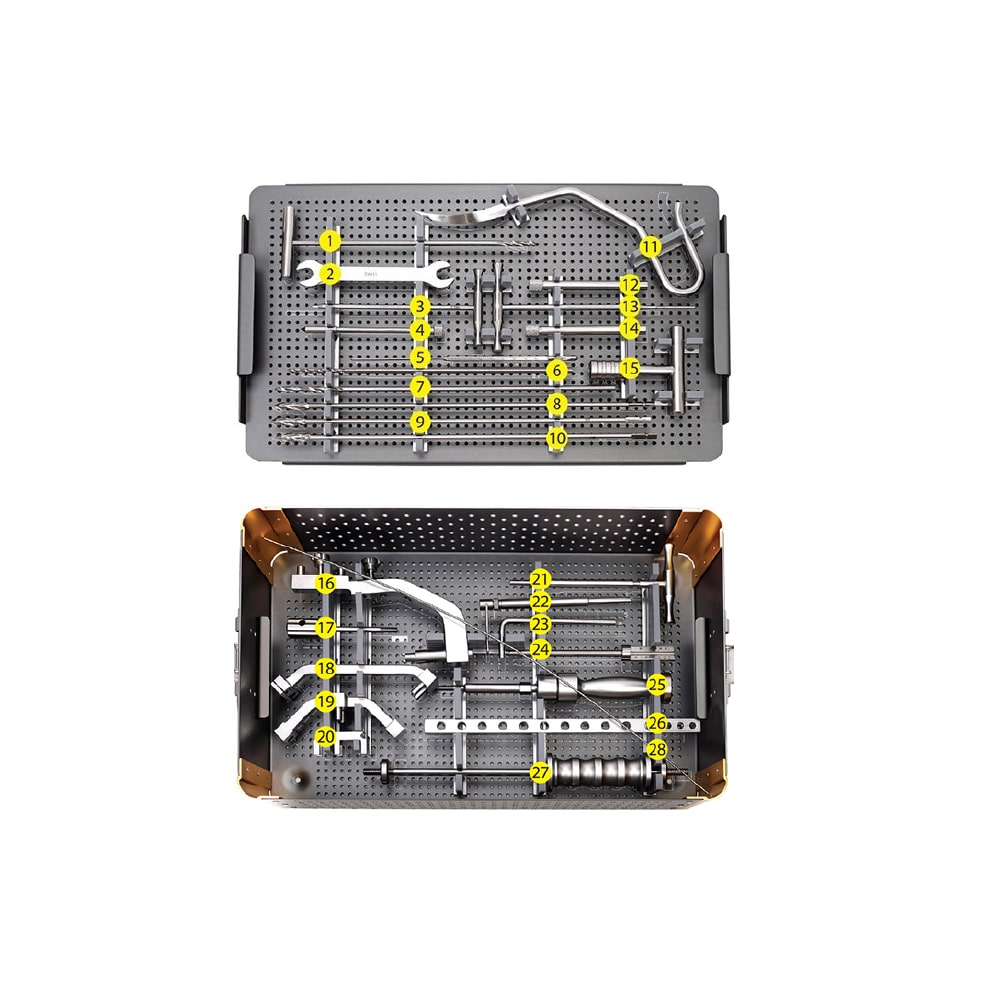
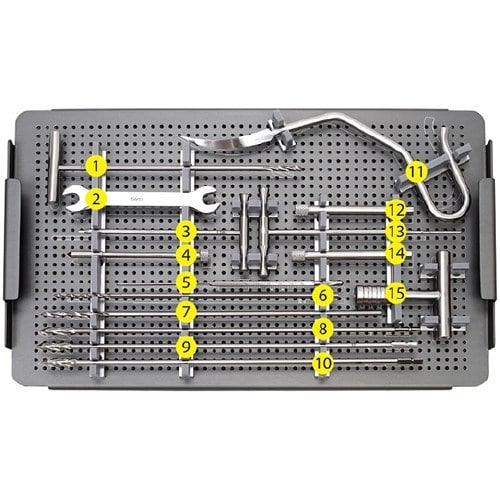
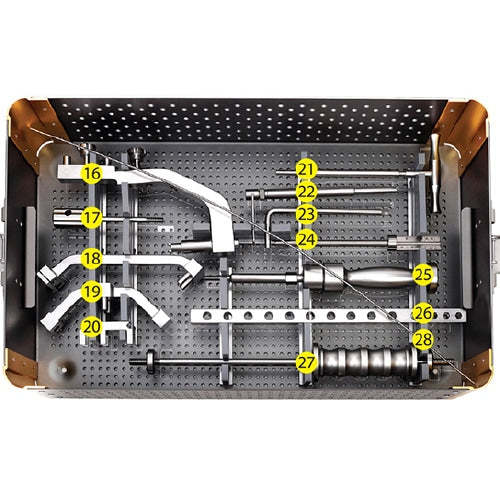
The Humeral Interlocking Nail Instrument Set (PS-HINIS-00125) is a complete 29-piece stainless steel ancillary instrumentation kit supplied in an aluminium case, designed for the insertion, distal and proximal locking, and intraoperative guidance of humeral interlocking intramedullary nails in the surgical fixation of humeral shaft fractures. The set provides every instrument required across the full antegrade or retrograde humeral nailing procedure — from canal preparation through nail insertion to proximal and distal interlocking screw placement — including a distal positioning frame and sighting device for accurate distal locking screw targeting, a complete reaming system with three reamer sizes (7.5mm, 8.0mm, and 8.5mm at 340mm working length), drill bits in 2.9mm and 5.2mm diameters at surgical working lengths, a 3.5mm tap for cortical screw preparation, proximal and distal guiders, a universal joint and quick-coupling T-handle for driveshaft instrumentation, a depth gauge calibrated 0–60mm for screw length determination, a nail connector and fixed connector for nail-instrument coupling during insertion, and the awl, guide wire, guide rod, hammer, hex wrench, screwdriver, and sleeves required for the complete procedure. Manufactured from surgical-grade stainless steel for repeated steam autoclave sterilization across the operative service life of the set. Used by orthopedic surgeons and orthopedic trauma teams in hospital operating theaters, trauma centers, and orthopedic surgical units performing humeral shaft fracture fixation. Supplied complete in a 29-piece configuration including the aluminium storage and sterilization case.
Humeral interlocking intramedullary nailing is a closed or minimally open surgical technique for the fixation of humeral shaft fractures, in which a pre-shaped intramedullary nail is introduced into the medullary canal of the humerus — via an antegrade approach through the proximal humerus near the greater tuberosity, or a retrograde approach through the distal humerus at the olecranon fossa — and secured in position with interlocking screws placed through the nail at both its proximal and distal ends, controlling fracture rotation, length, and axial alignment. The procedure sequence that this 29-piece instrument set supports begins with canal preparation: the guide wire is introduced into the medullary canal under image guidance to establish the nailing trajectory, followed by sequential reaming with the 7.5mm, 8.0mm, and 8.5mm reamers at 340mm working length to prepare the canal to the diameter appropriate for the selected nail size — reamer sizing in the humerus must account for the narrower medullary canal diameter compared to the femur and tibia, and the proximity of the radial nerve along the posterior humeral shaft makes careful reamer control during this stage particularly important. The nail is then mounted on the nail connector and inserted along the guide wire or guide rod using the quick-coupling T-handle and universal joint for driveshaft control, with the hammer used for controlled impaction during insertion. Once the nail is seated at the correct depth — verified using the depth gauge — proximal locking is performed first, typically through a targeting jig integrated with the insertion handle, followed by distal locking using the distal positioning frame and sighting device handle, which provide the alignment reference needed to place the distal interlocking screws accurately through the nail's distal locking holes without direct visualization, a critical step given the proximity of the radial nerve and the narrow target window of the distal locking holes in the humeral nail.
Distal locking screw placement is widely regarded as the technically most demanding step in interlocking intramedullary nailing, and this is especially true in the humerus, where the combination of a narrow medullary canal, the proximity of the radial nerve to the distal humeral shaft, and the deformation of jig-based proximal targeting systems over the length of a humeral nail (which is shorter than a femoral or tibial nail but still subject to cumulative targeting error) makes free-hand or jig-assisted distal locking technically challenging. This instrument set addresses distal locking with a dedicated distal positioning frame and sighting device handle — instruments designed to provide an external reference geometry that corresponds to the position of the distal locking holes inside the nail, allowing the surgeon to align the drill trajectory for the distal locking screws with the nail's locking holes despite the holes being located within the medullary canal and not directly visible. The distal guider works in conjunction with the drill sleeve and gauge cannula to maintain a fixed, stable drill trajectory once alignment is confirmed — typically under fluoroscopic imaging — preventing drift of the drill bit during the preparation of the distal locking screw holes. The proximal guider performs the analogous function for proximal locking, where the targeting geometry is generally more reliable because the proximal locking holes are closer to the insertion point and the jig attachment to the nail provides more direct mechanical reference. The depth gauge, calibrated 0–60mm, is used at both proximal and distal locking stages to measure the required screw length once the drill hole has been prepared, ensuring that the locking screws selected achieve bicortical purchase without excessive protrusion beyond the far cortex — a particular concern at the distal humerus given the thin soft tissue envelope and the radial nerve's course.
The three-reamer system included in this set — 7.5mm, 8.0mm, and 8.5mm reamers, each at 340mm working length — provides the sequential canal preparation needed to accommodate humeral interlocking nails across the typical range of adult humeral medullary canal diameters. The humeral medullary canal is narrower than the femoral or tibial canal throughout most of its length, and canal diameter varies significantly along the humeral shaft, narrowing toward the isthmus in the middle third of the bone. Sequential reaming with progressively larger reamer diameters — starting with the smallest reamer appropriate for the patient's canal diameter as assessed on preoperative imaging, and progressing in 0.5mm increments to the 8.5mm reamer — gradually enlarges the canal to accommodate the selected nail diameter while controlling the rate of bone removal at each pass, reducing the risk of cortical perforation, thermal bone necrosis from reaming friction, and fat embolism from rapid medullary content displacement. The 340mm working length of the reamers in this set reflects the overall length requirements for reaming the full humeral shaft from either the proximal or distal entry point to the opposite metaphyseal region, accommodating both antegrade and retrograde nailing approaches. The reamers are used over the guide wire, which establishes and maintains the intramedullary trajectory throughout the reaming sequence, with the guide rod available as a stiffer alternative for situations requiring additional canal control. The universal joint and quick-coupling T-handle provide the driveshaft connection between the reamer and the power or hand-driven reaming mechanism, with the universal joint accommodating the angular offset that may be required when the entry portal angle does not align directly with the medullary canal axis — a common scenario in antegrade humeral nailing where the proximal entry point at the greater tuberosity is offset from the canal's longitudinal axis.
All instruments in the PS-HINIS-00125 set are manufactured from surgical-grade stainless steel, providing the corrosion resistance, dimensional stability, and edge or thread retention required for instruments that undergo repeated steam autoclave sterilization between orthopedic trauma procedures. The aluminium case included with the set serves both as a protective storage container for transport and inventory management between procedures, and as a sterilization tray that can be processed through standard steam autoclave cycles with the instruments organized in their designated positions — facilitating both pre-procedure instrument verification (confirming all 29 pieces are present and accounted for before the case is opened in the operating theater) and post-procedure reprocessing tracking. Each instrument category in the set — drill bits, reamers, guidance instruments, driving and impaction instruments, and measurement instruments — requires specific reprocessing attention: drill bits and reamers with cutting flutes require thorough cleaning of flute grooves to remove bone debris and marrow content before sterilization, as residual organic material in flute grooves both compromises sterilization efficacy and accelerates corrosion at these high-stress cutting surfaces; the sighting device, distal positioning frame, and guiders, which have precision-machined alignment surfaces, require careful handling during cleaning to avoid impact damage that could compromise their targeting accuracy in subsequent procedures. The complete set should be inventoried against the 29-piece manifest after each use and before each procedure to ensure no instrument has been misplaced, as a missing reamer size or guidance instrument can compromise the surgeon's ability to complete the procedure as planned.
The Humeral Interlocking Nail Instrument Set PS-HINIS-00125 is manufactured under a quality management system certified to ISO 13485, governing surgical-grade stainless steel material sourcing, precision machining of all reaming, drilling, guidance, and measurement instruments, dimensional inspection across all 29 components, aluminium case fabrication, and final set assembly and packaging. CE Mark certification confirms conformity with European Medical Device Regulation requirements for reusable orthopedic surgical instrument sets distributed within EU and associated regulatory territories. FDA compliance documentation is maintained for United States distribution, satisfying regulatory requirements applicable to reusable orthopedic instrumentation procured by US hospitals, trauma centers, and orthopedic surgical instrument distributors. These certifications satisfy procurement and tender documentation requirements of institutional buyers in the USA, India, Pakistan, Vietnam, and across international orthopedic surgical supply frameworks. Certificates of conformity and quality management system documentation are available on request. OEM manufacturing and custom set configurations are available within the same certified manufacturing framework.
| SKU | PS-HINIS-00125 |
|---|---|
| Product Name | Humeral Interlocking Nail Instrument Set |
| Price | $1,320.00 USD |
| Set Configuration | 29 pieces including aluminium storage/sterilization case |
| Reamers | 7.5mm, 8.0mm, 8.5mm (each 340mm working length) |
| Drill Bits | 2.9mm × 250mm, 5.2mm × 300mm, 5.2mm |
| Tap | 3.5mm |
| Depth Gauge | 0–60mm calibrated range |
| Guidance Instruments | Distal positioning frame, sighting device handle, distal guider, proximal guider |
| Connectors | Nail connector, fixed connector |
| Driving Instruments | Quick coupling T-handle, universal joint, hex wrench, screwdriver SW2.5, open wrench, hammer |
| Wires and Rods | Guide wire, guide rod, location rod |
| Other Components | AWL, sleeve (×2), drill sleeve, gauge cannula, aluminium box |
| Material | Surgical-Grade Stainless Steel |
| Case Material | Aluminium |
| Certifications | CE Mark, ISO 13485, FDA |
| Reusability | Reusable |
| Quantity | 1 Set (29 pieces) |
| Rust Resistance | Yes |
| Warranty | 1 Year |
| MOQ | 1 Set |
| OEM / Custom Orders | Available |
| Packing | Aluminium Case |
| Place of Origin | Pakistan |
| Brand | Peak Surgicals |
| Primary Use | Complete ancillary instrumentation for the insertion and proximal/distal interlocking of humeral intramedullary nails in the surgical fixation of humeral shaft fractures |
| After-Sale Service | Return and Replacement |
What procedure is this instrument set designed for, and what does it allow the surgical team to do?
This 29-piece set provides the complete ancillary instrumentation required for humeral interlocking intramedullary nailing — the surgical fixation of humeral shaft fractures using an intramedullary nail secured with proximal and distal interlocking screws. The set supports the full procedure sequence from canal preparation through final locking. Canal preparation is performed using the guide wire to establish the intramedullary trajectory and the three-size reaming system (7.5mm, 8.0mm, 8.5mm at 340mm working length) to progressively enlarge the medullary canal to the diameter required for the selected nail. Nail insertion is performed using the nail connector to couple the nail to the insertion instrumentation, with the quick coupling T-handle, universal joint, and hammer providing the driving and impaction forces needed to advance the nail along the prepared canal. Locking screw placement — both proximal and distal — is supported by the proximal and distal guiders, the distal positioning frame, and the sighting device handle, which provide the targeting references needed to drill accurately through the nail's locking holes; the 3.5mm tap prepares the cortical bone for the locking screws, and the depth gauge (0–60mm) determines the correct screw length at each locking site. The complete set, supplied in its aluminium case, equips an orthopedic trauma team to perform the entire procedure without sourcing additional instrumentation.
Why is distal locking particularly challenging in humeral nailing, and which instruments in this set address it?
Distal interlocking screw placement is technically demanding in any intramedullary nailing procedure because the locking holes in the distal portion of the nail are located deep within the medullary canal and cannot be directly visualized — the surgeon must align a drill trajectory with holes that are only a few millimetres in diameter, positioned inside the bone. In the humerus, this challenge is compounded by three anatomical factors: the medullary canal is narrower than in the femur or tibia, providing a smaller margin for trajectory error; the radial nerve runs in close proximity to the posterior humeral shaft at the level where distal locking screws are typically placed, making an off-target drill pass a risk to the nerve rather than simply a failed screw placement; and the relatively short length of humeral nails compared to femoral or tibial nails means that any angular deviation in the proximal-to-distal targeting geometry produces proportionally more lateral displacement at the distal locking holes. This instrument set addresses distal locking with the distal positioning frame and sighting device handle, which together provide an external alignment reference corresponding to the internal position of the distal locking holes, used in conjunction with fluoroscopic imaging to confirm alignment before drilling. The distal guider and drill sleeve maintain trajectory stability once alignment is achieved, and the gauge cannula and depth gauge support accurate screw length determination at the distal locking sites.
How does the reaming sequence work, and why are three reamer sizes included?
The three reamers in this set — 7.5mm, 8.0mm, and 8.5mm, each at 340mm working length — are used in ascending sequence to progressively enlarge the humeral medullary canal to the diameter required for the nail selected for the case. Sequential reaming in 0.5mm increments, rather than reaming directly to final diameter with a single large reamer, is the standard technique for canal preparation because it controls the volume of bone removed and the heat generated at each pass, reducing the risk of cortical perforation (particularly relevant in the humerus, where cortical thickness varies and the canal narrows toward the isthmus), thermal osteonecrosis at the reamed surface, and fat embolism syndrome from rapid pressurization of medullary contents. The surgeon begins reaming with the smallest reamer that engages the canal — typically determined from preoperative templating of the patient's canal diameter on imaging — and proceeds through each subsequent reamer size until the canal diameter matches the planned nail diameter, generally reaming 0.5–1.0mm larger than the nail diameter to allow for nail insertion without excessive force. The 340mm working length of each reamer accommodates the full length of reaming required from either the proximal (antegrade) or distal (retrograde) entry portal to the opposite end of the medullary canal.
What sterilization and instrument management protocol is recommended for this set?
All 29 instruments in this set are manufactured from surgical-grade stainless steel and are compatible with standard steam autoclave sterilization at 134°C pre-vacuum parameters, the routine method for reusable orthopedic instrumentation. Before sterilization, instruments with flutes, threads, or cannulations — particularly the reamers, drill bits, the 3.5mm tap, and the gauge cannula — require thorough cleaning to remove bone debris, marrow content, and irrigation fluid residue from internal and flute surfaces, typically using an enzymatic pre-soak followed by ultrasonic cleaning with brush access to flute grooves and cannulations. The precision alignment surfaces of the distal positioning frame, sighting device handle, and the proximal and distal guiders should be handled carefully during cleaning and storage to avoid impact damage that could affect targeting accuracy. The aluminium case functions as both a transport container and a sterilization tray; the case should be inspected to confirm all 29 components are present and correctly seated in their designated positions both before sterilization and immediately before the case is opened for use in the operating theater, as a missing reamer size or guidance instrument discovered intraoperatively can delay or compromise the procedure.
What certifications does this set carry, and are bulk or OEM orders available?
The Humeral Interlocking Nail Instrument Set PS-HINIS-00125 is manufactured under an ISO 13485-certified quality management system covering surgical-grade stainless steel procurement, precision machining of all reaming, drilling, guidance, and measurement instruments, dimensional inspection across all 29 components, aluminium case fabrication, and final assembly. CE Mark certification confirms conformity with European Medical Device Regulation requirements for reusable orthopedic surgical instrument sets. FDA compliance documentation supports United States distribution. Certificates of conformity and quality management documentation are available on request for hospital procurement and tender processes. Bulk orders are accepted with a minimum of 1 set, with volume pricing available for hospitals, trauma centers, orthopedic instrument distributors, and group purchasing organizations. OEM manufacturing for custom set configurations, alternative reamer or drill bit size ranges, or private-label branding is available within the same ISO 13485-certified framework. Free shipping applies on orders of $99 or more.
