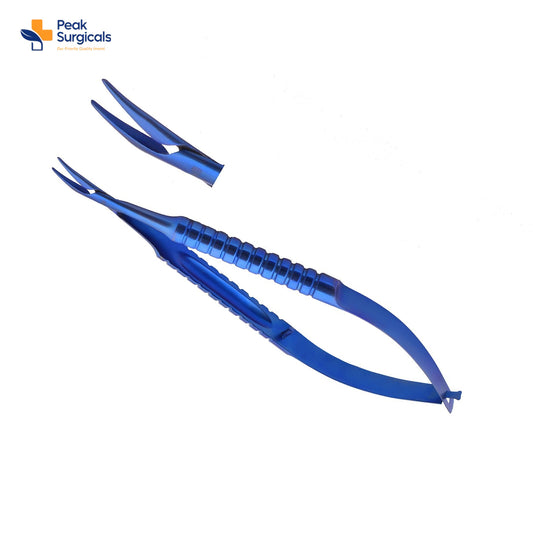
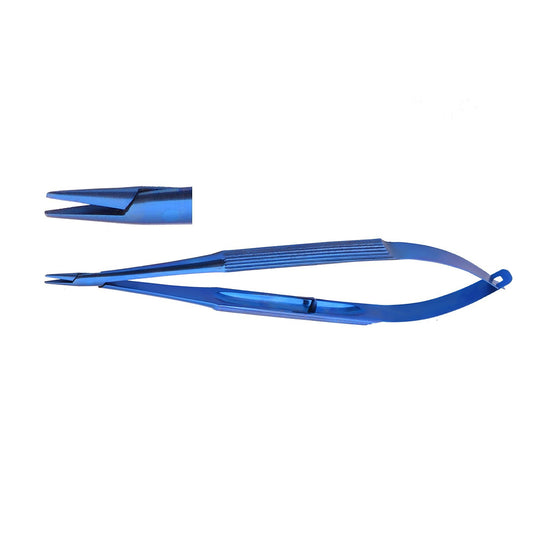
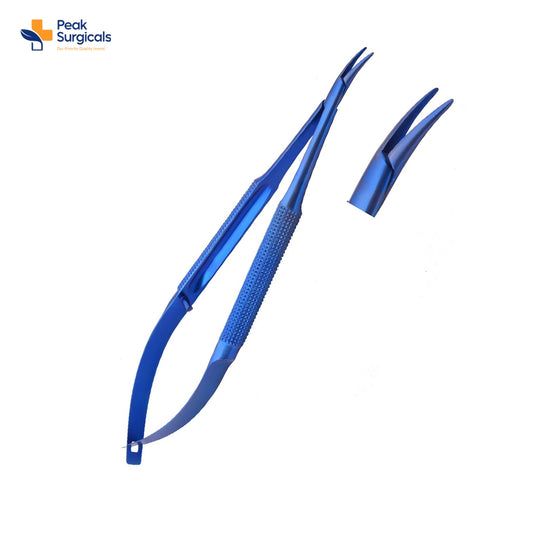
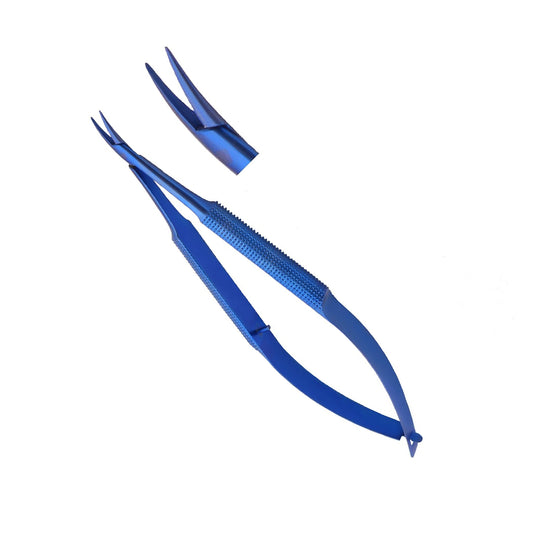
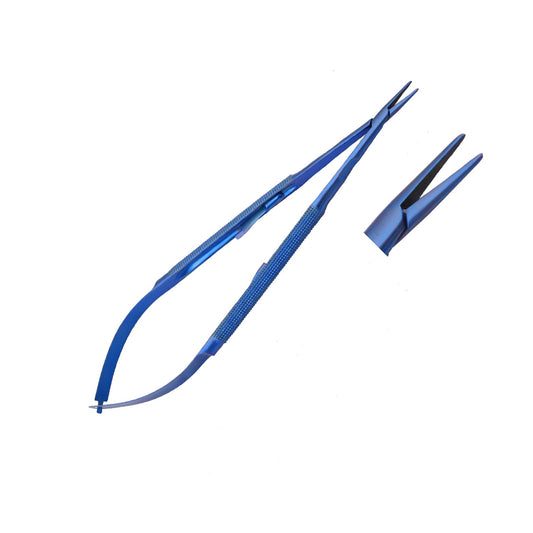
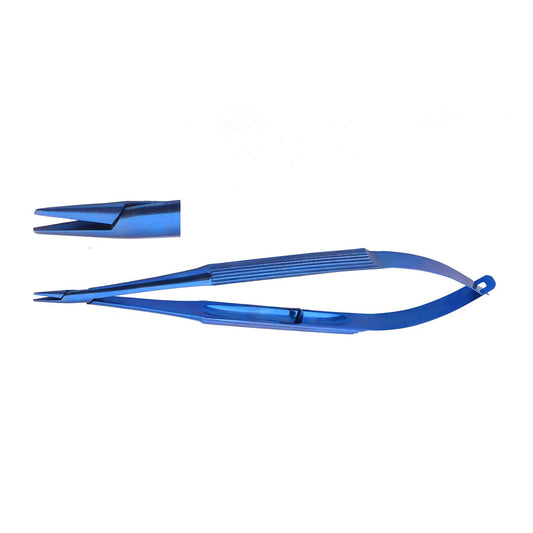
Ophthalmology Instruments - Titanium Micro Needle Holder
Titanium micro needle holders hold and drive fine suture through delicate tissue where a heavier steel instrument would fatigue the hand across a long procedure. Peak Surgicals supplies seven patterns, straight and curved, in 14cm, 16cm and 18cm lengths, in titanium, from $49.50 to $52.80. Each is CE marked and built under ISO 13485. Compare all seven patterns in the grid below .
Straight or Curved, Which Length?
Straight patterns give a direct line of approach for anterior and superficial suturing, while curved patterns angle the tip to reach around anatomy or work at a shallower angle to the tissue, and length is chosen for how far the working tip needs to sit from the hand. Ophthalmic and microsurgical suturing is worked at close range under magnification, so both variables matter more than on a general instrument.
Titanium Micro Needle Holders Straight (PS-2018A, $49.50) and Titanium Micro Needle Holders Curved (PS-2016A, $52.80) cover the base straight-vs-curved decision. The 14cm patterns (PS-2014A, $49.50 and Curved 14cm, PS-2020A, $49.50) suit closer, more confined work — corneal or anterior segment suturing where a shorter instrument gives finer control. The 16cm (PS-2017A, $51.70) and 18cm Curved (PS-2019A, $49.50) extend reach for deeper or posterior access. Micro Needle Holders Titanium (PS-2013A, $49.50) covers general microsurgical use across specialties including ophthalmic, neurosurgical, vascular and plastic surgery suturing. We supply every pattern at MOQ 1.
(186 words)
Why Titanium Over Stainless Steel
Titanium changes three things that matter in a needle holder used for hours of fine suturing. It runs close to half the weight of stainless steel, which reduces hand fatigue through a long procedure, the instrument is held under sustained fine muscle control, and lighter mass means less of that effort goes into simply supporting the tool. Titanium also resists corrosion, staining and pitting more completely than stainless steel across repeated sterilisation cycles, and the tip does not dull or wear down the way a steel edge gradually does.
Two further properties matter specifically in ophthalmic and neurosurgical use: titanium is non-magnetic, which resists static buildup and avoids interference near sensitive equipment, and instruments are typically finished with a blue-toned tint that reduces glare under the intense illumination microsurgical procedures use. The jaw tip is delicate by design — fine enough to control fine monofilament suture, which is also why it demands more careful handling than a heavier general-purpose needle holder.
Reprocessing, Tip Integrity and Certification
The jaw tips are the inspection point on every use: titanium resists wear better than steel, but a tip that has bent or lost alignment no longer grips suture securely, and delicate micro-jaws are more vulnerable to impact damage than heavier instruments. Store these needle holders with tip protectors in a mixed tray, since contact with other instruments is the most common cause of tip damage. Ultrasonic-clean before autoclaving so tissue and suture residue does not collect at the jaw serrations.
Every instrument is Class I, reusable, CE marked and built under ISO 13485 — the documentation a hospital supply team verifies before qualifying a vendor. Warranty is one year with return-and-replacement, MOQ is 1 piece, orders over $99 ship free in carton box packing, and OEM marking is available for distributors. For non-titanium and general ophthalmic patterns see needle holders, and for other titanium instruments see titanium needle holders. Talk to us about OEM and volume terms.
Our Top Selling Products
Sims Vaginal Retractors | Simpson Braun Obstetric Forceps | Parsonnet Epicardial Retractor | Blakesley Punch Forceps with 2.5-3.5mm Cups for Nasal Sinus Tissue Removal | Collins Expressor Forceps | Debakey S-shaped Peripheral Vascular Clamp | Markham Meyerding Hemilaminectomy Retractors | Kujat Fukuda Type Humeral Head Retractor | Fue Punch serrated 0.7 mm | FUE Serrated Punch 1.1mm