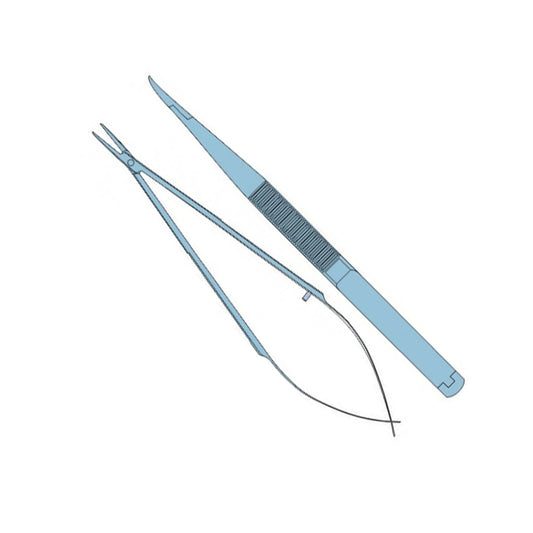
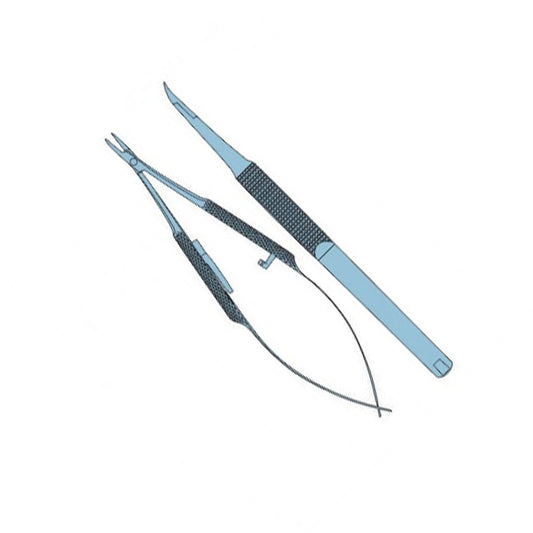
Titanium needle holders with a ratchet lock hold the needle grip without continuous hand pressure, the surgeon closes the jaws, the lock engages, and the tissue plane can be worked without maintaining tension on the handle. Peak Surgicals supplies two patterns in titanium, one curved with a 6mm tip at 106mm, at $27.50. Each is CE marked and built under ISO 13485. See both patterns in the grid below.
Locking or Unlocked: Why It Matters
A ratchet lock holds the needle holder's grip closed once engaged, freeing the surgeon's hand from continuous pressure between passes, while an unlocked needle holder gives up that convenience for finer tactile feedback through the fingers on every movement. The choice is a trade between control and comfort, and it depends on the suturing technique.
The Curved Needle Holder 6mm Tip 106mm Titanium with Lock (PS-S-00040, $27.50) carries a ratchet mechanism that secures the jaw closure, useful where the needle must be held steady between suture passes without the surgeon consciously maintaining grip, and where a longer procedure benefits from that reduced hand fatigue. The curved profile angles the tip for reach around anatomy or a shallower approach to the tissue plane. The Needle Holder (PS-S-00039, $27.50) covers general ophthalmic suturing at the same price point. We supply each at MOQ 1.
Titanium Properties and Where Lock Fits In
Titanium's advantages carry across both locking and unlocked patterns: close to half the weight of stainless steel for reduced hand fatigue, stronger resistance to corrosion, staining and pitting across repeated sterilisation, and a tip that holds its edge without dulling the way steel gradually does. Titanium is also non-magnetic and typically carries a blue-toned finish that reduces glare under ophthalmic surgical lighting.
The lock mechanism is a separate decision layered on top of that material choice. A ratchet lock is most valuable in longer procedures or where the surgeon needs both hands free between suture throws; a rotational, pencil-grip suturing technique, common in fine ophthalmic work, often favours an unlocked instrument that can be spun between the fingers without disengaging a ratchet first. Confirm technique preference before choosing between the two.
Reprocessing, Lock Integrity and Certification
The ratchet is the reprocessing point unique to the locking pattern: residue collecting in the ratchet teeth stiffens the mechanism across cycles, so clean it deliberately rather than relying on general instrument washing, and confirm the lock engages and releases cleanly before each use. On both patterns, the jaw tip is the second inspection point — a bent or misaligned tip no longer grips the needle securely.
Every instrument is Class I, reusable, CE marked and built under ISO 13485 — the documentation a hospital supply team verifies before qualifying a vendor. Warranty is one year with return-and-replacement, MOQ is 1 piece, orders over $99 ship free in carton box packing, and OEM marking is available for distributors. For the broader micro range see titanium micro needle holders; for general patterns see needle holders. Talk to us about OEM and volume terms.
Our Top Selling Products
Safety Lock Screw Ø3.5mm Self Tapping and Self Drilling | Austin Moore Hip Prosthesis Excel Stainless Steel | Russian Tissue Forceps Instrument | Gruber Ear Specula for Infant and Standard Ear Canal Visualization | UNC15 Periodontal Probe for 1-15mm Periodontal Pocket Charting | Safety Lock Screw Ø 2.4mm Star Like Self Tapping | Cancellous Safety Lock Screw Ø5.0mm | Cancellous Safety Lock Screw Ø3.5mm Self Tapping | Blake Blade Holder | Cortex Bone Screw 3.5mm Length Self-Tapping Hex Head Titanium