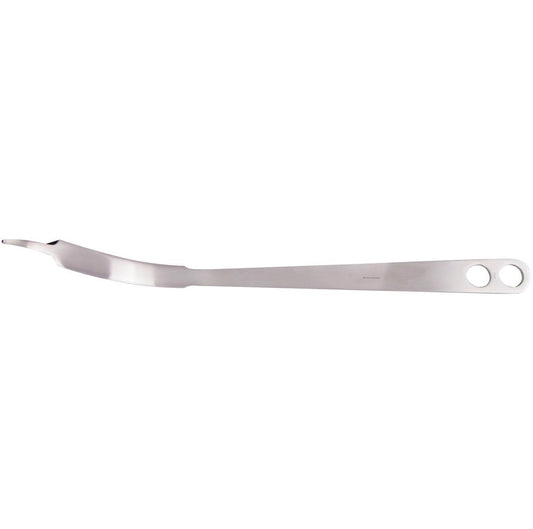
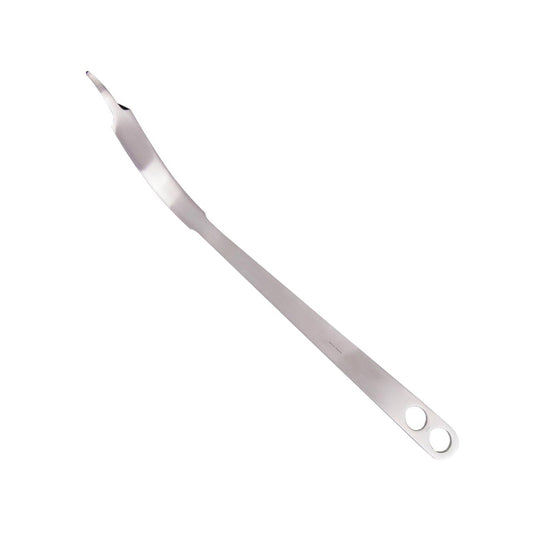
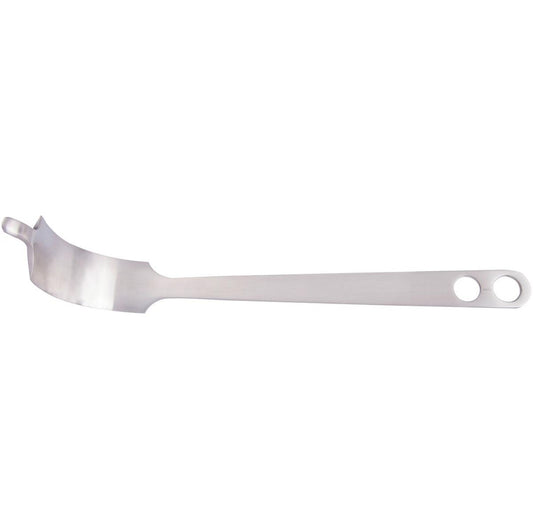
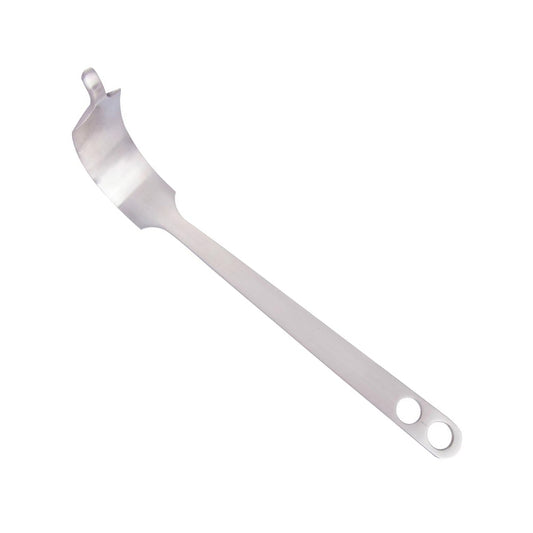
A Hohmann retractor is a lever, not a retractor in the ordinary sense. Its tip hooks behind the bone and the bone itself becomes the fulcrum, so soft tissue is lifted clear by the blade rather than pulled by the hand. Peak Surgicals stocks Hohmann retractors from 6mm to 43mm blade width, in German stainless steel and CE marked and built under ISO 13485. Compare the full range in the grid below.
Why Blade Width Is Matched to the Bone
The mechanism decides everything about how the instrument is chosen. A conventional retractor holds tissue by pulling against the assistant's hand, so its blade only has to be wide enough for the tissue it covers. A Hohmann works the other way: the narrow tip is passed around the far side of the bone and hooked there, the blade is levered against the near cortex, and the soft tissue rides up the blade and away from the working surface.
That is why blade width is matched to the bone rather than to the wound. A blade wider than the bone it sits on has nowhere to seat and will slide off under load; one much narrower concentrates the whole lever force on a small area of cortex. The tip has to reach around the bone circumference and the blade has to sit flat on the near surface, and both depend on the diameter in front of you. We supply every width at MOQ 1.
The 6mm to 43mm Ladder
The width ladder here runs from 6mm to 43mm, which in veterinary practice spans most of the working range. The narrow end, at 6mm and 8mm, suits phalangeal and small-bone exposure in cats and toy breeds, and fine work around the carpus and tarsus. The 15mm and 18mm blades cover the mid range, which is where most canine long-bone work sits: radius, ulna, tibia and the smaller humeral exposures.
The wider blades take the heavier bone. A 24mm blade suits femoral and larger humeral work in medium and large dogs, and 32mm and 43mm blades cover the exposures where the cortex is broad enough to seat them, including equine and large-animal applications. Ordering across the range rather than at one width is the usual approach, because the blade that seats correctly on a tibia will not seat on a phalanx.
Material, Reprocessing and Certification
Every pattern is forged from German stainless steel and passivated for corrosion resistance across repeated cycles. The inspection point is the tip and the blade, and it matters because this instrument is loaded as a lever rather than held: check the tip for bending or splaying, since a tip that has opened out will not hook the far cortex securely and can slip while the blade is under load; check the blade face is flat and unwarped, because a warped blade rocks on the cortex instead of seating; and sight along the shaft to confirm it is straight. Clean immediately with a neutral-pH enzymatic solution, brushing bone debris from the tip and blade junction before it dries, then rinse with deionised water and dry fully, following the reprocessing instructions supplied.
These are Class I reusable devices, supplied non-sterile, CE marked and built under ISO 13485, with a one-year warranty. We ship at MOQ 1 with free shipping over $99. See Veterinary Fracture Management Instruments for plating instrumentation, or browse all Veterinary Surgical Instruments.