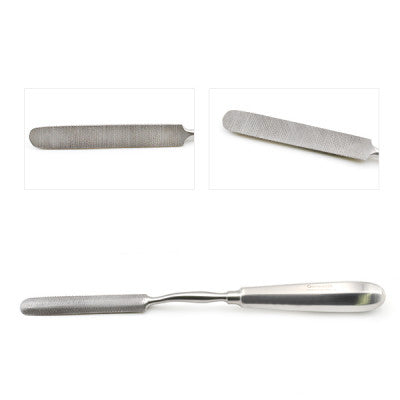
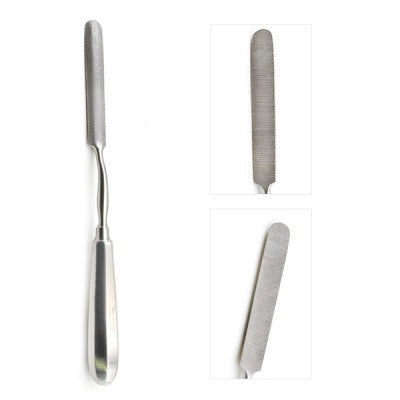
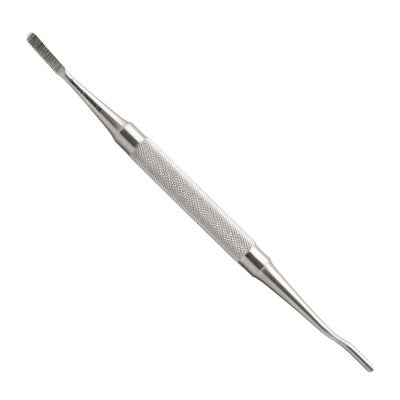
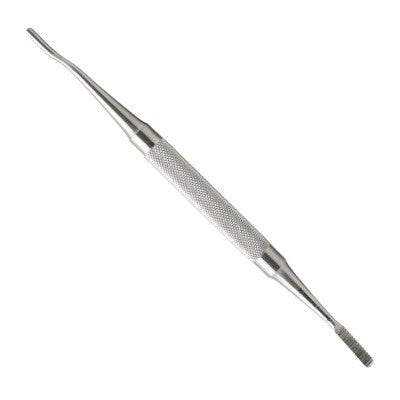
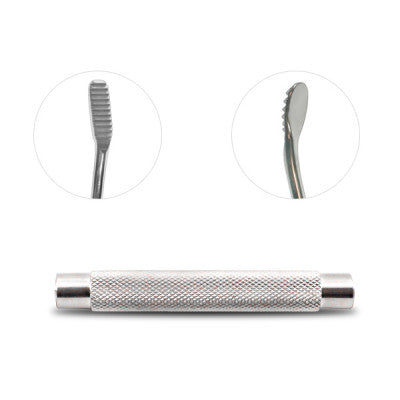
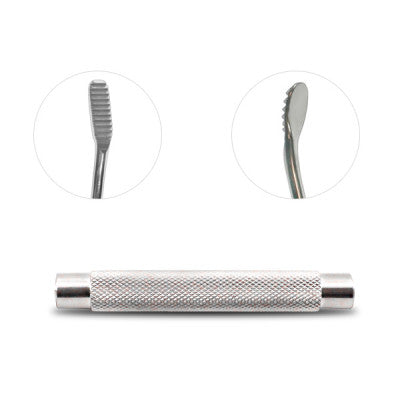
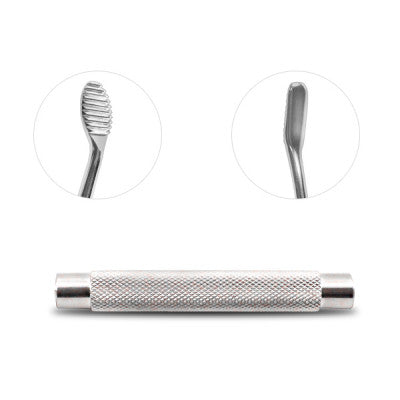
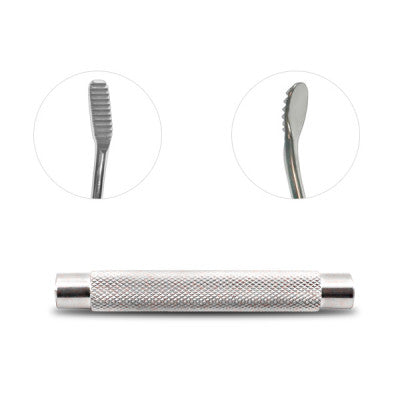
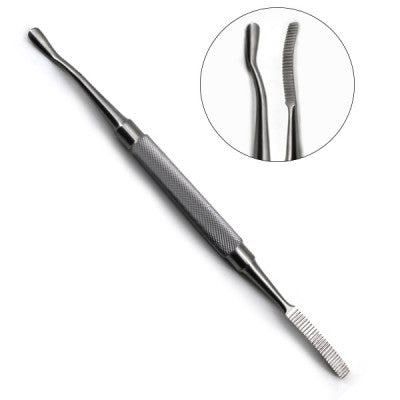
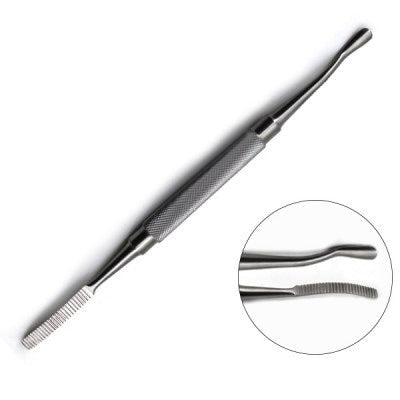
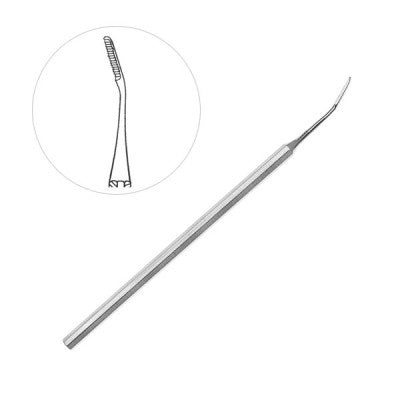
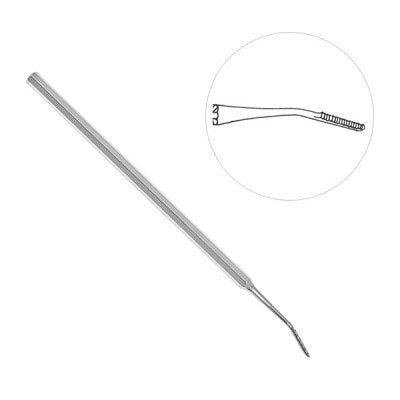
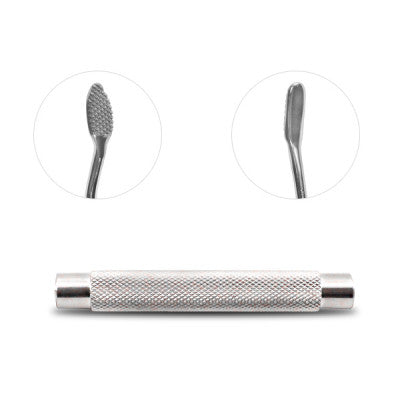
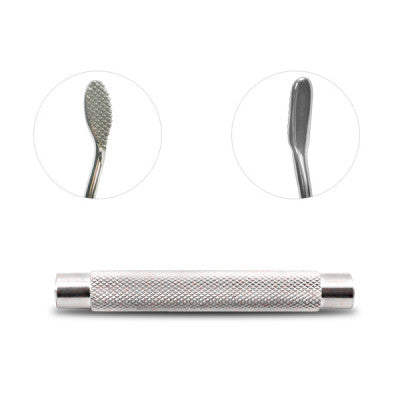
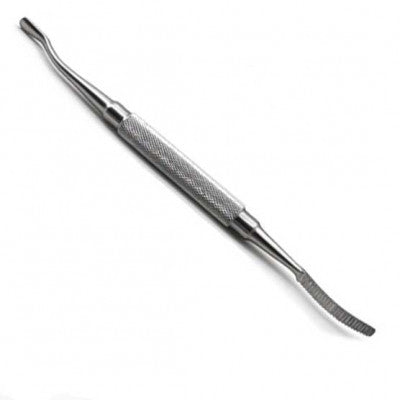
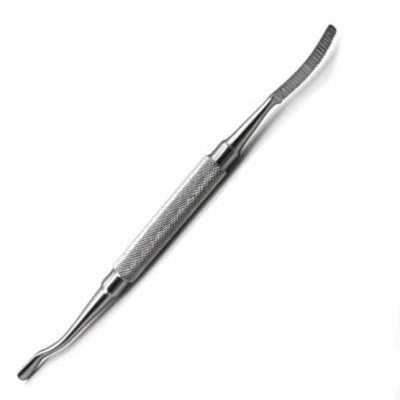
Veterinary bone files finish what a rasp or saw leaves rough, smoothing and contouring bone surfaces after cutting so the surrounding tissue heals against a clean margin rather than a jagged one. Peak Surgicals supplies nine patterns, Polokoff, Miller, Miller Colburn and Howard, in German stainless steel, from $11.00 to $19.80. Each is CE marked and built under ISO 13485. Compare all nine patterns in the grid below.
Which Bone File: Single-Cut, Double-Ended or Angled?
Double-ended files carry two working surfaces on one handle, letting the surgeon switch between coarse and fine serrations without changing instruments, while single-cut and angled patterns solve one specific access or finishing problem each. Serration pattern and reach are what separate this range, not size alone.
Polokoff Bone File Double Ended ($15.40) carries horizontal rasping serrations at both ends, sized for precise bone scraping in orthopedic and spinal work. Miller Bone File Single Cut ($13.20) and Miller Bone File Double Ended ($11.00) offer straight-cut serrations for final smoothing and shaping once contouring is complete. Miller Colburn Bone File Cross Cut ($11.00) carries a cross-serrated pattern that smooths and contours bone during orthopedic, periodontal and maxillofacial work. Bone File Bayonet Shank Half Round Blade ($19.80) steps the shank sideways so the hand clears the sightline in a confined field, with a half-round blade curved on one side and flat on the other for both smoothing and contouring in the same pass. Bone File Angled ($11.00), Bone Files Double Ended ($11.00), Howard Bone File Double Ended ($13.20) and Sugarman Furcation File Double Sided ($11.00) round out the range for general and confined-space work. We supply every pattern at MOQ 1.
Serration, Blade Shape and Why Double-Ended Matters
Serration type decides what the file removes and how fast. Coarse serrations cut aggressively for shaping and contouring where bulk removal matters more than finish; fine serrations smooth what the coarse end already shaped, leaving a surface ready for tissue closure. A file used at the wrong stage either takes too long or leaves a rougher margin than the procedure calls for.
Blade shape follows the bone surface being worked. A half-round blade, flat on one face, curved on the other, handles both flat and contoured surfaces without a second instrument. Bayonet-shanked patterns exist for the same reason a bayonet exists on scissors and forceps elsewhere in this catalogue: the offset keeps the hand and shaft clear of the operative field in deep or confined access. Double-ended construction, common across this range, is what makes a single instrument cover coarse-to-fine finishing in one pass rather than requiring a tray of single-function files.
Reprocessing, Edge Retention and Certification
These files are forged from German stainless steel, corrosion-resistant across repeated autoclave cycles, and holding serration edge where a softer instrument would round over under scraping pressure. The serrated faces are the reprocessing point: bone debris packs into the teeth and hardens there, so ultrasonic cleaning before autoclaving is what keeps the file cutting rather than burnishing. Inspect serrations for wear after each cycle, a dulled file compresses bone instead of removing it.
Every instrument is Class I, reusable, CE marked and built under ISO 13485, the documentation a veterinary supply team verifies before qualifying a vendor. Warranty is one year with return-and-replacement, MOQ is 1 piece, orders over $99 ship free in carton box packing, and OEM marking is available for distributors. For related shaping instruments see bone files and rasps; browse all veterinary orthopedic instruments. Talk to us about OEM and volume terms.