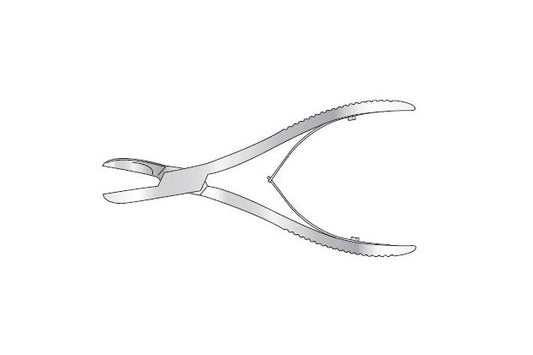
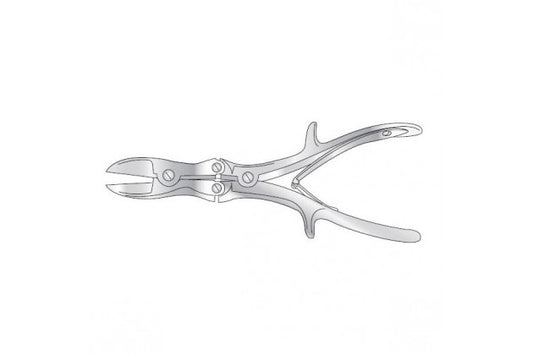
Post mortem bone cutting forceps section bone during autopsy, grasping, cutting and manipulating skeletal structures to establish cause of death, built specifically for that purpose rather than adapted from live-patient surgical instruments. Peak Surgicals supplies two patterns, Liston and Horsley, in stainless steel, from $38.50 to $60.50. Each is CE marked and built under ISO 13485. Compare both patterns in the grid below.
Liston or Horsley: Straight Cut or Compound Action?
The Liston Bone Cutting Forceps applies direct hand force through a straight 9-inch jaw for general skeletal sectioning, while the Horsley Bone Cutter uses a compound action joint that multiplies grip force through leverage, cutting denser bone with less effort than a straight-action instrument requires. The mechanism, not the size, is what separates them.
Liston Bone Cutting Forceps (PS-P-0002, 9"/228mm, $38.50) carries sharp jaws on a straight shaft for clean sectioning during general autopsy work, the pattern reached for first in routine cases. Horsley Bone Cutter Compound Action (PS-P-0001, 10.5"/266mm, $60.50) adds a compound joint that trades stroke length for force, making it the choice where bone density or the specific cut demands more cutting power than a single-action jaw delivers efficiently. Both work by direct hand grip rather than mallet force, giving the operator continuous control through the cut. We supply each at MOQ 1.
Autopsy-Specific Design, Not Adapted Surgical Hardware
The Liston pattern name also exists in orthopaedic surgical catalogues, but the autopsy version and the surgical version are not the same instrument, and the distinction matters. A surgical bone cutting forceps used on a living patient is built and validated for that use; a post-mortem bone cutting forceps is built for autopsy and pathology work specifically, and manufacturers explicitly state these patterns are not intended for use on patients. The naming overlap exists because both trace to the same 19th-century Liston pattern, but they diverge in application from there.
That distinction is why this collection exists separately from general orthopaedic bone-cutting forceps. Choosing correctly matters for procurement accuracy as much as for use, a mortuary or forensic pathology department sourcing bone cutting forceps should specify the post-mortem pattern rather than the general orthopaedic listing, even though the product names look identical on a search results page.
Reprocessing, Blade Integrity and Certification
These forceps are forged from stainless steel corrosion-resistant across repeated disinfection and autoclave cycles. The jaw edges are the inspection point: a dulled or chipped edge crushes bone rather than cutting it cleanly, and the Horsley's compound joint should be checked for smooth action, since a stiff joint loses the mechanical advantage the pattern is built to deliver. Manufactured to recognised stainless steel instrument standards, both patterns are built for repeated mortuary use.
Every instrument is Class I, reusable, CE marked and built under ISO 13485 the documentation a supply team verifies before qualifying a vendor. Warranty is one year with return-and-replacement, MOQ is 1 piece, orders over $99 ship free in carton box packing, and OEM marking is available for distributors. For the full autopsy range see post mortem instruments; related patterns sit in post mortem bone saws. Talk to us about OEM and volume terms.