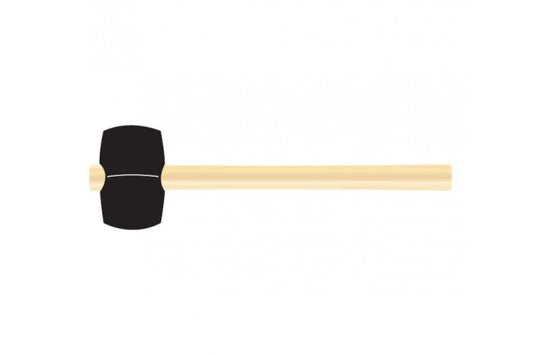
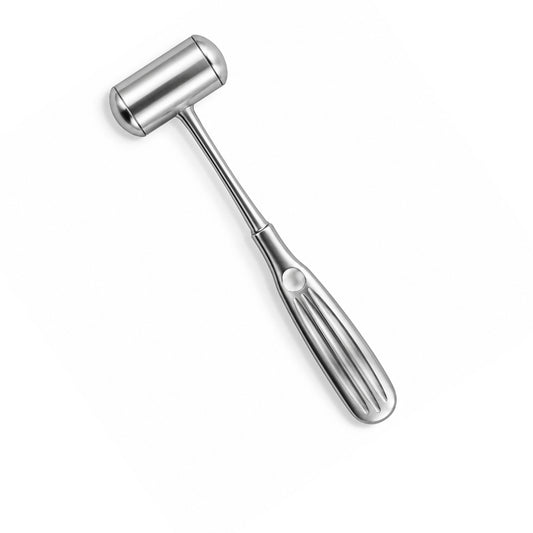
Two post mortem mallets in a set do opposite things. One drives a chisel through bone; the other separates bone without driving anything at all. Peak Surgicals supplies Army Pattern Mallet (PS-P-00015, $27.50) and Rubber Mallet 300g (PS-P-00016, $27.50), both designated for autopsy use only. Compare both patterns in the grid below.
Why One of Them Is Rubber
The rubber mallet is not a lighter version of the other one. It is used where the object is to loosen rather than to cut: tapping around a sawn calvarium to break the remaining dural adhesions and free the skull cap, or working along costal margins to separate what the saw has already scored. The rubber face spreads the impact over a longer contact time, so the bone moves without a sharp force arriving at any single point, and a section comes away intact rather than fragmenting at the line of the cut.
That distinction matters at autopsy because a fractured calvarium or a splintered rib is a finding that was not there before the examination began. An intact specimen is part of the record, and a mallet that shatters what it was meant to release destroys evidence rather than exposing it.
Head Mass and Why 300g
The Army Pattern mallet does the opposite job. It transmits force directly, which is what a chisel or gouge needs when it is being driven into cortex, and its weight is carried in a head that delivers that force in controlled increments rather than in one push. Both instruments run at $27.50 and both are supplied at MOQ 1.
Head mass is the specification that matters, and 300g is heavier than most theatre mallets for a reason. Post-mortem bone is not perfused, has been subject to rigor, and does not behave under an edge the way living bone does. It resists more and gives less warning before it goes, so the instruments that work it are built heavier through the head and the shank than their surgical equivalents.
Material, Reprocessing and Certification
Both are manufactured from German stainless steel with a rubber head on the pattern supplied that way, and passivated for corrosion resistance across repeated cycles. The inspection point is the head and the head-to-handle junction: on the steel pattern check the striking face for mushrooming or spread at the rim, because a deformed face throws the strike off axis and no longer meets a chisel squarely; on the rubber pattern check the head for cracking, hardening or looseness in its seat, since a rubber face that has hardened no longer damps the strike. Grip the head and twist against the handle to confirm the junction is solid. Post-mortem instruments carry a heavier soil burden than theatre instruments, so clean immediately with a neutral-pH enzymatic solution, working around the head junction before residue dries, then rinse with deionised water and dry fully, following the reprocessing instructions supplied.
These are Class I reusable devices designated for autopsy use, supplied non-sterile, CE marked and built under ISO 13485, with a one-year warranty. We ship at MOQ 1 with free shipping over $99. See Post Mortem Gouges for the wider range, or browse all Post Mortem Instruments.