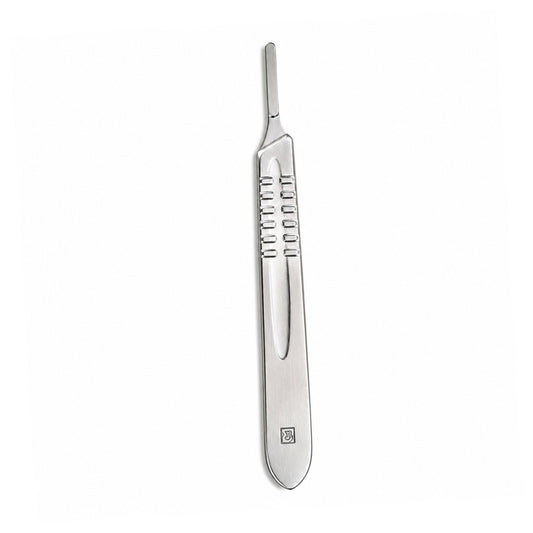
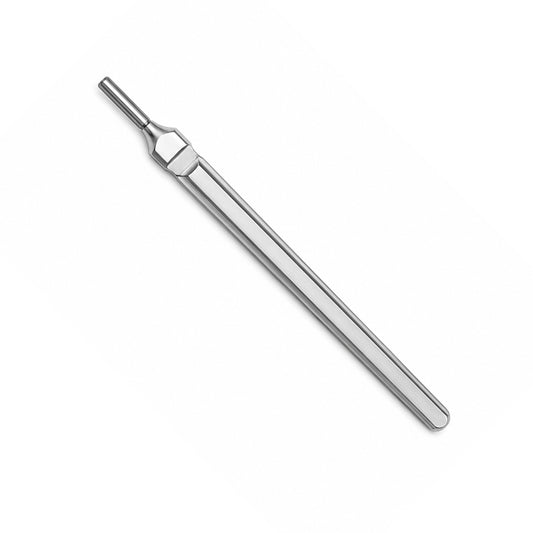
Skalpelskafter er nummereret efter et standardsystem for klinge-pasform – nummeret angiver, hvilke klingetyper der passer på det, ikke kun skaftets størrelse. Peak Surgicals leverer to modeller – Baron nr. 3 og nr. 7 i rustfrit stål, begge til 27,50 USD. Hver er CE-mærket og fremstillet under ISO 13485. Se begge skafter i gitteret nedenfor.
Hvilket skaft til hvilket snit?
Nr. 3-skaftet monterer buede klinger som #10, #11 og #15 på en flad spaltet rille til generelle indsnit, mens nr. 7-skaftet har en mere præcis montering til fint, kontrolleret arbejde som detaljeret dissektion. Monteringsmekanismen og de klingetyper, det accepterer, er det, der adskiller de to. ISO 7740 regulerer denne nummerering, så nummeret fortæller en køber præcis, hvilke klinger der passer, før skaftet ankommer.
Baron Skalpelskaft nr. 3 (PS-P-00028, 130 mm, 27,50 USD) er standarden for generelle post-mortem indsnit; dets flade, slanke profil passer til de buede #10- og #15-klinger, der bruges til hud og blødt væv. Skalpelskaft nr. 7 (PS-P-00029, 127 mm, 27,50 USD) er slankere og rundere, bygget til præcisionssnit, der følger det indledende indsnit: fin dissektion, delikate vævsplan og arbejde, hvor balance betyder mere end kraft. En almindelig post-mortem-sekvens bruger nr. 3 med en #10-klinge til det primære hudindsnit og skifter derefter til nr. 7 med en #15 til den resterende dissektion. Vi leverer hver med en MOQ på 1.
Klinge-pasform, montering og valg af et par
Klinge-pasform er hele pointen med nummereringen. Nr. 3-monteringen er en flad spaltet rille, let at ilægge og frigøre, tilpasset klinger i området #10 til #15. Nr. 7-monteringen er en mere præcis låsemekanisme, der er egnet til mindre klinger, der håndteres med finere kontrol – de samme #10, #11 og #15 klinger passer, men skaftets balance og reducerede masse ændrer, hvordan snittet føles i hånden. At købe en forkert klinge til skaftet er den mest almindelige indkøbsfejl i denne kategori: bekræft klingens nummer mod skaftet, før du bestiller, da den forkerte parring enten ikke vil sidde eller ikke vil holde sikkert.
Til generelt post-mortem-arbejde, hvor der skæres i varieret væv, giver et tungere skaft med en større klinge mere holdbarhed og kontrol; til fin dissektion, hvor præcision opvejer kraft, er det lettere skaft det bedre valg. At have begge modeller ved hånden dækker hele spektret af en autopsi-indsnitssekvens uden at skifte klingestørrelse midt i proceduren.
Genbehandling, monteringsintegritet og certificering
Disse skafter er smedet af rustfrit stål, genanvendelige, korrosionsbestandige over for gentagne autoklavcyklusser og opretholder den monteringsgeometri, som klingens sikkerhed afhænger af. Monteringen er inspektionspunktet: en slidt eller deformeret rille fastholder ikke længere klingen sikkert, hvilket lader den flytte sig eller løsne sig midt i et snit, så kontroller monteringen, før du ilægger en ny klinge hver gang. Rengør med ultralyd før autoklavering, så vævsrester ikke samler sig ved monteringen.
Hvert skaft er Klasse I, genanvendeligt, CE-mærket og bygget under ISO 13485, den dokumentation et forsyningsteam verificerer, før en leverandør godkendes. Garanti er ét år med retur og udskiftning, MOQ er 1 stk., ordrer over 99 USD sendes fragtfrit i kartonemballage, og OEM-mærkning er tilgængelig for distributører. For sikker fjernelse af klinger, se skalpelklingefjernere; for det fulde autopsi-udvalg, se post mortem-instrumenter. Tal med os om OEM og volumenbetingelser.