
Featured Collection
Din varukorg
Featured Collection

PEAK SURGICALS
Lagerhållningsenhet:PS-NI-OT-002
Det gick inte att ladda hämtningstillgänglighet
 CE Certified
 FDA Certified
 ISO Certified


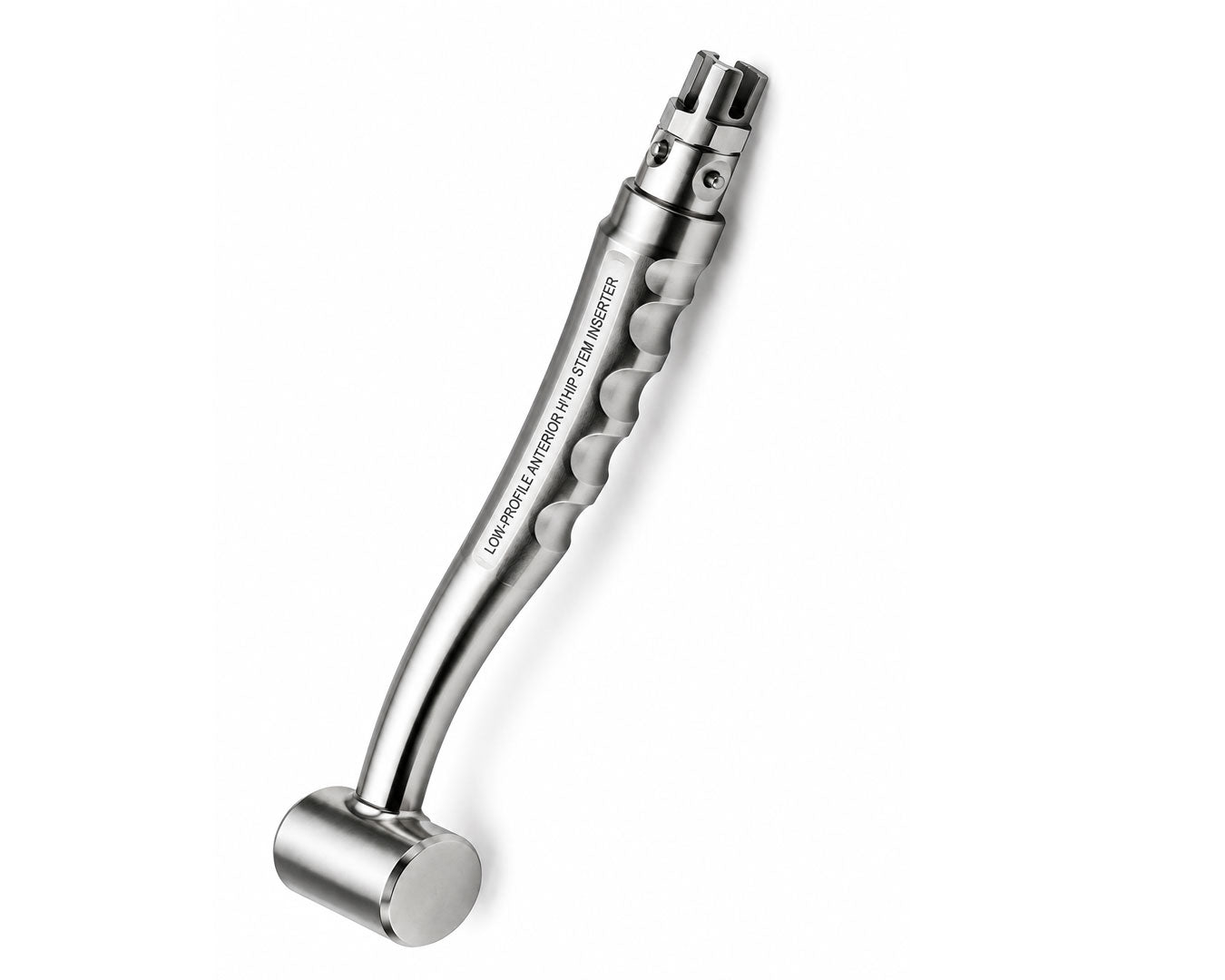
Low-Profile Anterior Hip Stem Inserter is a four-part stainless-steel prototype instrument concept developed for attachment, alignment, and controlled impaction of a femoral stem during Total Hip Arthroplasty performed through the Direct Anterior Approach. The current more-curved prototype configuration uses a proposed 220 mm overall length, Ø14 mm structural shaft, Ø27 mm hand-control region, Ø25 mm impact head, and 32.5° shaft curvature. Its architecture consists of the main curved body, radiused impact head, stem-specific keyed connector, and captive locking pin. The curved shaft is intended to move the surgeon’s hand and mallet trajectory away from the constrained anterior working corridor while maintaining a continuous mechanical path between the strike surface and the selected femoral component. The distal connector is designed around one specific stem system rather than a universal interface and must match that implant’s native impaction geometry. During Direct Anterior Total Hip Arthroplasty, the instrument enters the workflow after femoral preparation, attaches to the selected stem, transmits controlled mallet impact during insertion, and is released after the component reaches the seating position defined by the implant manufacturer’s validated technique.
The Low-Profile Anterior Hip Stem Inserter is designed around a direct mechanical force path from the mallet strike surface to the implanted femoral component. Controlled impact is applied to the broad radiused proximal head, transferred through the solid curved shaft, and delivered to the stem through the distal connector. The continuous curvature is functional rather than decorative: it is intended to provide clearance around the anterior soft-tissue corridor while preserving a structural route for axial and off-axis loading. Machined finger scallops along the enlarged grip region give the surgeon a defined hand-control zone during attachment, alignment, insertion, and release. At the distal end, a keyed anti-rotation interface is intended to mate with the native impaction feature of one selected femoral stem system. This geometry limits rotational movement between instrument and implant while controlled strikes are delivered. A captive locking pin passes through the connector region to retain the stem during the insertion sequence. The connector and locking pin are the most safety-critical elements because repeated impact, bending, and torsional loads converge at this interface. Final key geometry, taper, seating relationship, pin diameter, thread, fit, and tolerances require controlled implant drawings and mechanical validation before production release.
Within the proposed Direct Anterior Approach workflow, the Low-Profile Anterior Hip Stem Inserter is used after surgical exposure and preparation of the femoral canal according to the selected implant system. Once the definitive femoral stem has been selected, its native impaction interface engages the stem-specific distal connector and the locking mechanism retains the component. The surgeon then positions the curved shaft so the hand and mallet remain clear of the restricted anterior working corridor while the stem axis is maintained according to the validated implant technique. Controlled strikes are delivered to the proximal impact head and transmitted through the curved body to advance the femoral component into the prepared canal. The instrument remains attached during progressive insertion so alignment can be controlled while the stem approaches its required depth and orientation. Final seating criteria, impact energy, version, axial alignment, implant handling, and acceptance of stem position are determined by the femoral component manufacturer’s validated surgical technique rather than by the prototype dimensions of the inserter. After seating has been completed, the locking mechanism is released and the inserter is detached from the implant. The instrument is temporary and does not remain in the patient after implantation.
The current more-curved prototype uses proposed starting targets of 220 mm overall assembled length, Ø14 mm main shaft diameter, Ø27 mm grip diameter, Ø25 mm impact-head diameter, and 32.5° curvature. These values sit within the broader source concept ranges of 180–260 mm overall length, 10–18 mm shaft diameter, 22–32 mm grip diameter, 20–30 mm impact-head diameter, and 25°–40° shaft offset. The 220 mm length provides the initial CAD envelope between strike surface and connector, while the Ø14 mm shaft establishes the proposed structural section carrying impact and bending loads. The enlarged Ø27 mm grip creates a distinct hand-control region without a polymer overmold. The Ø25 mm head provides the initial mallet-contact diameter. The 32.5° curve is a prototype starting point intended to investigate anterior-corridor clearance rather than a validated clinical angle. Engineering selection should ultimately use the smallest curvature that provides the required surgical envelope because increasing offset also increases bending moment at the distal interface. Bend radius, connector length, key dimensions, locking-pin geometry, GD&T, and interface tolerances remain dependent on the final implant system, stress analysis, prototype testing, and controlled production drawings.
The current engineering concept uses an all-stainless-steel architecture with 17-4 PH stainless steel identified as a candidate for the structural body, connector, and impact head because the final design requires suitable strength, hardness, wear resistance, corrosion resistance, machinability, and repeated-load capability. 303 or 304 stainless steel may be considered for lower-stress components where appropriate, while 316L is an alternative when enhanced corrosion resistance is prioritized. The proposed surface concept combines a satin stainless-steel body with polished functional faces at the impact and connector interfaces, rounded edges, smooth transitions, and passivation following final machining and finishing. Version 1 intentionally avoids polymer overmolds, springs, electronics, batteries, hydraulics, and unnecessary enclosed mechanisms. The geometry is also intended to avoid deep blind cavities and trapped-debris features so cleaning access can be addressed during design validation. Reusable cleaning and steam-sterilization compatibility are engineering objectives rather than demonstrated performance claims at the current stage. Before clinical release, the final device requires material verification, static bending, torsional testing, repeated-impact fatigue evaluation, connector-retention testing, locking-pin strength assessment, corrosion verification, cleaning validation, sterilization compatibility testing, dimensional inspection, surface-finish verification, risk management, and completion of the applicable regulatory pathway.
| Specification | Details |
|---|---|
| SKU | PS-NI-OT-002 |
| Product Name | Low-Profile Anterior Hip Stem Inserter |
| Price | $69.99 |
| Size/Gauge Variants | Current proposed prototype: 220 mm overall length, Ø14 mm shaft, Ø27 mm grip, Ø25 mm impact head, 32.5° curvature |
| Instrument Category | Orthopedic Hip Arthroplasty Instrument |
| Procedure | Total Hip Arthroplasty through the Direct Anterior Approach; femoral stem attachment, alignment, impaction and removal of the inserter after seating |
| Material | All-stainless-steel concept; 17-4 PH stainless steel is the primary candidate for structural components, with 303/304 and 316L alternatives subject to engineering assessment |
| Finish | Satin stainless-steel body, polished impact and connector interfaces, rounded transitions and passivated final surfaces |
| Sterilization | Reusable concept intended for validated cleaning and steam-sterilization workflows; compatibility testing remains part of the engineering release program |
| Instrument Classification | Reusable manual orthopedic femoral-stem impaction instrument — prototype-development concept |
| Reusable | Designed as reusable; final reprocessing performance requires validation before clinical release |
| Certifications | Product-specific CE marking, FDA clearance or approval, and clinical validation are not established by the supplied engineering documents |
| Warranty | Commercial warranty terms to be defined after production release |
| MOQ | Commercial MOQ to be defined after production release |
| OEM / Custom Orders | Stem-specific engineering is required because the keyed connector and locking mechanism must match one selected femoral stem system |
| After-Sale Service | Commercial support terms to be defined following validated product release |
How does the Low-Profile Anterior Hip Stem Inserter differ from a straight femoral stem inserter?
The Low-Profile Anterior Hip Stem Inserter uses a continuously curved structural shaft rather than a straight impact path. A conventional straight inserter places the handle and impact head substantially along the same longitudinal axis as the stem connection. The curved concept offsets the surgeon’s hand and mallet position to create clearance within the restricted Direct Anterior Approach corridor. That offset changes the mechanical loading because the instrument must manage both axial impact transmission and additional bending moment generated by the curve. The proposed design therefore requires specific bending, torsional, repeated-impact, and connector-retention validation before its geometry can be released clinically. A straight and curved inserter should not be considered interchangeable unless each is validated for the selected implant system and surgical technique.
Why were 220 mm length and 32.5° curvature selected for the prototype?
The Low-Profile Anterior Hip Stem Inserter currently uses 220 mm length and 32.5° curvature as prototype-development targets rather than validated clinical sizes. The source concept allows an overall length range of 180–260 mm and a curvature range of 25°–40°. A 32.5° offset was selected as a midpoint-style starting value for investigation of the more-curved prototype. Its intended function is to move the hand and mallet away from the anterior working corridor while maintaining an acceptable force path toward the femoral stem. Additional curvature can improve geometric clearance but also increases bending moment at the connector and curved shaft. Final selection therefore requires surgical-envelope evaluation, CAD analysis, mechanical testing, and determination of the smallest offset that provides adequate corridor clearance.
What is the regulatory status of the Low-Profile Anterior Hip Stem Inserter?
The supplied engineering documents define the Low-Profile Anterior Hip Stem Inserter as a preliminary prototype-development concept. They do not establish product-specific CE marking, FDA clearance or approval, clinical validation, or proven patient benefit. Mechanical validation, cleaning verification, sterilization compatibility, risk management, design controls, and the applicable regulatory pathway remain open release activities. A company-level quality-management certification such as ISO 13485 should be distinguished from product-specific regulatory authorization. Regulatory claims should therefore be added to the commercial product page only after the finished device has completed the applicable release pathway. Until then, the instrument should be described as an engineering concept rather than a clinically released product.
How do the keyed connector and captive locking pin control the femoral stem?
The distal connector on the Low-Profile Anterior Hip Stem Inserter is intended to mate with the native impaction interface of one specific femoral stem system. A keyed feature provides the anti-rotation relationship so the stem and inserter remain rotationally aligned during handling and controlled impact. The captive locking pin retains the implant at the connector and is intended to prevent disengagement during the insertion sequence. The connector is not a universal adapter and cannot be finalized from the prototype image alone. Key width, depth, taper, seating geometry, cross-bore location, pin dimensions, thread form, and retention capacity must be derived from the selected stem manufacturer’s controlled interface drawing. These features then require fit verification and repeated-impact, torsional, retention, and pin-strength testing before production release.
What must a hospital or distributor confirm before this instrument becomes a commercial reusable device?
The Low-Profile Anterior Hip Stem Inserter should not enter clinical procurement while its current prototype release gates remain open. The specific compatible femoral stem system must first be frozen and its controlled connector dimensions incorporated into revision-controlled CAD and production drawings. Final alloy, heat treatment, hardness, surface finish, passivation, tolerances, and manufacturing inspection requirements must then be established. Mechanical testing must address bending, torsion, repeated impact, connector retention, pin strength, permanent deformation, and dimensional stability. Cleaning validation and repeated steam-sterilization compatibility must demonstrate that the final geometry can be adequately reprocessed without loss of material or mechanical function. Formal risk management, design-control review, regulatory release, traceability documentation, and the relevant implant manufacturer’s surgical instructions must be completed before commercial clinical use.


