Tá do chairt folamh
Lean ort ag siopadóireachtAn bhfuil cuntas agat?
Logáil isteach chun seiceáil amach níos tapúla.

Bailiúchán Luaite
Do chairt siopadóireachta
Tá do chairt folamh
Lean ort ag siopadóireachtAn bhfuil cuntas agat?
Logáil isteach chun seiceáil amach níos tapúla.
Bailiúchán Luaite

PEAK SURGICALS
SKU:PS-000032
Níorbh fhéidir infhaighteacht bailithe a luchtú


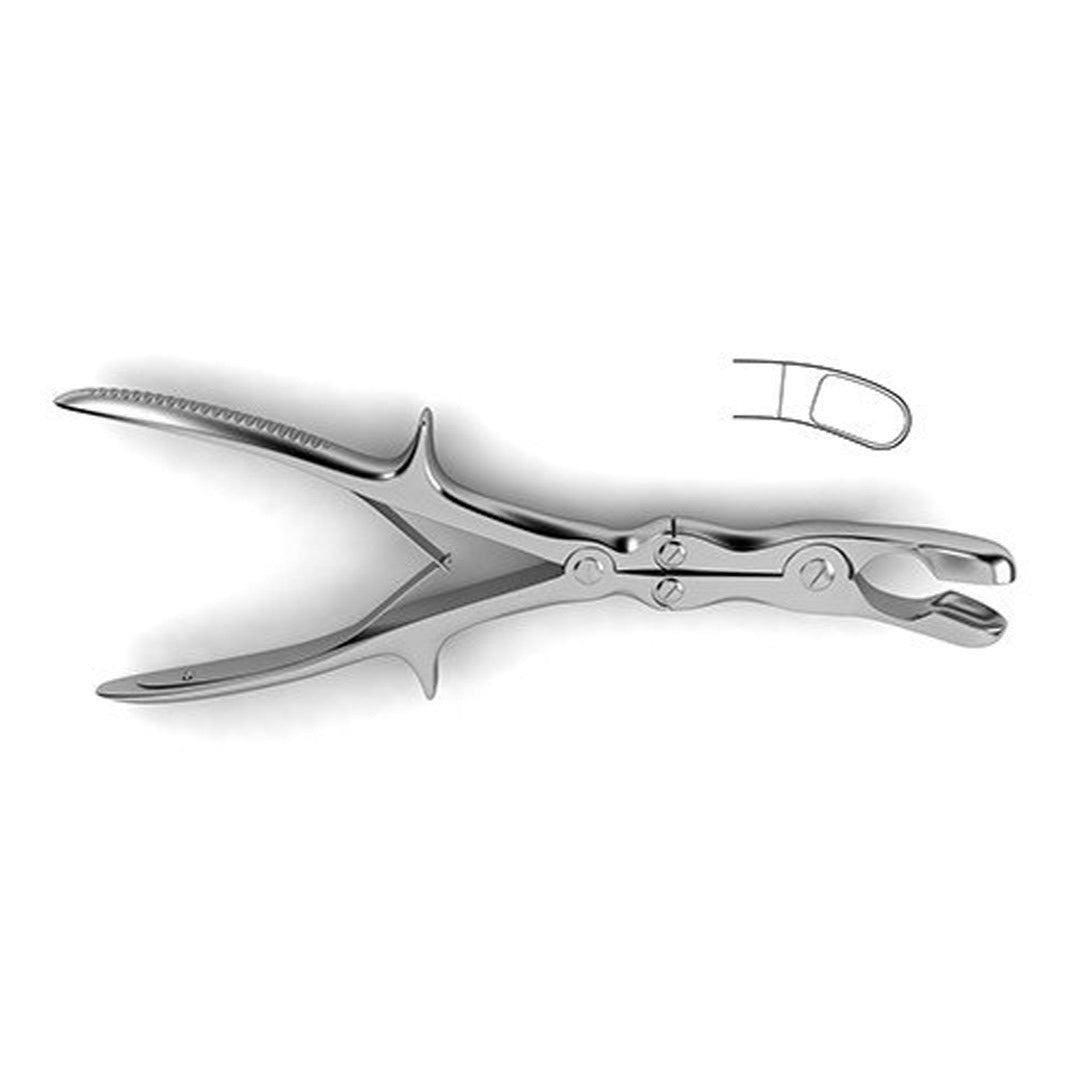
Ruskin-Liston Bone Cutting Forceps, SKU PS-000032, are reusable orthopedic bone cutters manufactured from German surgical steel for controlled cutting, trimming, and removal of exposed bone during orthopedic and reconstructive procedures. The instrument follows the Ruskin-Liston pattern with straight cutting jaws, a double-action mechanism, and an overall length of approximately 7 1/8 to 7 1/4 in. Double-action linkage multiplies the force generated at the handles before transferring it to the cutting jaws, allowing the surgeon to divide or contour bone with less hand excursion than a conventional single-action cutter. The relatively compact Ruskin-Liston pattern is particularly useful for small and delicate bone compared with larger Stille-Liston forceps. Straight jaws provide direct axial access to visible osseous margins and fragments during fracture surgery, osteotomy, bone contouring, and reconstructive procedures. The instrument is supplied as a reusable medical-grade steel device for professional surgical use and can be incorporated into orthopedic bone-cutting, trauma, reconstructive, podiatric, and related instrument sets.
The principal mechanical advantage of the Ruskin-Liston Bone Cutting Forceps is its double-action linkage. Initial movement of the plier-style handles is transferred through an intermediate joint before reaching the distal cutting jaws, increasing mechanical leverage at the working end while limiting the amount of hand force required to achieve controlled bone division. This compound-action geometry is particularly useful when the surgeon must trim cortical edges, remove a small osseous projection, or divide bone through a restricted operative field. The straight jaws align the cutting edges with the longitudinal axis of the instrument and provide a direct approach to exposed bone. Sharp opposed cutting surfaces meet as the handles are compressed and should be positioned completely around the intended section before significant force is applied. The surgeon can regulate cutting progression through incremental closure rather than attempting to complete a difficult cut with uncontrolled force. Because the forceps are non-locking cutting instruments, jaw closure remains directly controlled by the operator throughout use. Correct placement, visibility of the cutting margins, and protection of surrounding soft tissue are essential before the double-action mechanism is activated.
During orthopedic fracture surgery, the Ruskin-Liston Bone Cutting Forceps can be introduced after adequate exposure has provided clear visualization of the osseous area requiring modification. The straight jaws can be positioned around a projecting bone edge, accessible fragment, or other section identified for controlled removal or contouring. Progressive handle compression activates the double-action linkage and closes the cutting jaws through the targeted bone. In reconstructive procedures, the instrument can assist with contouring bone surfaces before plate application, graft placement, or definitive fixation when the operative plan requires removal of a limited amount of bone. The compact Ruskin-Liston design is also appropriate for smaller bone procedures where the mass and jaw dimensions of a larger Stille-Liston cutter would be unnecessary. During podiatric, hand, or other small-bone surgery, the straight pattern allows the surgeon to approach the target directly when adequate axial access is available. Bone should remain fully visible at the intended cutting site, and vessels, nerves, tendons, periosteum, or other protected soft tissues should be displaced from the jaw path before closure.
Peak Surgicals SKU PS-000032 identifies the straight Ruskin-Liston Bone Cutting Forceps currently listed with an approximate overall length of 7 1/8 to 7 1/4 in. This size corresponds closely with established straight Ruskin-Liston bone cutters commonly produced around 7 1/4 to 7 1/2 in overall. The Ruskin-Liston family is also available commercially in shorter delicate patterns and angled configurations, demonstrating that jaw orientation and overall length should be selected according to surgical access rather than by pattern name alone. A straight model is appropriate when the surgeon can approach the intended bone-cutting site directly along the instrument axis. An angled Ruskin-Liston configuration may be preferable when surrounding anatomy prevents straight-line access or when the handles must remain offset from the bone surface. Compared with Stille-Liston forceps, Ruskin-Liston patterns generally use a shorter overall profile and smaller jaws for more controlled work on relatively small or delicate osseous structures. Hospitals should retain SKU PS-000032, the straight-jaw designation, and the approximate 7.25-inch size in purchasing and orthopedic tray records.
German surgical steel provides the rigidity, corrosion resistance, edge stability, and mechanical strength required for reusable bone-cutting forceps subjected to repeated cutting loads and sterilization cycles. Reprocessing should begin promptly after clinical use so blood, marrow, bone particles, and tissue residue do not dry around the cutting jaws, compound-action joints, spring components, grooves, or plier handles. The forceps should remain sufficiently open during cleaning so all working and articulated surfaces can be accessed. Thorough rinsing and complete drying should follow before visual and functional inspection. Sterile-processing personnel should inspect the cutting edges for chips, dents, misalignment, corrosion, or loss of edge integrity and confirm that the double-action mechanism opens and closes smoothly without binding. Moving joints can receive instrument-compatible lubrication according to the facility's validated maintenance process. Terminal sterilization should follow the healthcare facility's validated protocol for reusable surgical steel instrumentation. Peak Surgicals displays CE, FDA, and ISO certification badges and supports ISO 13485 procurement documentation; specific FDA status should be documented through an exact manufacturer or device record rather than interpreted as individual FDA approval of PS-000032.
| SKU | PS-000032 |
|---|---|
| Product Name | Ruskin-Liston Bone Cutting Forceps |
| Price | $74.80 USD |
| Brand | Von Klaus |
| UPC | 0619915054666 |
| Size/Gauge Variants | Approximately 7 1/8 to 7 1/4 in overall length |
| Jaw Configuration | Straight Cutting Jaws |
| Mechanism | Double-Action / Compound Leverage |
| Instrument Category | Orthopedic Bone Cutting Forceps |
| Procedure | Orthopedic bone cutting, fracture surgery, bone trimming, osteotomy, reconstructive surgery, and small-bone contouring |
| Material | German Surgical Steel |
| Finish | Surgical Instrument Finish |
| Sterilization | Reusable; sterilize following validated healthcare-facility cleaning and reprocessing protocols |
| Instrument Classification | Reusable Manual Bone Cutting Forceps |
| Reusable | Yes |
| Certifications | CE and ISO 13485 procurement documentation; FDA-related documentation subject to exact manufacturer/device identification |
| Warranty | 30-Day Money-Back Guarantee on eligible purchases |
| MOQ | 1 Piece for standard online ordering |
| OEM / Custom Orders | Available for institutional, distributor, and custom procurement requirements |
| After-Sale Service | Return and replacement support under Peak Surgicals policy |
How do Ruskin-Liston Bone Cutting Forceps differ from Stille-Liston Bone Cutting Forceps?
Ruskin-Liston Bone Cutting Forceps are generally shorter and use smaller working jaws than Stille-Liston patterns. This makes the Ruskin-Liston design suitable for controlled work on relatively small or delicate bone where a large cutter would occupy unnecessary space. Stille-Liston forceps commonly provide longer handles, larger jaws, and greater leverage for heavier orthopedic bone cutting. Both families can use compound double-action mechanisms to increase mechanical cutting force. The correct instrument should be selected according to bone dimensions, required cutting capacity, operative depth, and available working space. PS-000032 is the compact straight Ruskin-Liston configuration rather than a heavy Stille-Liston cutter.
Why select a straight approximately 7.25-inch Ruskin-Liston pattern?
The approximately 7.25-inch length provides a compact balance between working reach and maneuverability. Straight jaws allow direct access when the target bone can be approached along the longitudinal axis of the forceps. This configuration is useful for exposed small or delicate osseous structures where a larger cutter may interfere with visualization or nearby instruments. An angled Ruskin-Liston may be preferable when the bone surface cannot be reached directly or when the handles need to remain offset from the target. Shorter delicate patterns provide even more localized handling for especially restricted work. Selection should therefore follow operative depth, bone size, cutting direction, surrounding anatomy, and the amount of mechanical leverage required.
What do CE, ISO 13485 and FDA references mean for procurement?
Peak Surgicals displays CE, FDA, and ISO certification badges on the Ruskin-Liston Bone Cutting Forceps listing. ISO 13485 relates to quality-management systems used for medical-device manufacturing rather than proving individual instrument performance. CE documentation supports applicable medical-device conformity requirements within relevant markets. Comparable reusable Ruskin-Liston bone cutters are represented in FDA device databases under the bone cutter classification. However, an exact FDA record linked specifically to Peak SKU PS-000032 is not identified on the live product page. Procurement teams should therefore retain the exact SKU, brand information, supplier certificates, and any manufacturer-specific regulatory documentation used during qualification rather than describing PS-000032 as individually FDA approved.
How does the double-action mechanism improve cutting control?
The double-action mechanism uses more than one pivot stage between the handles and cutting jaws. This compound linkage increases mechanical leverage as the operator closes the plier handles. Greater leverage allows the cutting edges to generate useful force without requiring the same degree of direct hand pressure as a simple single-action cutter. The surgeon can still control progression through incremental handle closure rather than applying unrestricted force. The jaws should be completely positioned around the intended bone segment before significant compression is applied. Double action improves mechanical efficiency but does not replace correct jaw placement, visualization, or protection of surrounding tissue.
How should hospitals order and reprocess Ruskin-Liston Bone Cutting Forceps?
Hospitals should order this exact instrument using Peak Surgicals SKU PS-000032 together with the straight-jaw, double-action, and approximately 7.25-inch specifications. Peak Surgicals currently lists the product at $74.80 and displays a 30-day money-back guarantee. The listing identifies the brand as Von Klaus and provides UPC 0619915054666 for additional purchasing identification. After use, bone particles, marrow, blood, and tissue residue should be removed promptly from the cutting jaws, action joints, spring components, and handles. Cleaning should be followed by thorough rinsing, complete drying, inspection of cutting-edge alignment and joint movement, and instrument-compatible lubrication where required. Final sterilization should follow the healthcare facility's validated reusable surgical-instrument process before PS-000032 returns to the orthopedic bone-cutting tray.


