Tá do chairt folamh
Lean ort ag siopadóireachtAn bhfuil cuntas agat?
Logáil isteach chun seiceáil amach níos tapúla.

Bailiúchán Luaite
Do chairt siopadóireachta
Tá do chairt folamh
Lean ort ag siopadóireachtAn bhfuil cuntas agat?
Logáil isteach chun seiceáil amach níos tapúla.
Bailiúchán Luaite

PEAK SURGICALS
SKU:PS-000073
Níorbh fhéidir infhaighteacht bailithe a luchtú


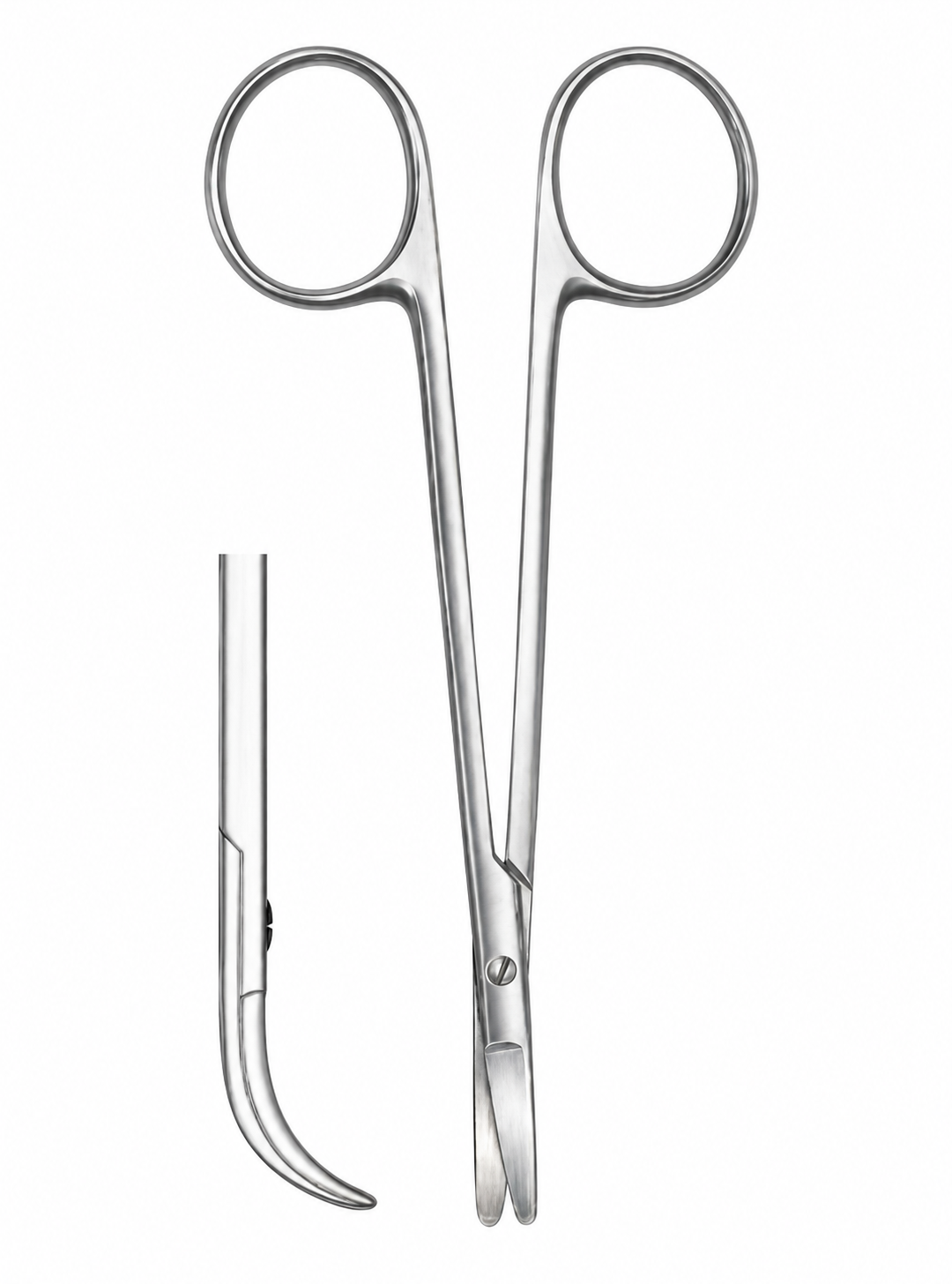
Fomon Scissors, SKU PS-000073 and catalog number 415-110, are reusable rhinoplasty scissors manufactured from German stainless steel for controlled dissection and trimming of the lower lateral nasal cartilage and adjacent soft-tissue planes. The instrument measures 4 1/2 in (115 mm) overall, with a 31 mm working length and 24 mm tip/jaw length. Its full-curved configuration follows the contour of the alar cartilage, while beveled blades create a defined shearing interface during short, deliberate cuts. The compact profile is used during open rhinoplasty, closed rhinoplasty, nasal tip refinement, cephalic trimming of the lateral crus, lower lateral cartilage modification, septorhinoplasty, and selected reconstructive nasal procedures. Ring handles provide familiar thumb-and-finger control, while the screw joint maintains coordinated blade movement through each cutting cycle. The curvature permits the working end to enter the nasal operative field without placing the surgeon's hand directly over the tissue being shaped. Plastic surgeons, facial plastic surgeons, otolaryngologists, and reconstructive surgeons use this pattern in hospital operating rooms, ambulatory surgical centers, and specialist rhinoplasty facilities where precise cartilage and soft-tissue division is required.
The Fomon pattern uses two opposed blades connected through a central screw joint that converts closure of the ring handles into progressive shearing at the distal working end. The full curvature is clinically significant because it follows the convex configuration of the lower lateral cartilage more closely than a straight scissor pattern. This geometry allows the surgeon to approach the lateral crus from a controlled tangential direction while preserving visualization of the cartilage margin and overlying soft-tissue envelope. Each beveled edge passes against its opposing blade as the handles close, dividing the material positioned within the jaws rather than crushing it through simple compression. The 24 mm distal section provides a compact active cutting surface suited to short sequential strokes. A 31 mm working length maintains sufficient reach from the pivot into the nasal field while keeping the finger rings outside the immediate incision. The screw joint must remain correctly tensioned so the blades move freely without lateral separation that could compromise accurate engagement. Ring handles permit opening, closure, rotation, and immediate release with one hand. Because there is no ratchet, spring, or locking system, cutting pressure ceases as soon as handle approximation stops, giving the surgeon continuous manual control throughout cartilage shaping and soft-tissue dissection.
During open rhinoplasty, Fomon Scissors are used after exposure of the lower lateral cartilages when controlled division or contouring is required around the nasal tip framework. During a planned cephalic trim, the surgeon identifies the lateral crus and preserves the structural segment needed to maintain alar support before removing the selected cephalic portion. The curved blades can follow the cartilage contour while short cutting strokes advance along the predetermined line. During tip refinement, the same instrument may assist with release or trimming of soft tissue surrounding the alar framework where a curved working path provides better access than straight scissors. In closed rhinoplasty, its compact profile can be introduced through intranasal approaches for localized cartilage or soft-tissue division when visualization and exposure permit. During septorhinoplasty or reconstructive nasal surgery, the scissors can support preparation of selected cartilage margins and adjacent tissue as part of the planned structural correction. The working end should remain visible whenever possible because blind advancement can place vestibular skin, mucosa, internal nasal valve structures, or neighboring soft tissue within the cutting path. The surgeon therefore uses incremental closure, reassesses the tissue margin after each cut, and maintains the amount of cartilage required for the intended structural result.
Catalog 415-110 is supplied in a 4 1/2 in (115 mm) overall configuration with a 31 mm working length and 24 mm tip/jaw section. The overall dimension gives the surgeon a compact instrument suited to the limited spatial envelope of nasal plastic surgery while keeping the finger rings close enough for fine tactile control. The 31 mm segment between the joint and distal tip provides reach into the lower lateral nasal framework without introducing the bulk of a longer general surgical scissor. Its 24 mm jaws form the active cutting zone and are intended for controlled incremental division rather than long sweeping transection. Full curvature distinguishes this configuration from Fomon dorsal scissors, which use a different geometry to approach the nasal dorsum. The curved PS-000073 pattern is therefore selected when the operative step centers on lower lateral cartilage, alar framework, or adjacent rhinoplasty soft tissue. Instrument choice should reflect the direction of the intended cut and the relationship between the blades and cartilage surface rather than overall length alone. A correctly selected curved pattern allows the surgeon to position the cutting edges along the planned contour while keeping the joint and rings clear of the narrow operative field.
German stainless steel provides the rigidity, corrosion resistance, and edge support required for reusable nasal scissors exposed to repeated cutting and sterilization cycles. The satin finish reduces distracting reflection beneath operating-room illumination and provides a surface that can be inspected for staining, corrosion, retained residue, or mechanical damage. Reprocessing should begin promptly after surgery so blood, cartilage fragments, and soft-tissue debris do not dry along the beveled edges or within the screw joint. Cleaning must address both blade surfaces, the pivot, shanks, and finger rings, followed by thorough rinsing and complete drying. Functional inspection should confirm smooth opening and closure, appropriate joint tension, accurate blade approximation, intact tips, and absence of lateral play. A loose pivot, damaged edge, bent working end, or irregular closure can compromise controlled shearing and should be addressed before the device returns to clinical service. The reusable instrument can undergo steam sterilization within a validated healthcare-facility process compatible with stainless steel surgical instrumentation and the applicable instructions for use. Peak Surgicals supports CE and ISO 13485 procurement documentation together with FDA-related records used by hospitals, surgical centers, and distributors during supplier qualification.
| SKU | PS-000073 |
|---|---|
| Product Name | Fomon Scissors |
| Price | $27.50 USD |
| Size/Gauge Variants | 4 1/2 in (115 mm) overall; 31 mm working length; 24 mm tip/jaw length |
| Instrument Category | Plastic and Reconstructive Surgery Rhinoplasty Scissors |
| Procedure | Open rhinoplasty, closed rhinoplasty, lower lateral cartilage dissection, nasal tip refinement, cephalic trim, septorhinoplasty, and nasal reconstruction |
| Material | German Stainless Steel |
| Finish | Satin |
| Sterilization | Reusable; steam sterilization following validated healthcare-facility cleaning and reprocessing protocols |
| Instrument Classification | Class I Reusable Manual Surgical Scissors |
| Reusable | Yes |
| Certifications | CE, ISO 13485, FDA-related procurement documentation |
| Warranty | 1 Year |
| MOQ | 1 Piece |
| OEM / Custom Orders | Available |
| After-Sale Service | Return and Replacement |
How do Fomon Lower Lateral Scissors differ from Fomon Dorsal Scissors?
Fomon Lower Lateral Scissors use full-curved blades designed to follow the contour of the lower lateral nasal cartilage. Fomon Dorsal Scissors use an angled-on-flat configuration that redirects the cutting end toward structures along the nasal dorsum. The curved 415-110 pattern is therefore better aligned with lateral crus and nasal tip cartilage work. A dorsal configuration provides a different relationship between the handles and working plane when dissection is required higher along the nasal framework. Both instruments use ring handles and a screw-joint shearing mechanism. Selection depends on whether the planned rhinoplasty stage involves lower lateral cartilage contouring or dorsal access and dissection.
What is the purpose of the 115 mm length and 24 mm curved jaws?
The 115 mm overall length keeps Fomon Scissors compact enough for controlled manipulation around the nasal tip and lower lateral framework. Its 31 mm working section provides reach from the screw joint into the operative field without excessive instrument bulk. The 24 mm jaws create a short cutting surface for incremental cartilage and soft-tissue division. Full curvature helps the working end follow the natural contour of the lateral crus during rhinoplasty. This configuration supports deliberate short cuts rather than broad tissue transection. The listed product is a single dimensional pattern, so selection centers on its blade geometry and intended operative plane rather than choosing between multiple lengths.
What do CE, ISO 13485 and FDA references mean for procurement?
Peak Surgicals supports CE, ISO 13485, and FDA-related procurement documentation for Fomon Scissors. ISO 13485 addresses the quality-management system governing controlled medical-device manufacturing and associated processes. CE documentation supports conformity review for applicable medical-device markets. United States hospitals and distributors evaluate FDA-related manufacturer and device records according to their purchasing and vendor-qualification requirements. These references should not be converted into an unsupported statement that PS-000073 is individually FDA approved. Procurement teams can retain applicable certificates, catalog identification, purchasing records, and supplier documentation within their institutional quality files.
How does the screw joint control cutting during rhinoplasty?
The screw joint acts as the central pivot connecting the two blades of the Fomon Scissors. As the surgeon closes the ring handles, each blade rotates around this pivot and the beveled edges pass against one another to create a shearing action. Stable joint tension helps maintain correct blade alignment throughout the cutting cycle. If excessive lateral play develops, the edges may separate instead of engaging cartilage or soft tissue cleanly. There is no ratchet or locking mechanism, so cutting force changes immediately with movement of the surgeon's fingers. This direct control allows the operator to make short sequential cuts and reassess the lower lateral cartilage after every closure.
How should hospitals order and reprocess Fomon Scissors?
Hospitals should order Fomon Scissors using SKU PS-000073 and catalog number 415-110 together with the 115 mm overall specification. Peak Surgicals lists a current price of $27.50, while standard procurement terms include a one-year warranty, one-piece MOQ, OEM availability, and return-and-replacement support. After use, blood, cartilage, and soft-tissue residue should be removed promptly from the blades, screw joint, shanks, and finger rings. Cleaning should be followed by complete rinsing, drying, and inspection of blade alignment, cutting edges, tip geometry, joint tension, and surface condition. The curved working end should be protected from impact with heavier devices during instrument-tray assembly. Final steam sterilization should follow the facility's validated reusable surgical-instrument cycle and applicable reprocessing instructions before the scissors return to the rhinoplasty set.


