Tá do chairt folamh
Lean ort ag siopadóireachtAn bhfuil cuntas agat?
Logáil isteach chun seiceáil amach níos tapúla.

Bailiúchán Luaite
Do chairt siopadóireachta
Tá do chairt folamh
Lean ort ag siopadóireachtAn bhfuil cuntas agat?
Logáil isteach chun seiceáil amach níos tapúla.
Bailiúchán Luaite

PEAK SURGICALS
SKU:PS-000059
Níorbh fhéidir infhaighteacht bailithe a luchtú


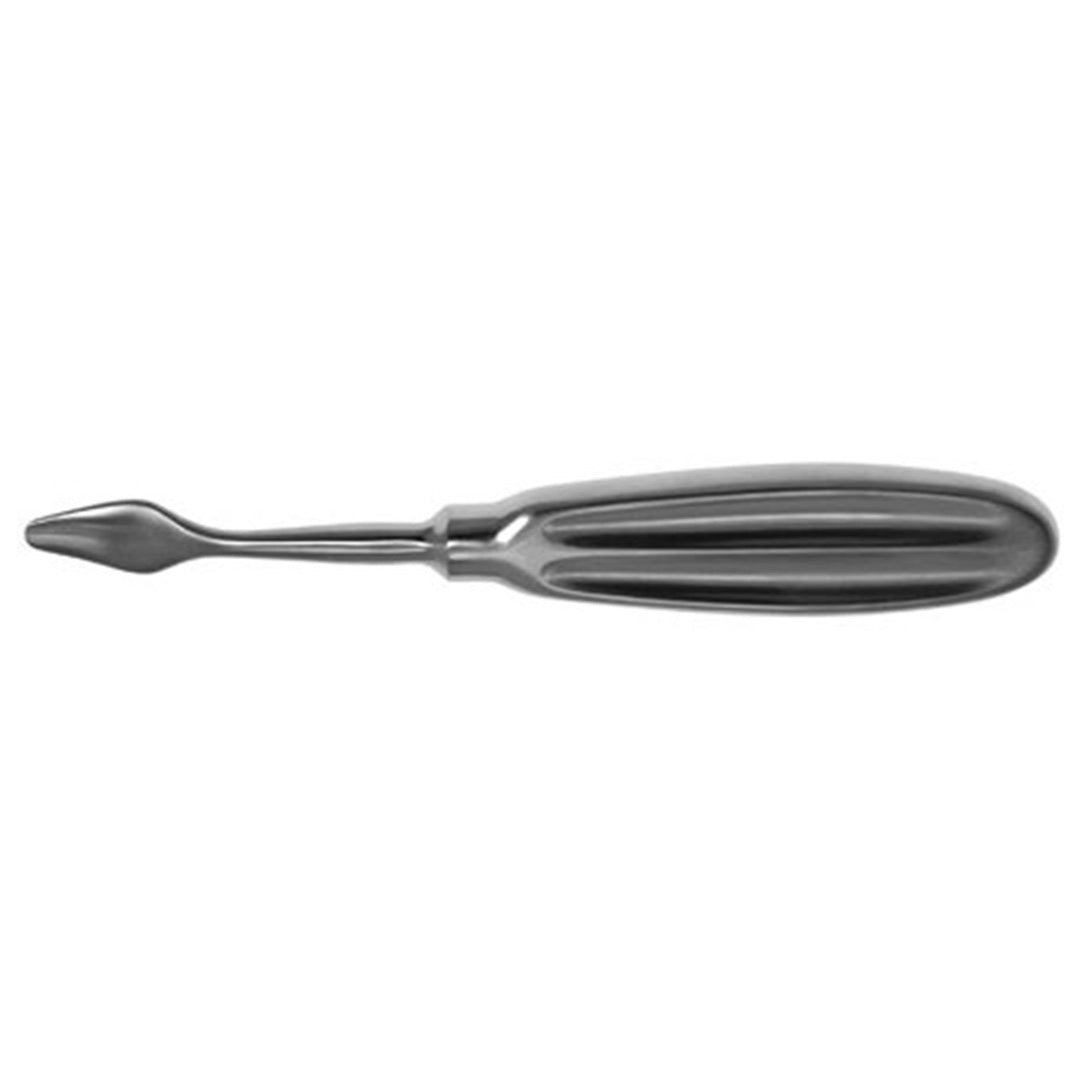
Chandler Elevator, SKU PS-000059 and part number gS 43.3500, is a reusable orthopedic, spine, and neurosurgical elevator manufactured from German surgical stainless steel for controlled elevation of periosteum, soft tissue, and exposed bone fragments. The instrument measures 7 1/2 in overall and incorporates a 13 mm blunt working end, rigid shaft, and broad manual handle for direct tactile control during dissection and retraction. Its smooth blunt blade allows the surgeon to develop a plane along bone without the concentrated cutting action of a sharp periosteal elevator. The Chandler pattern is used during posterior spinal exposure, laminectomy and fusion approaches, cranial bone-flap manipulation, fracture exposure, metatarsal and other small-bone procedures, and operative steps requiring periosteal separation from an osseous surface. The 13 mm width provides a focused working footprint while remaining broad enough to distribute lifting force across the tissue interface. Orthopedic surgeons, spine surgeons, neurosurgeons, and reconstructive teams use this configuration in hospital operating rooms and specialty surgical centers where controlled blunt elevation is required.
The Chandler design works through direct hand-applied leverage rather than a ratchet, spring, pivot, or powered mechanism. Its 13 mm blunt distal blade is advanced along a visible tissue-bone interface so the working surface can separate periosteum or mobilize soft tissue without using a sharp cutting edge. The rounded profile reduces focal penetration and allows pressure to be distributed across the width of the blade as the surgeon develops the dissection plane. A rigid stainless steel shaft transfers axial, lifting, and gentle sweeping movements from the handle to the working end without mechanical articulation. The surgeon can alter the angle of approach by rotating or tilting the handle while maintaining direct tactile feedback from the distal surface. This feedback is useful when distinguishing a firm osseous boundary from adjacent soft tissue during controlled elevation. The blade can also support limited manipulation of exposed bone fragments where a blunt surface is preferable to a pointed lever. Because there is no mechanical depth limiter, insertion and elevation are governed by visualization, tactile resistance, shaft angle, and the amount of force applied by hand. The working end should remain against the intended osseous plane rather than being advanced blindly into adjacent tissue.
During posterior spinal surgery, the Chandler Elevator can be used after the incision and fascial exposure to assist with controlled elevation of paraspinal soft tissue and periosteal attachments from accessible spinous process, laminar, or adjacent bony surfaces. This can support exposure during laminectomy, decompression, and fusion procedures before drilling, instrumentation, or bone-graft preparation proceeds. In neurosurgical workflows, the Chandler pattern is classified for bone-flap elevation and can assist with controlled mobilization of an exposed cranial bone segment after the planned osteotomy has been completed. The blunt 13 mm end distributes lifting force while the surgeon maintains awareness of the underlying dura and surrounding soft tissues. In orthopedic trauma, the same manual mechanism can develop a periosteal plane around a visible fracture surface when exposure is required for reduction or fixation. During metatarsal and other small-bone surgery, the compact blade can retract tissue from the osseous surface while osteotomy, drilling, or implant placement is performed. The instrument should be used for deliberate elevation and dissection rather than aggressive prying. Force should be reduced whenever tissue resistance changes unexpectedly or the distal end approaches neural, vascular, dural, or other protected structures.
Part number gS 43.3500 identifies the 7 1/2 in Chandler Elevator with a 13 mm blunt working end. This is the smallest documented blade width within the established Chandler family, which also includes 19 mm, 25 mm, and 30 mm configurations with progressively longer overall lengths. The 13 mm model provides a narrower contact surface for restricted operative corridors and localized periosteal elevation where a broader blade would occupy unnecessary space. Its 7 1/2 in overall length preserves maneuverability during small-bone, spinal, and cranial exposure while maintaining adequate distance between the surgeon's hand and the working site. A 19 mm Chandler provides additional tissue contact when more surface area must be elevated, while 25 mm and 30 mm patterns are suited to broader exposed planes where the anatomy permits a larger blade. The 13 mm PS-000059 configuration should therefore be selected according to incision dimensions, target bone surface, depth of exposure, surrounding structures, and the amount of tissue requiring displacement. Blade width changes the contact footprint rather than the permissible depth of insertion, which remains controlled entirely by the operator.
German surgical stainless steel provides the rigidity, corrosion resistance, and dimensional stability required for a reusable elevator subjected to repeated manual loading and sterilization cycles. Peak Surgicals identifies gS 43.3500 as Premium OR grade and reusable. The fixed construction eliminates articulated joints, simplifying mechanical inspection while still requiring complete cleaning of the blade, shaft, handle, and surface transitions. Reprocessing should begin promptly after clinical use so blood, periosteal tissue, bone debris, or other residue does not dry on the instrument. Cleaning should be followed by thorough rinsing and complete drying before visual inspection under suitable lighting. Sterile-processing personnel should assess the 13 mm blunt end for deformation, burrs, corrosion, surface damage, or loss of its intended smooth profile and confirm that the shaft remains aligned. A bent or damaged working end can alter the direction of applied force and should not return to clinical service until appropriately assessed. Terminal sterilization should follow the healthcare facility's validated protocol for reusable stainless steel surgical instrumentation. Peak Surgicals supports CE and ISO 13485 procurement documentation, with FDA-related records maintained according to institutional supplier-qualification requirements.
| SKU | PS-000059 |
|---|---|
| Product Name | Chandler Elevator |
| Price | $59.40 USD |
| Size/Gauge Variants | gS 43.3500: 7 1/2 in overall length with 13 mm blunt working end |
| Instrument Category | Orthopedic, Spine and Neurosurgical Elevator |
| Procedure | Posterior spinal exposure, laminectomy and fusion approaches, cranial bone-flap elevation, fracture exposure, periosteal dissection, and small-bone surgery |
| Material | German Surgical Stainless Steel |
| Finish | Premium OR Surgical Finish |
| Sterilization | Reusable; steam sterilization following validated healthcare-facility cleaning and reprocessing protocols |
| Instrument Classification | Reusable Manual Surgical Elevator |
| Reusable | Yes |
| Certifications | CE, ISO 13485, FDA-related procurement documentation |
| Warranty | 30-Day Money-Back Guarantee |
| MOQ | 1 Piece |
| OEM / Custom Orders | Available for institutional and distributor requirements |
| After-Sale Service | Return and replacement support under Peak Surgicals policy |
How does the Chandler Elevator differ from a Cobb Elevator?
The Chandler Elevator uses a blunt working end designed for controlled elevation and separation along a bone surface. A Cobb Elevator is commonly supplied with a sharper periosteal blade and is used when more active stripping of firmly attached tissue is required. The 13 mm Chandler therefore provides a less aggressive distal interface for lifting periosteum, soft tissue, or exposed bone fragments. Cobb patterns are often broader and provide stronger scraping action during spinal or orthopedic exposure. Both instruments are manually controlled and transfer hand movement directly through a rigid shaft. Selection depends on tissue adherence, required blade width, operative depth, and whether blunt elevation or sharper periosteal dissection is required.
Why select the 13 mm Chandler Elevator instead of a wider size?
The 13 mm working end provides the most focused blade footprint within the established Chandler size family. This makes gS 43.3500 useful when the operative corridor is narrow or when surrounding structures limit the amount of blade that can safely contact the bone surface. Wider 19 mm, 25 mm, and 30 mm models engage progressively larger tissue areas and are better suited to broader exposed osseous planes. The 7 1/2 in length also provides greater maneuverability than the longer configurations used with wider blades. A narrow tip does not permit deeper insertion by itself; depth remains controlled through visualization, anatomy, and tactile feedback. PS-000059 should therefore be selected when localized blunt elevation is preferable to broad periosteal displacement.
What do CE, ISO 13485 and FDA references mean for procurement?
Peak Surgicals displays CE, FDA, and ISO-related information for the Chandler Elevator and supports ISO 13485 procurement documentation. ISO 13485 concerns the quality-management system used for controlled medical-device manufacturing and associated processes. CE documentation supports conformity assessment within applicable medical-device markets. FDA AccessGUDID identifies gS 43.3500 as a commercially distributed reusable neurosurgical bone-flap elevator. This information should not be rewritten as an unsupported statement that PS-000059 is individually FDA approved. Hospitals and distributors can retain supplier certificates, SKU and part-number identification, applicable regulatory records, and purchase documentation within their vendor-qualification system.
How is the Chandler Elevator controlled without a locking mechanism?
The Chandler Elevator is a fixed manual instrument with no ratchet, spring, pivot, or self-retaining lock. The surgeon positions the 13 mm blunt end at the intended visible tissue-bone interface and applies controlled movement through the handle. The rigid shaft transfers lifting, axial, or gentle sweeping force directly toward the working blade. Rotating the handle changes the orientation of the distal surface and allows the surgeon to follow the contour of the exposed bone. Reducing hand force immediately reduces pressure at the tip, providing continuous tactile control during dissection. The device should be repositioned when the operative plane changes rather than used for uncontrolled levering against unseen bone or protected underlying structures.
How should hospitals order and reprocess the Chandler Elevator?
Hospitals should order the Chandler Elevator using SKU PS-000059 and part number gS 43.3500 together with the 7 1/2 in length and 13 mm blunt-tip specification. Peak Surgicals currently lists the instrument at $59.40 and provides a 30-day money-back guarantee. Standard online procurement begins with one piece, while OEM and custom purchasing support is available for institutional or distributor requirements. After surgery, blood, tissue, and bone residue should be removed promptly from the distal blade, shaft, and handle. Cleaning should be followed by thorough rinsing, complete drying, and inspection for corrosion, tip deformation, burr formation, surface defects, or unintended shaft bending. Final sterilization should follow the healthcare facility's validated reusable stainless steel instrument process before PS-000059 returns to the orthopedic, spine, or neurosurgical instrument set.


