Tá do chairt folamh
Lean ort ag siopadóireachtAn bhfuil cuntas agat?
Logáil isteach chun seiceáil amach níos tapúla.

Bailiúchán Luaite
Do chairt siopadóireachta
Tá do chairt folamh
Lean ort ag siopadóireachtAn bhfuil cuntas agat?
Logáil isteach chun seiceáil amach níos tapúla.
Bailiúchán Luaite

PEAK SURGICALS
SKU:PS-000058
Níorbh fhéidir infhaighteacht bailithe a luchtú


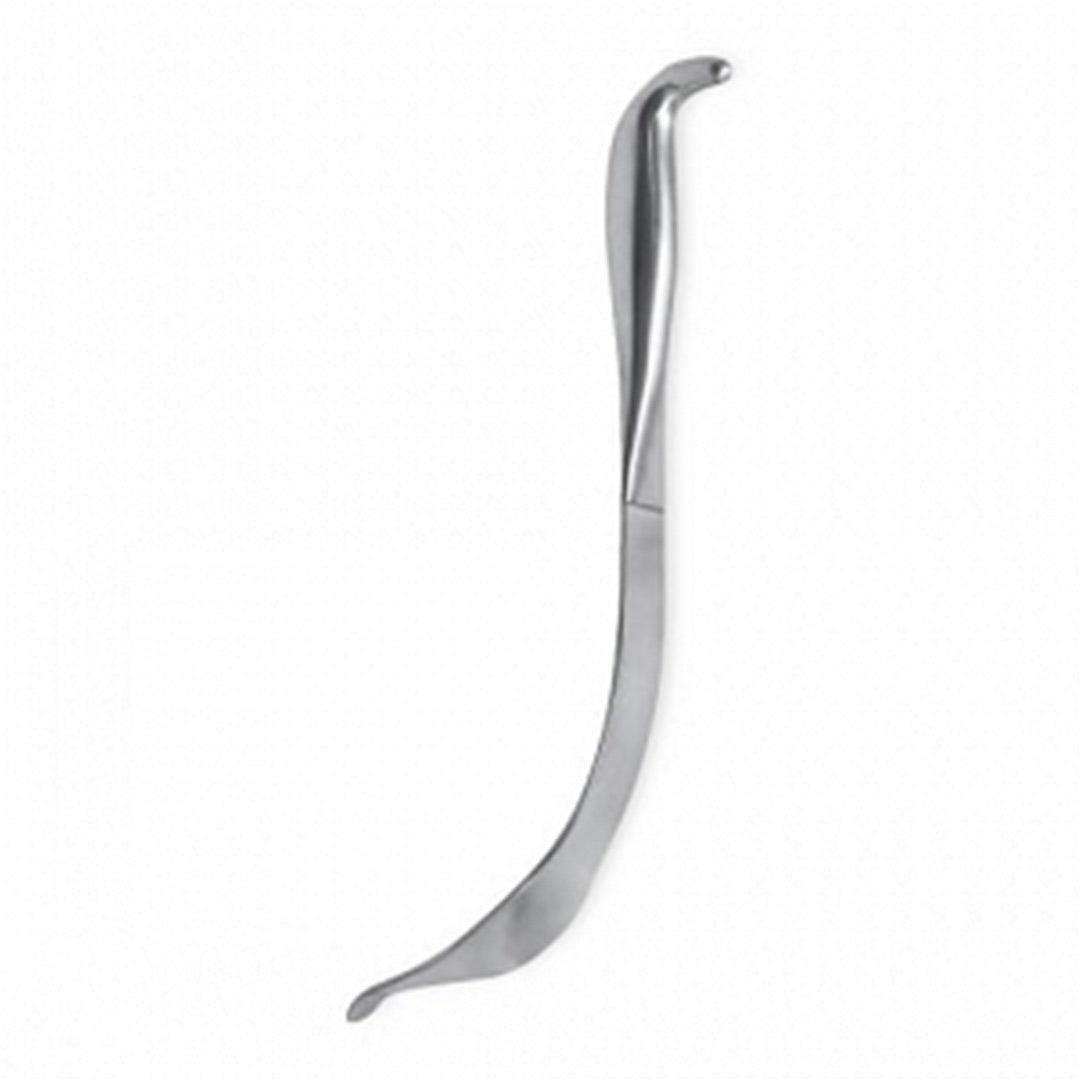
Aufranc Cobra Retractor, SKU PS-8811, is a reusable orthopedic hand-held retractor manufactured from German stainless steel for deep soft-tissue displacement and exposure around large bones and joints. The instrument uses a distinctive cobra-shaped curved blade with a broad flared working surface, narrowing distal profile, smooth edges, blunt tip, rigid shaft, and manual handle for controlled positioning against an appropriate osseous margin. Its geometry is suited to total hip arthroplasty, acetabular exposure, proximal femoral surgery, hip reconstruction, fracture fixation, and other orthopedic procedures where muscle and periarticular tissue must be displaced while preserving access for reamers, broaches, drills, reduction instruments, plates, screws, trials, and implant components. The curved blade redirects retraction away from the central operative axis, while the broad surface supports stable tissue control across a larger contact area than narrow bone retractors. Orthopedic arthroplasty surgeons, trauma specialists, reconstructive surgeons, and operating-room teams use the Aufranc pattern during deep musculoskeletal exposure in hospitals and specialist orthopedic surgical centers.
The defining feature of the Aufranc pattern is its broad cobra-shaped blade, which flares through the working section and then narrows toward the distal end. This geometry allows the retractor to obtain deep placement around a suitable bone margin while maintaining a wider surface for displacement of muscle, capsule, and periarticular tissue. A smooth blunt tip reduces the focal penetration associated with sharp-point orthopedic retractors and permits deliberate seating against the intended osseous boundary. The blade curvature changes the relationship between the working end and proximal shaft, moving the operator's hand away from the central surgical corridor while traction is maintained. A rigid stainless steel body transfers force directly from the handle to the distal surface without a pivot, ratchet, spring, or self-retaining lock. This fixed construction allows immediate adjustment of the retraction vector through changes in hand position. The broad working face should remain securely positioned before sustained force is applied, particularly during deep hip exposure. The device is not intended for blind levering beyond a visible bone margin. Controlled placement, adequate surgical release, and continuous awareness of surrounding neurovascular structures remain necessary throughout use.
During total hip arthroplasty, an Aufranc Cobra Retractor can be incorporated after capsular preparation and exposure of the proximal femur or acetabular region when deeper periarticular tissues must remain outside the operative pathway. Around the acetabulum, the curved blade can maintain soft-tissue clearance while the surgeon identifies the rim, removes residual labral or capsular tissue, performs sequential reaming, and introduces trial or definitive components. During femoral preparation, the same deep-retraction principle can preserve access for canal-opening instruments, broaches, rasps, trial stems, and implantation equipment. In proximal femoral reconstruction or fracture surgery, the broad working surface can displace muscular tissue from exposed bone while reduction, plate positioning, drilling, or fixation proceeds. The instrument is also useful in other open large-joint approaches where conventional straight retractors would position the shaft directly over the surgical target. Retraction should be coordinated with limb positioning and appropriate tissue release rather than increased simply by applying greater leverage. The operator should reassess the distal contact point whenever the bone position, implant configuration, or operative stage changes so the blade remains seated on the intended anatomical boundary.
PS-8811 identifies the Peak Surgicals Aufranc Cobra Retractor product family. The clinical configuration is defined primarily by the curved cobra-shaped blade, broad tissue-contact surface, narrowing distal section, smooth blunt working tip, rigid body, and manual handle. The broad blade distributes retraction across a larger surface than a narrow Hohmann-style working end, making the pattern suitable for substantial muscle and periarticular tissue around the hip and other large osseous structures. Its curved profile provides depth while offsetting the shaft from the central operative field. The blunt distal end is selected when controlled bone-edge placement is preferred without the focal engagement produced by a sharp retractor tip. The live product listing includes a pattern selector, allowing the required configuration to be chosen during ordering. Established Aufranc Cobra families are manufactured with differences in working-surface texture, tip geometry, blade dimensions, overall reach, and handle configuration. Clinical selection should therefore reflect surgical approach, operative depth, bone contour, tissue bulk, and the instruments that must pass adjacent to the retractor. Hospitals should retain the selected pattern with PS-8811 in purchasing and tray records so the requested configuration remains traceable.
German stainless steel provides the rigidity, corrosion resistance, and dimensional stability required for a reusable orthopedic retractor subjected to sustained manual loading during deep joint exposure. Peak Surgicals lists satin, dull, and mirror finish options for PS-8811. Satin and dull surfaces can reduce distracting reflections under operating-room illumination, while a polished surface remains accessible for visual inspection during sterile processing. Reprocessing should begin promptly following surgery so blood, marrow, and tissue residue do not dry along the broad blade, distal tip, curved transition, shaft, or handle. Thorough cleaning should be followed by rinsing and complete drying before inspection for corrosion, blade deformation, surface damage, unintended bending, or alteration of the blunt working end. The rigid body should retain its designed curvature and structural alignment before returning to an orthopedic tray. The reusable instrument can undergo steam sterilization according to the healthcare facility's validated process and applicable reprocessing instructions. Peak Surgicals lists the device as Class I and supports CE and ISO 13485 procurement documentation together with FDA-related records for institutional and distributor supplier qualification.
| SKU | PS-8811 |
|---|---|
| Product Name | Aufranc Cobra Retractor |
| Price | $22.00 USD |
| Size/Gauge Variants | PS-8811 product family with pattern selection available for orthopedic retraction requirements |
| Instrument Category | Orthopedic Cobra Bone and Soft-Tissue Retractor |
| Procedure | Total hip arthroplasty, acetabular exposure, proximal femoral surgery, hip reconstruction, fracture fixation, and deep large-joint exposure |
| Material | German Stainless Steel |
| Finish | Satin, Dull, Mirror |
| Sterilization | Reusable; steam sterilization following validated healthcare-facility cleaning and reprocessing protocols |
| Instrument Classification | Class I Reusable Manual Orthopedic Retractor |
| Reusable | Yes |
| Certifications | CE, ISO 13485, FDA-related procurement documentation |
| Warranty | 1 Year |
| MOQ | 1 Piece |
| OEM / Custom Orders | Available |
| After-Sale Service | Return and Replacement |
How does the Aufranc Cobra Retractor differ from a Hohmann Retractor?
The Aufranc Cobra Retractor uses a deeply curved, flared blade that broadens through the working section before narrowing toward the distal tip. A conventional Hohmann Retractor generally uses a flatter, narrower blade positioned directly against a bone margin for more focused tissue displacement. The Cobra configuration provides broader contact and greater offset between the deep working end and proximal handle. This makes it particularly useful where substantial periarticular muscle must remain outside the hip or large-joint operative corridor. A Hohmann is often preferable when the surgeon requires a smaller footprint or more localized bone-edge retraction. Both are manually controlled instruments, so selection depends on surgical depth, bone contour, tissue bulk, blade clearance, and the direction of exposure required.
How should the appropriate Aufranc Cobra pattern be selected?
The required pattern should be selected according to the surgical approach, working depth, bone dimensions, and amount of tissue requiring displacement. A smooth blunt configuration is appropriate when the surgeon requires broad controlled contact without a penetrating distal point. Wider working surfaces provide greater tissue coverage but require sufficient operative space for insertion and positioning. Narrower or differently contoured Cobra configurations can preserve clearance where the approach is more restricted. Handle design and overall reach also affect how far the operator's hand remains from the deep working site. For PS-8811 procurement, the exact pattern selected on the Shopify product page should be retained in the purchase and instrument-set record so the requested configuration remains identifiable.
What do CE, ISO 13485 and FDA references mean for procurement?
Peak Surgicals lists CE, ISO 13485, and FDA-related information for the Aufranc Cobra Retractor. ISO 13485 concerns the quality-management system used for controlled medical-device manufacturing and associated processes. CE documentation supports conformity assessment requirements within applicable medical-device markets. United States hospitals and distributors should review the relevant manufacturer, establishment, listing, and device documentation required by their procurement procedures. These references should not be converted into an unsupported statement that PS-8811 is individually FDA approved. Procurement teams can retain certificates, SKU and pattern identification, supplier records, and purchasing documentation within their institutional vendor-qualification files.
How is retraction controlled without a ratchet or locking mechanism?
The Aufranc Cobra Retractor is a fully hand-held device and contains no ratchet, spring, pivot, or self-retaining lock. The surgeon or assistant first positions the blunt distal end against an appropriate visible bone margin. Traction applied through the handle travels along the rigid curved body and displaces adjacent muscle or periarticular tissue through the broad blade. The cobra-shaped profile redirects the shaft away from the central operative pathway while maintaining contact at depth. Increasing or reducing manual pressure immediately changes the degree of exposure, allowing adjustment during reaming, broaching, drilling, reduction, or implant placement. The retractor should be lifted and repositioned whenever the required contact point changes rather than levered blindly around unseen anatomy.
How should hospitals order and reprocess the Aufranc Cobra Retractor?
Hospitals should order the Aufranc Cobra Retractor using SKU PS-8811 together with the exact pattern selected on the live product listing. Peak Surgicals lists the instrument at $22.00 with a one-piece MOQ, one-year warranty, OEM availability, and return-and-replacement after-sale service. Following surgery, blood, marrow, and tissue residue should be removed promptly from the broad blade, blunt tip, curved section, shaft, and handle. Cleaning should be followed by thorough rinsing, complete drying, and inspection for corrosion, deformation, surface damage, or alteration of the intended curvature. The working end should remain smooth and structurally aligned before the device is packaged for sterilization. Final steam processing should follow the healthcare facility's validated reusable surgical-instrument cycle before PS-8811 returns to the hip, trauma, or large-joint orthopedic tray.


