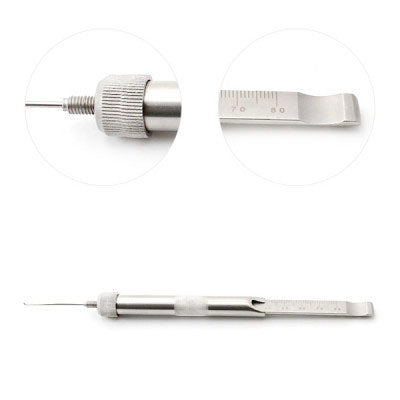
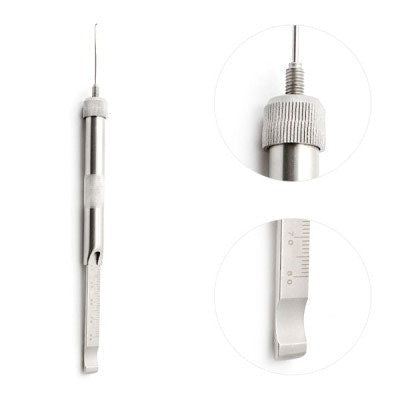
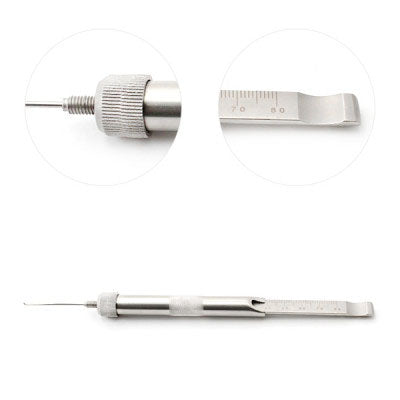
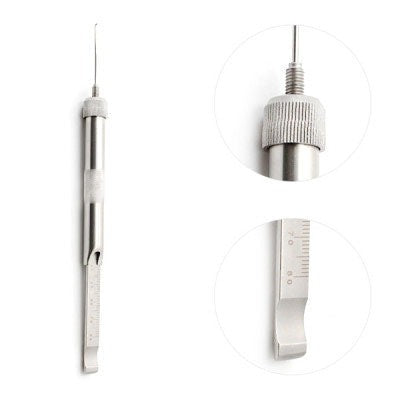
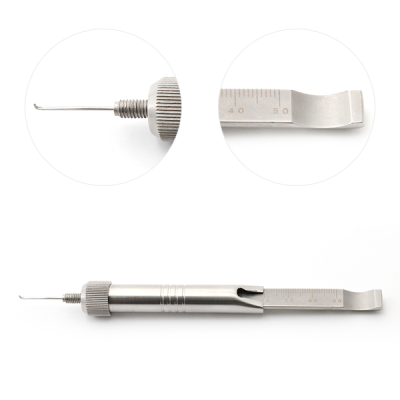
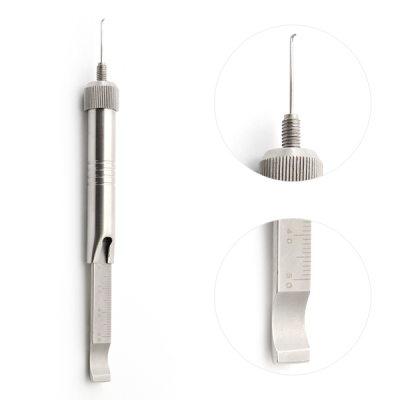
Os medidores de profundidade ortopédicos veterinários decidem o comprimento do parafuso, e o comprimento do parafuso está errado em duas direções: muito curto e a fixação é fraca, muito longo e a ponta fica saliente na cortical distante contra o nervo ou vaso. A Peak Surgicals tem três padrões em stock: Medidor de Profundidade 100mm (PS-VS-00771, $16,50), Medidor de Profundidade TTA 160mm a 40mm (PS-VS-00770, $22,00) e Medidor de Profundidade ($19,80), em aço inoxidável alemão, com marcação CE e construído sob a ISO 13485. Compare os três na grelha abaixo.
Como um Medidor de Profundidade Lê um Osso Que Não Pode Ver
O medidor mede o que o cirurgião não pode ver, porque apenas uma superfície do osso está exposta. Uma sonda em forma de gancho é passada através do orifício perfurado até que o gancho prenda a cortical distante, uma luva deslizante é baixada até a cortical próxima, e a escala é lida diretamente, geralmente em incrementos de um milímetro. Essa leitura é o comprimento de trabalho do osso que o parafuso tem que atravessar.
O que é adicionado a isso depende do osso. No osso cortical normal, a ponta do parafuso deve ficar cerca de um milímetro além da cortical distante; no osso osteoporótico, pelo menos dois. Acertar na primeira leitura é importante, porque retirar um parafuso e substituí-lo alarga o canal e reduz a aderência que o substituto pode desenvolver. Para um parafuso unicortical, o mesmo medidor é usado de outra forma, enganchando a cortical próxima para ler o comprimento mínimo. Fornecemos todos os padrões com MOQ 1.
Escolher Alcance e Gama
A gama e o alcance separam os três padrões aqui. O Medidor de Profundidade 100mm (PS-VS-00771, $16,50) é o instrumento de curto alcance para trabalhos corticais em pequenos animais, onde a medição é feita perto da superfície e um corpo mais longo apenas atrapalha. O Medidor de Profundidade TTA 160mm a 40mm (PS-VS-00770, $22,00) é construído para avanço da tuberosidade tibial, onde a abordagem é mais profunda e a leitura é feita numa gama de avanço definida, em vez de uma simples extensão córtice-a-córtex. O Medidor de Profundidade ($19,80) fica entre os dois como o padrão ortopédico geral.
Escolha primeiro a profundidade de campo e depois a gama. Um medidor cujo corpo é muito curto força a mão na ferida para ler a escala; um cuja gama não cobre a construção tem que ser trocado a meio do procedimento, que é onde a maioria dos erros de medição são introduzidos.
Material, Reprocessamento e Certificação
Cada padrão é fabricado em aço inoxidável alemão e passivado para resistência à corrosão em ciclos repetidos. O ponto de inspeção é a sonda, e este é o único instrumento num conjunto ortopédico onde uma falha permanece invisível em uso: observe a sonda contra uma borda reta antes de cada caso, porque a autoclavagem repetida enfraquece um eixo fino e mesmo uma ligeira curvatura altera a leitura sem que o operador saiba. Verifique também o gancho quanto a arredondamento, pois um gancho desgastado escorrega do córtex em vez de prendê-lo. Limpe imediatamente com uma solução enzimática de pH neutro, removendo os detritos ósseos de debaixo da manga, depois enxágue com água desionizada e seque completamente antes de autoclavar a 134°C.
Estes são dispositivos reutilizáveis de Classe I, com marcação CE e construídos segundo a ISO 13485, com garantia de fabrico de 1 ano. Enviamos com MOQ 1 com frete grátis acima de $99, e a produção OEM está disponível para distribuidores. Consulte a gama completa de Instrumentos Cirúrgicos Veterinários. Fale connosco sobre os termos OEM.