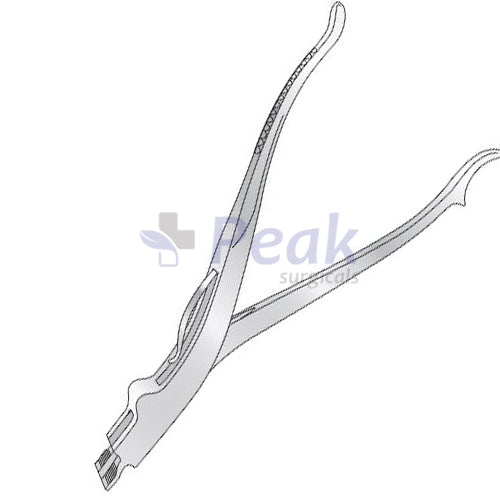
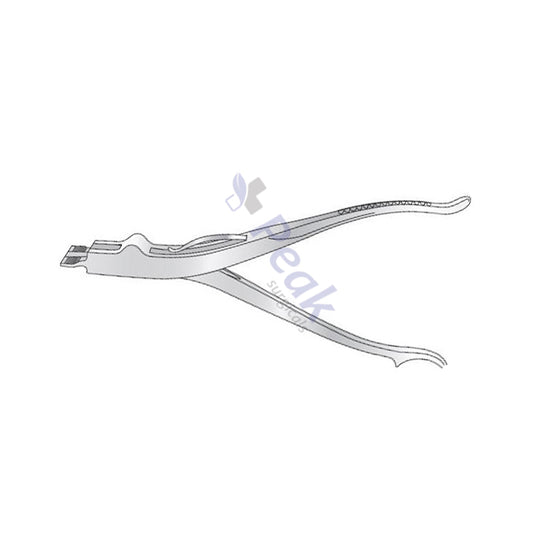
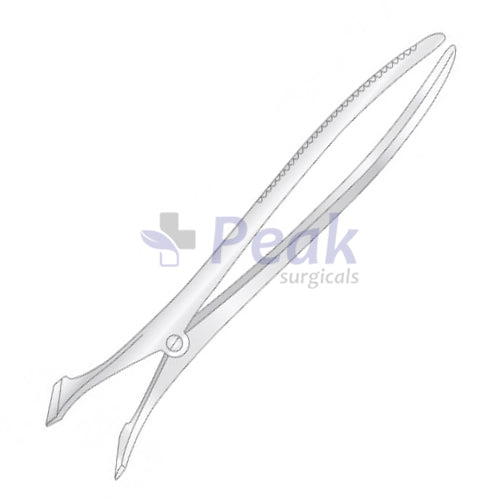
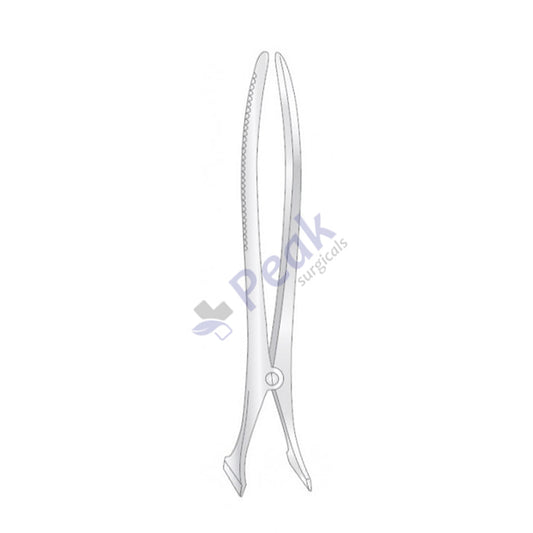
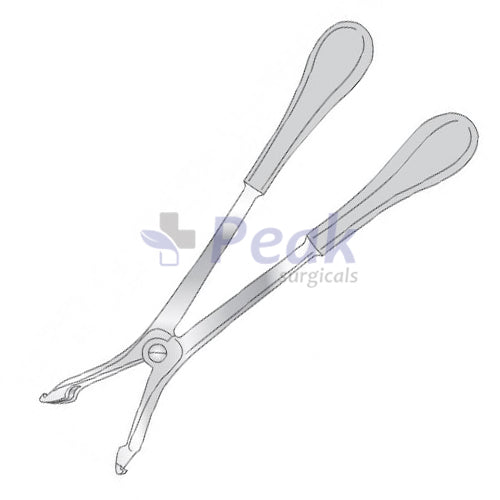
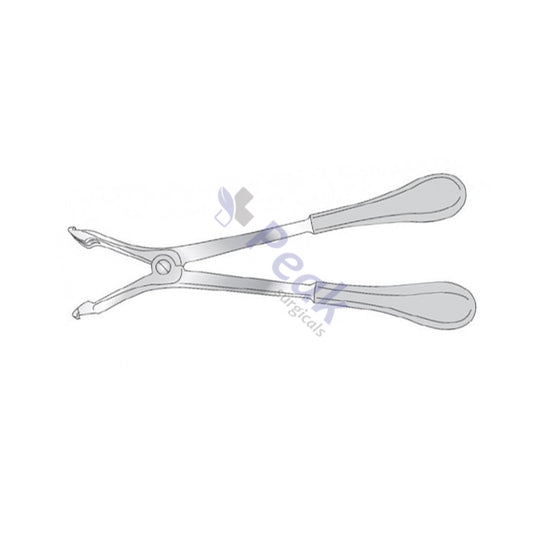
Orthopedic spreaders open a cast along a cut that has already been made, they follow the saw or shear, they do not replace it. Peak Surgicals supplies three patterns, Henning, Haglund and Lawton, with flat serrated jaws in German stainless steel, from $41.80 to $71.50, each carrying a model number. Every pattern is CE marked and built under ISO 13485. Compare all three patterns in the grid below.
Where the Spreader Fits in Cast Removal
A cast saw or plaster shear cuts the shell, the spreader is inserted into that cut and its jaws are driven apart to widen the gap, and only then can the cast be lifted clear — using a spreader on an uncut cast achieves nothing. Cast removal runs saw, spreader, then bandage scissors for the padding beneath, and each instrument fails at the others' job.
Henning Plaster Spreader (PS-HPS-00308, $44.00) is the pattern most cast rooms standardise on flat rectangular jaws with horizontal serrations on the outer faces, driven by a plier-style spring-loaded handle. The serrations grip the cut edges so the jaws do not skate as force builds. Haglund Plaster Spreader (PS-HPS-00307, $71.50) sits at the heavier end of the range for thick or reinforced casts. Lawton Plaster Spreader (PS-LPS-00309, $41.80) covers routine work at the lowest entry point. We supply every pattern at MOQ 1.
Jaw Geometry and the Spring-Loaded Action
The jaws do the safety work. They are deliberately thin and flat so they slip into a saw kerf only millimetres wide, and deliberately blunt so that when they pass through the shell they meet skin without cutting it. Horizontal serrations sit on the outer faces, biting the cast edges rather than the limb.
The spring-loaded plier action inverts normal handle logic, and it matters in the hand. Opening the handles closes the blades, which is how the spreader enters the cut; squeezing the handles then drives the blades apart against the cast. That reversal lets the whole hand generate the spreading force in one motion rather than two, which is why the pattern can be worked one-handed while the other hand steadies the limb.
Jaw spread how far the blades travel apart sets how much of the cast opens per bite. Work along the cut in successive bites rather than forcing one section open; a single overloaded bite cracks the shell unpredictably instead of parting it along the kerf.
Reprocessing, Corrosion and Certification
Gypsum residue is the reprocessing problem specific to cast-room instruments. Set plaster packs into the jaw serrations and the spring mechanism, stiffening the action across cycles, and it holds moisture against the steel long after the instrument looks dry. Clean the jaws and spring before residue sets rather than after, ultrasonic-clean before autoclaving, and dry the mechanism fully.
Check the spring and the jaw faces together each cycle. A weakened spring means the blades no longer close cleanly for insertion, and worn serrations slip out of the kerf under load. Every instrument is Class I, reusable, CE marked and built under ISO 13485. Warranty is one year with return-and-replacement, MOQ is 1 piece, orders over $99 ship free in carton box packing, and OEM marking is available. For the cutting stage see orthopedic shears, and for the wider cast room see plaster spreaders. Browse all orthopedic instruments. Talk to us about OEM and volume terms.